


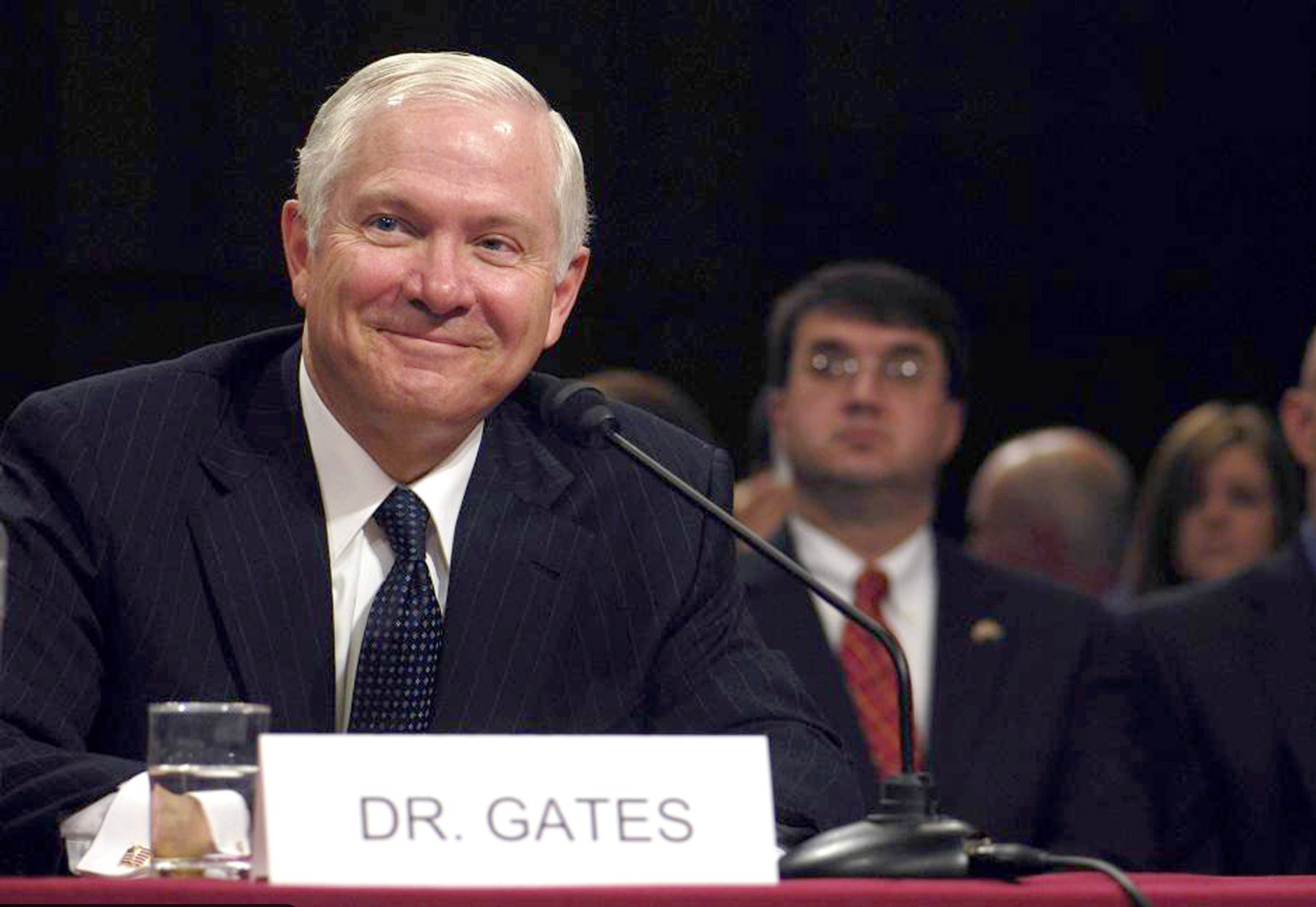
Robert Gates appears before the Senate Armed Services Committee during his confirmation process to become secretary of defense. U.S. Air Force photo.
Robert M. Gates Hall opens on the William & Mary campus later this year, timed to the country’s 250th anniversary. It stands a short walk from the classrooms Gates entered at seventeen, intending to become a surgeon. In February he was re-invested as the university’s chancellor for a third term running through 2033, the first person to hold the office three times; in May, the Robert M. Gates Initiative in American Statecraft launched there, devoted to the instruments of national power that are not military — diplomacy, technology, development, and economic policy. 1 2
Almost none of what came in between was planned. Gates abandoned pre-med for history, intending to teach; took an entry-level job at the CIA as a stopgap; and then, for the better part of four decades, kept telling himself and his wife that the next posting would last a couple of years before he left for the classroom. He is the only career officer to rise from the bottom of the agency to its directorship, and he insists he never positioned himself for any of it.
Robert Gates rose from entry-level CIA analyst to director of Central Intelligence, then became the only secretary of defense to serve presidents of both parties. He is now the first chancellor in William & Mary’s history to serve three terms.
This interview has been edited for length and clarity.
A “D” in calculus
Benjamin Wolf: Secretary Gates, thank you for joining me. When you arrived at William & Mary for undergrad, what kind of life did you imagine you were preparing for? How different was it from the life you ultimately lived?
Robert Gates: It was pretty dramatic. When I arrived at William & Mary, I was seventeen years old. I had been kind of a science geek in high school, and I entered William & Mary as a pre-med student. I wanted to be a surgeon.
I had a very heavy load as a freshman: five hours of chemistry, five hours of biology, three hours of calculus, and three hours of English. I got a D in calculus.
My father made a long-distance call — which in those days was very expensive — and said, “Tell me about the D.”
I said, “Well, Dad, the D was a gift.”
Being in Williamsburg also had a big impact on me. I had always been interested in history and in reading biographies. I read a lot of biographies of American leaders as a kid, and I became taken with the history of the place.
I was also more interested in laboratory work than in the academic and mathematical sides of science. Midway through my sophomore year, I changed my major from pre-med to history. That is where the ball started rolling. I did not know what I would do with it, except that I would probably teach college.
The CIA job that was supposed to be temporary
BW: You went from there to the CIA as an entry-level analyst. What made you say yes, and did you recognize it as the beginning of what would become your career?
RG: I had gradually moved east in my study of history. I started in American history, then moved to Eastern Europe, and then to Russia and the Soviet Union.
I decided I wanted to teach, so I went to Indiana University to get a master’s degree. In the fall of 1965, a CIA recruiter came to campus. I went to see him just as a lark. The first James Bond movie had come out not long before, so the CIA had a certain allure. I was curious, and I also hoped I might get a free trip to Washington as part of the interview process.
By early spring, they invited me to Washington for interviews, a polygraph, and so on. They eventually made me an offer. At the time, my only other job prospect was teaching seventh-grade history back in Williamsburg. I think the teaching job actually paid a little more.
But the CIA sounded interesting and intriguing, so I said, “I’ll do that for a while, and then I’ll go teach.” I never considered the CIA a career.
After I completed my Air Force service and returned to the CIA, I began my Ph.D. program at Georgetown in the fall of 1969. It was a tough few years. I was working probably fifty hours a week at the CIA while taking twelve graduate hours at Georgetown each semester. Later, when graduate students at Texas A&M complained to me about how hard they were working, I would tell them that story. They did not get much sympathy.
I completed my Ph.D. in early 1974 and began sending letters around the country asking about teaching positions. At almost exactly the same time, I received a call from the National Security Council asking me to interview for the Soviet desk, working for Henry Kissinger and Brent Scowcroft.
I told my wife, “I’ll do that for a couple of years, and then I’ll go teach.”
One thing led to another.
Why Soviet history mattered inside the agency
BW: Your doctorate was in Russian and Soviet history. Why that instead of international relations or security studies, and how did it train you to read intelligence differently?
RG: Partly because it interested me. Even while working on my master’s degree, I had moved toward Eastern European, Russian, and Soviet history.
There was also a practical consideration. There were virtually no teaching jobs available in American or European history in those days. I thought I would have a better chance of finding a position if I focused on Russia and the Soviet Union.
The Ph.D. made a significant difference in the way I looked at the Soviet Union. Many people analyzing Soviet policy at the CIA had studied international relations, government, or something similar. They did not necessarily know a great deal about Russia or the Soviet Union. There were not many of us with advanced degrees in Russian and Soviet studies.
Most analysts tended to see the Soviet Union as simply another country or another great power. I thought that perspective missed the ideological foundations of the regime and its policies.
Ideology did not guide every decision. It may not have guided any specific decision completely. But it influenced every decision.
Learning how policymakers actually use intelligence
BW: You are the only career CIA officer to have risen from an entry-level position to become the agency’s director. What set you apart early on, and how did starting at the bottom affect the way you later led the institution?
RG: The thing that made the difference was that I left.
When I went to the National Security Council, I ended up spending about six years there during the 1970s under three presidents: Nixon, Ford, and Carter. By 1980, there was probably no one in the intelligence community who understood better how policymakers used intelligence. I had watched it firsthand under three very different presidents — two Republicans and one Democrat.
That experience did not necessarily win me many points in the intelligence hierarchy, but it caught the attention of people in the White House and in Congress. I was not quiet about how I thought intelligence needed to be reshaped and reformed to become more responsive to policymakers’ needs.
That certainly caught the attention of Vice President George H.W. Bush in 1981. He had served as director of Central Intelligence himself, so he had a feel for these things.
BW: You held substantive positions across several administrations. What did those transitions look like in practice, and is a similar career still possible for young people today?
RG: It would be very difficult today for someone to move from a Republican presidency to a Democratic presidency — or vice versa — while remaining on the NSC in a substantive position.
The process has become much more partisan. People tend to come into the NSC through either a Republican or Democratic channel. A career like mine has become much more difficult.
Serving under those different presidents shaped how I looked at the way intelligence was prepared and delivered to the president and other senior officials. That experience had a significant influence on the actions I took once I reached more senior positions.
Why Washington defaults to military power
BW: The Robert M. Gates Initiative in American Statecraft focuses on the tools of national power short of military force. Having led both the CIA and the Pentagon, why does Washington still find it easier to organize military power than everything around it?
RG: Because the Pentagon has the largest budget in the government, and it has constituents in every state.
It is much easier to get money for the Defense Department and the CIA than for nonmilitary, non-hard-power capabilities. When I was dealing with the F-22, for example, the aircraft had contractors in forty-four states. That is eighty-eight senators. It is tough to cut the money for an F-22.
There is a much broader political base across the political spectrum for defense spending than there is for non-defense expenditures.
The reform he got right and imposed badly
BW: Looking back at the decisions you made at the highest levels of government, which strengthened your confidence in your judgment — and which made you more humble about its limits?
RG: It really began when I became deputy director for intelligence at the CIA and started making some dramatic changes in how we conducted analysis.
I wanted analysts to be accountable for their judgments. Were you right, or were you wrong? Nobody had paid much attention to that in the past.
You can be wrong on any individual issue and still be a brilliant analyst. The question is how you perform over time. I had a portfolio assembled for every analyst so we could evaluate that record. Were you more often accurate than not?
People do not necessarily enjoy being held accountable that way, but it made them more thoughtful. It also required them to be more specific. “On the one hand, on the other hand” is not good enough for the president of the United States. You have to say what you think is actually going to happen. Then, after the fact, you have to ask whether you got it right or wrong.
I made a lot of changes as deputy director for intelligence. The lesson I learned — which did not help me at the time, but stood me in good stead in every subsequent job, including Texas A&M — was about how I implemented them.
I had the support of the director and deputy director of Central Intelligence, William Casey and Admiral Bobby Inman. They thought the changes were exactly right. But I essentially announced and imposed them from the top without consultation, dialogue, or including people in the process.
That was a mistake. Even many people who supported what I wanted to do became hostile to the changes because of the way I had introduced them.
I never did that again as a leader. It taught me the importance of an inclusive and transparent decision-making process.
Telling presidents what they do not want to hear
BW: How did you distinguish between faithfully serving a president and preserving the independence necessary to tell him something he did not want to hear?
RG: We just did it.
During the Reagan administration, we produced an analysis making the case that the pace of Soviet military spending was decreasing. The percentage increases in its defense spending were diminishing.
That was not a welcome message in the middle of the Reagan administration’s military buildup. But we said it anyway. Those were the facts. The Soviets were running out of money and dealing with serious economic problems.
Someone on the NSC staff called me when I was deputy director for intelligence and said, “This is not helpful to the president’s program.”
I said, “My job is not to be helpful to the president’s program. It is to inform him honestly about what is going on.”
That was the only call I ever received like that.
You simply have to suck it up. I was fortunate to serve presidents who might not have liked what we told them but did not put the squeeze on us. Secretaries of state and defense complained about our intelligence all the time, especially when it suggested their policies were not working very well. But nobody ever put serious pressure on me to change a judgment.
Why history beats international relations
BW: Much of your education was rooted in history. What was the importance of that foundation, and should young people interested in careers like yours still follow it?
RG: I have never had any regrets about choosing history.
If you do not know the history of Iran, Russia, or China, you do not have a clue what you are talking about when you try to anticipate what their leaders are going to do.
If you do not understand that Putin believes it is his destiny to recreate the Russian Empire — and that there is no Russian Empire without Ukraine — you do not understand what is going on in Russia. I do not know how you can advise the president without that understanding.
The same is true with Iran. People negotiating with the Iranians today often have little understanding of Persian or Iranian history. They do not understand how the Iranians negotiate, and they have no experience dealing with people who may prefer to die rather than make a concession.
History is much more relevant than political science or international relations, broadly speaking. International relations is certainly useful in helping you understand relationships among countries. But if you do not understand the individual countries involved in that process, I am not sure it takes you very far.
Writing half a page for the president
BW: For someone entering the CIA today, what talents or skills were most important to your success?
RG: I would divide the answer into two parts: bureaucratic and substantive.
The bureaucratic part was figuring out how government worked — or did not work. Its failures created opportunities to think about how it could be made better.
On the substantive side, the work made me a much better and more succinct writer. When you have half a page to explain a complicated problem to the president of the United States, you had better figure out how to make every word and every sentence count.
It is surprising how many people in government struggle with writing, especially writing succinctly.
When I was deputy national security advisor, someone once brought me a six-page, single-spaced memorandum about a very complicated space issue. I said, “You have to make it one page before we can send it to the president.”
He said, “I can’t do that. I don’t know how.”
I said, “Okay, I’ll do it.”
And I did. I did not know anything about the technology. It was a question of how you presented the argument.
Government also teaches you how things work in the real world, as opposed to the classroom. The classroom is often about how things are supposed to work, not necessarily how they actually work.
That is one reason internships are so important for college students. They give you a flavor of the real world and of how institutions actually operate.
Relationships, criticism, and choosing the right fights
BW: Many people spend entire careers in government without reaching its highest positions. What gives someone the chance to rise? How much depends on relationships, and how much on the quality of the work?
RG: It is both.
As you rise through the ranks, you are inevitably going to antagonize some people. One of my favorite sayings is: To avoid criticism, say nothing, do nothing, be nothing.
You have to learn how to accept criticism. As Director Casey used to put it, you have to grow the hide of a rhinoceros. You have to be willing to watch somebody go after you in print, on television, or elsewhere.
You also have to figure out how to interact with people, particularly those with whom you disagree. That becomes especially important on Capitol Hill as you grow more senior.
You have to approach people who disagree with you, try to find common ground, and, first of all, treat them respectfully and patiently. I cannot imagine testifying the way some people have in recent years — shouting at members of Congress, insulting them, and so on.
You have to show respect for the institution, even when you do not respect some of the individuals.
The same principle applies inside an administration. I had a complicated relationship with Secretary of State George Shultz. I led the analytical side of the CIA for much of the time he was secretary of state, and there were areas in which he completely disagreed with our analysis.
We argued that the Soviet economy was doomed, that the system was not going to survive, and that Gorbachev’s economic reforms would not work. Shultz disagreed with much of that. At the same time, he considered the CIA an invaluable asset in arms-control negotiations and brought CIA officers onto his negotiating teams.
It was a complicated relationship, but we managed it. I think he respected me, and I certainly respected him. I thought he was one of the best secretaries of state we ever had.
You also have to be mindful of your place. There are hierarchies in government. Too many people are willing to antagonize others over trivial things.
If you are going to have a fight, make it about something worth fighting for. If you are going to make an enemy, the issue had better be worth it.
There are no shortcuts. You have to manage relationships and understand the bureaucracy.
The career he never planned
BW: Did you ever know you were aiming for one of those senior positions? Were you consciously taking steps to reach them?
RG: I never had a clue.
I became deputy director for intelligence while I was still in my thirties. I was jumped over a very large number of people who were more senior than I was.
It was not luck, exactly, but it had nothing to do with planning.
William Casey became director under President Reagan, and Admiral Inman, who had led the National Security Agency, became his deputy. Casey hired me as his executive assistant. I had previously been Admiral Stansfield Turner’s executive assistant before moving to a substantive position as national intelligence officer for the Soviet Union.
Casey had heard that I had done a good job for both Zbigniew Brzezinski and Turner, so he asked me to become his executive assistant. I already knew Inman from his time at the NSA, when I worked for Brzezinski at the White House.
Casey and Inman did not get along, and they both trusted me more than they trusted each other. I became executive assistant to both of them and served, in a sense, as a mediator between the director and the deputy.
I knew Casey had a major agenda for improving the analytical product. I wrote him a paper explaining how I thought it could be done. He read it and liked it. Inman liked it too. So they made me deputy director for intelligence.
I had no idea I would be jumped that far, that fast.
Later, when the incumbent retired, I was asked to become deputy director of Central Intelligence. I became acting director when Casey became ill.
President Reagan then nominated me to become director. It was in the middle of Iran-Contra, and there was uncertainty about what my role had been. It was clearly going to be a very difficult confirmation, so I asked Reagan to withdraw my nomination. I told him I was happy to remain as deputy.
The way I handled that impressed a lot of people.
In 1991, when William Webster decided to retire, President George H.W. Bush did the unthinkable: He nominated me again for director of Central Intelligence. The brass ring never comes around twice in Washington. To be nominated for the same job by two different presidents — especially after withdrawing the first time — was extraordinary.
There was no way to predict it. When I withdrew in 1987, I assumed that was it. I thought I would retire as deputy national security advisor to President Bush. Then he nominated me again, and I was confirmed.
The secretary of defense appointment came completely out of the blue as well.
I did not consciously strive to get any of those jobs. Circumstances created the opportunities, and people I had worked with over the years were in positions to make things happen.
You can call it luck or coincidence. It is not that I did not want those jobs, but I never thought they would come to pass. I never consciously tried to position myself to get them.
What setbacks reveal
BW: Gates Hall will open on the campus where you were once an undergraduate. What do you want a freshman walking into that building to learn — even if the lesson has to be learned the hard way?
RG: I would hope no student has to learn lessons the hard way. I would like to think people could learn them the easy way.
But I would tie together two moments: withdrawing my nomination for director of Central Intelligence under President Reagan and getting the D in calculus.
The lesson everybody has to learn is how to deal with setbacks and disappointment. Do you pick yourself up, dust yourself off, and say, “That was not much fun. I do not think I want to do that again” — but then keep moving?
The way I handled withdrawing in 1987 made me a lot of friends, including on Capitol Hill. Some people who had opposed me the first time became supporters the second time.
The most liberal senator in the Senate at the time was Alan Cranston, a Democrat from California. After I withdrew, I received a call from him.
He said, “I think you got a really raw deal, and I want you to know that if you ever come up here for confirmation again, I’ll support you.”
Four years later, he did.
How you deal with a setback — and whether you deal with it gracefully — makes an impression on people. It is also simply better for you.
If someone has to learn a hard lesson, it should be how to deal with disappointment and setbacks.
Reading beyond the present
BW: You have mentioned the importance of the histories and biographies you read as a young person. What books would you recommend to students inspired by your career?
RG: I would recommend biographies of people they admire.
Most of the biographies I read as a kid were about George Washington, Benjamin Franklin, Davy Crockett, Daniel Boone, Abraham Lincoln, and other figures from the country’s early history.
I do not read many books about contemporary politics now. I read a lot, but contemporary books generally do not have sufficient perspective.
I am currently reading Hubris, about the creation of Athens as a democracy, the role of Pericles, and so on. I find books like that more applicable to today’s problems than books about contemporary political figures.
The advent of democracy in Athens involved a popular uprising against oligarchs who controlled the wealth. The relevance to the present is obvious. It is a story about the origins of populism.
Populism did not begin with the Tea Party. It began in Periclean Athens, for God’s sake.
Those kinds of books provide more insight than most biographies of people who are still active today.
About the guest: Robert M. Gates served as the 22nd United States secretary of defense from 2006 to 2011 under Presidents George W. Bush and Barack Obama — the only defense secretary in American history to serve in both Republican and Democratic administrations. He spent nearly twenty-seven years as an intelligence professional, including nearly nine years at the National Security Council, and served as director of Central Intelligence from 1991 to 1993. He was president of Texas A&M University from 2002 to 2006 and is the chancellor of William & Mary, where he began an unprecedented third term in 2026. He chairs the Robert M. Gates Global Policy Center. President Obama awarded him the Presidential Medal of Freedom in 2011. 1 2
About The Pathway Review: The Pathway Review publishes long-form interviews with people in politics, policy, journalism, law, diplomacy, markets, and public service about the work they do and the path that brought them there. 3
Subscribe to receive new interviews in your inbox.
This interview was conducted in July 2026 and has been edited for length and clarity.