


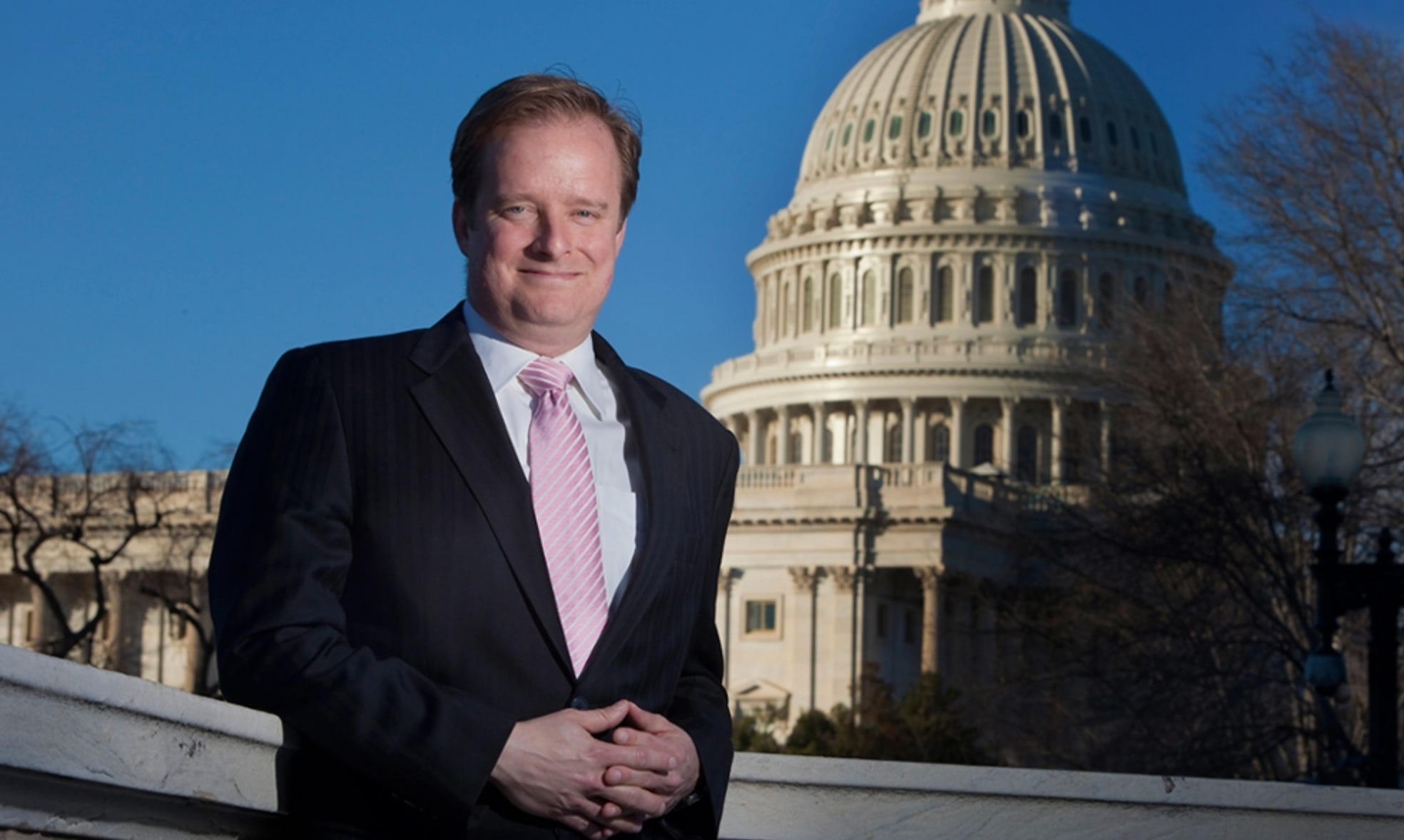
Matthew A. Wasniewski, Historian of the U.S. House of Representatives, speaks at a 2015 briefing on the Cannon House Office Building. Credit: Architect of the Capitol.
Congress may be the most publicly scrutinized institution in Washington and one of the least understood. We watch its votes, fights, speeches, and procedural breakdowns in real time. But the House seen on C-SPAN is only a fraction of the institution itself—a place shaped by more than 11,000 members since 1789, by customs that never made it into the Constitution, and by relationships that rarely make the evening news.
Matthew Wasniewski has spent nearly 25 years trying to make sense of that larger institution from the inside. As Historian of the U.S. House of Representatives, he is responsible for helping preserve its institutional memory: documenting its members, conducting oral histories, answering questions from lawmakers and the public, and telling the parts of congressional history the institution might just as easily prefer to forget.
That last responsibility is especially interesting now. Wasniewski works inside an institution that has grown increasingly partisan while leading an office whose credibility depends on remaining rigorously outside those fights. His job requires him to explain both the traditions that have held the House together and the moments when it has fallen badly short of its ideals.
We spoke about what Congress looks like when you stop watching the floor and start studying the people behind it; what has changed during his quarter-century on Capitol Hill; how a House historian writes about racism, Japanese American incarceration, and other unflattering chapters of congressional history; and why, beneath an institution that can look dysfunctional from the outside, he still sees something the cameras tend to miss: human relationships.
Eleven Thousand Members, a Staff of Twelve
Ben Wolf: Most people, when they picture the House, picture what happens on C-SPAN. What does your office actually do on an ordinary day that nobody sees?
Matthew Wasniewski: When you watch the House on C-SPAN, you see a lot of procedure on the floor that goes back to the 18th century and even further. And you see an institution that’s somewhat monolithic.
There have been more than 11,000 members over time. When you compare that to the presidency or the Supreme Court, those seem like institutions you can get your mind around. But 11,000 people going back to 1789, the House can seem like a pretty remote place for the public.
What we try to do on a day-to-day basis is put a human face on the institution. Give people a blog post, a biographical profile, an oral history snippet. Working with our friends, the curators and archivists, maybe it’s an interesting artifact or document. How do those things tie into the larger history of the institution?
That’s one of the joys of my job. I had a choice to go down an academic route and teach, or to do public history. I chose public history because the work is so diverse. We’re not talking to a small group of academics about very specialized topics.
Today I’m editing a blog post where we’re tying the House to America 250 and talking about the Continental Congresses and how they fed into the federal Congress. I’m working on an oral history transcript. I’m having this conversation with you.
We really have two audiences. One is the institutional side, the members and staff. That’s what we’re here for. But truth be told, the even bigger audience is the general public.
We hear from genealogists. Somebody might call and say, “My Uncle Joe served in the 80th Congress. What committees was he on? What room was he in?” We hear from teachers, students, the press.
BW: How much of your work is someone coming to you with a request and you having to research the answer, versus knowledge you’ve accumulated over the years?
MW: It’s a mix. We have a public-facing website, history.house.gov, that filters out a lot of the typical requests. You can go see who the first Speaker was. You can read about how the Office of the Clerk developed.
But we tell our staff: if you have to say, “Gee, that’s a great question. I don’t know. Let me go research that,” that’s actually lesson number one in this job. The House is such a big and sprawling institution. We don’t have all the answers.
A lot of our work, blog posts for instance, comes out of reference questions that we didn’t have a ready answer to.
I’ve been here nearly 25 years. I started with the Office of the Clerk in the history operation in 2002. And I still learn new things every day about this place.
“If you have to say, ‘Gee, that’s a great question. I don’t know. Let me go research that,’ that’s actually lesson number one in this job.”
Sometimes the House may say, “We want you to do this oral history project,” or, “We want you to publish these books.” Then there are longer-term projects that we propose and develop ourselves. Our oral history program is a great example. We started that in 2002. The House had never had one.
BW: You’ve been in the House for nearly 25 years. How have you seen the institution, and your role inside it, change?
MW: In one way, our role has remained remarkably consistent. We have always been asked to be the authoritative, nonpartisan experts on the history of the institution.
In recent years, we’ve had a lot more public interest in what you might call Civics 101 information about the House. What does the Speaker do? Where did that office develop? Why did the Framers decide to lodge the power of the purse in the House?
We can see what people are looking at on the website, and there has been a noticeable uptick in those kinds of questions. So we’ve developed parts of the website to anticipate some of that interest.
For such a long time, civics was greatly discounted in high school and college. Now there is an interest in it. People are tracking politics a little bit more.
BW: Are there norms you’ve watched erode in real time, things that were simply customs when you arrived that aren’t as present anymore?
MW: Our interactions with member offices, committee staff, and support staff have largely remained the same. People are very interested when they first arrive: how do I fit into the long narrative of this institution?
I participate in orientation for new members. That often leads to meetings down the road where members want us to come talk to their staff or participate in a retreat. Members are interested in things like their office assignment. Who occupied this office before me? What did my district look like over time? Who were my predecessors? Those questions are remarkably consistent.
One trend, which was already present before I arrived, is staff turnover. The Hill is a very dynamic place. It’s the starting point for so many careers, and I think that turnover has accelerated. We might talk to a member’s office during one Congress and go back the next Congress and find that a large number of the staff have moved on. So part of our work is a constant effort to remind member offices that we are a resource.
And over time, like politics nationally, it has become a more partisan place. Looking at the House from the 1970s forward, you can see trends that have made it an environment where partisanship can be more pronounced. One factor is not having as many spaces for members to interact away from the floor. Less social space. Again, that trend was present before I got here, but it has certainly accelerated.
History Without a Party Line
BW: There’s the old saying that history is written by the winners. Your office is supposed to be explicitly nonpartisan. What does nonpartisanship actually require of you in practice?
MW: We’ve been very fortunate. When our office was originally placed under the Clerk of the House, the Clerk was a nonpartisan officer. The Clerk is appointed by the Speaker, by the majority party, but the office has a tradition of being strictly nonpartisan. You are there to serve the members, staff, committees, everybody, equally, irrespective of their political stripe. We were all brought up in that culture.
When I became Historian and the two history offices came together, I also had the benefit of being hired by an outside search committee of academic historians, public historians, and public historians who had federal experience. They made the recommendation to the Speaker’s office.
Speaker Pelosi’s office and Speaker Boehner’s office worked closely together in that hiring process. When I was appointed Historian in late 2010, I received a letter from Speaker Pelosi, but a big part of that was that it was done with the concurrence of Republican Leader Boehner.
There was a party change a month after I was appointed. We’ve had several party changes since then, and the support for the office has been unwavering from both sides.
We carry on that Clerk tradition. We work with whoever comes to us with a question. We tell the history of the House in a straightforward manner. We have to be able to support our facts as scholars. I’ve got a staff of 12 who work with me. We have a number of Ph.D.s on staff, and pretty much everyone else has a master’s or is working on it.
When it comes to telling the history of the House, it’s something of a warts-and-all approach. That’s just the way you need to do it. We’ve never had anyone looking over our shoulder telling us how to do that history.
I think that goes back to the rapport and the trust we’ve built up with the institution through so many years. They know our work is good. That might be a hard thing for people outside the institution, or people looking at Washington politics now, to understand. But it’s a real thing.
“We’ve never had anyone looking over our shoulder telling us how to do that history.”
BW: Your office has produced the congressionally mandated volumes on Black Americans, women, Hispanic Americans, and Asian and Pacific Islander Americans in Congress. What did that research turn up that surprised you?
MW: A lot. That series actually started around the time of the American bicentennial. Lindy Boggs, the congresswoman from New Orleans who was kind of the patron saint of House history, and Senator Edward Brooke from Massachusetts co-chaired a commission that authorized those studies. Originally, Women in Congress and Black Americans in Congress were pamphlets. Now they’re big books.
When we started working on Women in Congress in 2004, it was at a point in women’s history and African American history where there had been an explosion of biographical work and secondary-source material. So we got to take a crack at periodizing that history. The original books introduced members alphabetically. The profiles were very spare, maybe 400 words, and there wasn’t much context. We periodized the history and introduced the members chronologically.
One of the really interesting things was that first generation of women members. Many had familial ties to the institution. Many were accomplished politically and had supported their husbands, but when the husbands died, they were elected in special elections to the House. Then, in the middle of the 20th century, you get what I think of as an apprenticeship generation of women in Congress, women who had made it in their own right, along with some widows, and were learning how to navigate the institution.
The 19th-century African American members are another fascinating cohort. Most were elected during Reconstruction, with a few in the years afterward. From 1870 to 1901, you get this group of 20 Black lawmakers. Reading and writing about how they got to the House, how they tried to integrate into the institution, the extent to which they were able to and the extent to which they weren’t, it was fascinating. What a brave group of people they were.
BW: How do you handle the parts of the history that don’t flatter the institution? Slavery, the treatment of Black members during and after Reconstruction, Japanese American incarceration. Does telling those stories require a different process?
MW: No, not really. We tell the story how it happened.
The story of the Reconstruction members is a good example. On the one hand, I talked about how remarkable and resilient they were as individuals. But from a congressional perspective, that’s a hurtful story to tell. Putting that history out there in a way that is dependable and documented is important.
Eric Foner wrote the book on Reconstruction, but we were able to take that prism and turn it on the House. How did those members integrate into this place? How did they sit on the floor? Were they all consigned to one spot? How did they get committee assignments, or why didn’t they get some committee assignments? Those stories are a valuable lens on that larger history of Reconstruction and the civil rights era that followed.
The story of Japanese American incarceration is another difficult one. It came out of a presidential directive, but Congress had a role in supporting and funding it. The story for us was also how newly arrived Asian Pacific Islander American members tackled the question of getting justice for the wartime incarceration, and how central that became to the way they unified around a legislative program and pushed it. People like Daniel Inouye, Norm Mineta, and Spark Matsunaga.
It is telling the hard part. But in a lot of instances, there’s also a redemptive quality to it. They pushed through redress in the 1980s. Think about what that meant culturally for Japanese Americans, to be able to tell those stories and have what happened acknowledged.
There are good and bad aspects to it, but we don’t treat that history any differently. If you go to our books, it’s all there.
From Sportswriting to the House
BW: Your dissertation was on Walter Lippmann and Cold War foreign policy. How does a diplomatic historian end up becoming the House’s institutional memory?
MW: I always tell people that my path here is like the way a lot of legislation gets done. It’s very nonlinear.
I started out in college thinking I wanted to be the next Tom Boswell or Tony Kornheiser. I loved sportswriting. That’s a lot of what I read in high school. I went to James Madison for undergrad, and it had a great journalism program, a lot of it based around writing for the student newspaper and getting practicum credit for it. It taught me how to write, and I loved the work.
Along the way, I was living with roommates who were history majors. They knew I liked to write, and I loved writing feature stories and longer-form nonfiction. They said, “You really ought to take this methods course that we took last year.” I did, and it totally hooked me. I double-majored.
I got out and worked for about a year and a half for a small weekly newspaper. I went from covering college sports and Lefty Driesell in basketball to covering middle schools and a county high school. It was fun, but I realized along the way that the writing I wanted to do was more history-based.
I had always had an interest in history. When I was a kid, my dad would take me metal detecting in rural Virginia and we’d find Civil War Minié balls.
So I went back to grad school. I ended up at the University of Maryland and found a great network of people doing public history at cultural institutions, for the House and Senate, the Smithsonian, the Library of Congress. That’s how I got connected to the field. I worked for a nonprofit on Capitol Hill, the U.S. Capitol Historical Society, for a couple of years. Then a history office was recreated in the House in the early 2000s, and that’s how I ended up here.
Walter Lippmann was a passion. That combined my journalism background and my love of history. I was a 20th-century diplomatic historian, but because Lippmann touched on so many aspects of 20th-century politics, I was also plugged into American political history. That gave me a good grounding.
I wasn’t a congressional studies student. Maryland at the time didn’t offer any courses on congressional history. They tended to be presidentially focused. I think that’s true at most universities. Congressional studies are largely left to political scientists. And that’s a shame, because Congress has so many good stories, and there is so much good history that is relevant to almost every aspect of American life.
Congress touches on everything. That’s one thing I wish universities would embrace again.
“Congress touches on everything. That’s one thing I wish universities would embrace again.”
BW: You’ve said one of your goals was to bridge public history and the academy. Twenty years in, has that worked?
MW: The academy marches to its own beat. From our perspective here, we interact with a lot of academics who are studying aspects of the institution. They come to us and ask specialized questions about sources or members’ manuscript collections. Maybe they want a tour of part of the building they’re writing about. You might have somebody writing about the 19th century who asks: what would the walk from the Speaker’s rostrum to the Speaker’s office have been like in the 19th century?
I also give a fair number of talks and participate in panels aimed at students who are public historians. That’s relatively new. There were a few public history programs in the 1990s. Maryland did not have one. The idea that this could be a way for students to have a fruitful, sustainable career working in public history, I don’t think that was really on the radar. I see that in more and more departments now. James Madison, my undergraduate alma mater, has a public history program. West Virginia University. American.
The Book He Can’t Write
BW: You’ve spent a career doing history inside the institution you study rather than about it entirely from the outside. What does that get you, and what does it cost you?
MW: My colleagues and I have a perspective on this place that so few people have. And I wish more did.
I made that statement earlier about putting a human face on the institution. This is a place that, even though it may sometimes seem dysfunctional or impersonal, completely relies on human relationships. That’s a fascinating thing to watch from the inside. You get to see relationships. You get to see patterns over time that you’re not going to see on the evening news or in a news article. I feel like that’s one of the great benefits of the job, and it’s necessary to be an institutional historian.
The drawback? That’s tougher. I don’t get to do a lot of writing of my own. That’s harder for me to do from an ethics perspective. We are pretty limited, at least as senior staff, in what we can do in terms of outside writing.
In some ways, I haven’t been able to follow up on big projects that I’ve wanted to do. For instance, turning my dissertation into a book, which I think would still be relevant. When I retire, that would change. But I can’t think of many other drawbacks beyond that.
“I don’t get to do a lot of writing of my own. When I retire, that would change.”
BW: For a student interested in understanding congressional history, what would you recommend they read? And what is sitting in your office’s public archive that they might not find unless somebody told them to look?
MW: I’d invite them to come visit our website, history.house.gov. There is so much material up on the site. All the books we were talking about earlier. Many of the oral histories we’ve done, but by no means all of them.
I think we’re now up to something like 600 to 650 oral histories since we started the program. Everyone from Speakers to pages, ranging back as far as the 1930s in terms of the people we’ve interviewed.
If you want to do research, there’s a reference section and an archival section. If you’re interested in objects, you watch C-SPAN and see the mace of the House by the rostrum. You can go to the curatorial section and read about that. It’s a great place to start.
There are also a lot of great books published in the last decade. There’s a new book on the speakership by Daniel Peart, The Soul of the House: Speakers of the US House of Representatives, 1789-1861. And I’m also thinking of people like Joanne Freeman, who’ve written about the culture of Congress in the antebellum period.
There are a lot of places we can direct you if you have a particular interest. I’d say give us a call or drop us an email. We’d be happy to chat.
About the guest
Matthew A. Wasniewski is the Historian of the United States House of Representatives. He has worked in House history since 2002 and has served as Historian since 2010. The Office of the Historian documents the history of the House, maintains its major historical publications, conducts oral histories, and serves as a resource for members, staff, scholars, journalists, and the public. Its work is online at history.house.gov.
About The Pathway Review
The Pathway Review publishes long-form interviews with people in politics, policy, journalism, law, diplomacy, markets, and public service about the work they do and the path that brought them there.
Subscribe to receive new interviews in your inbox.