


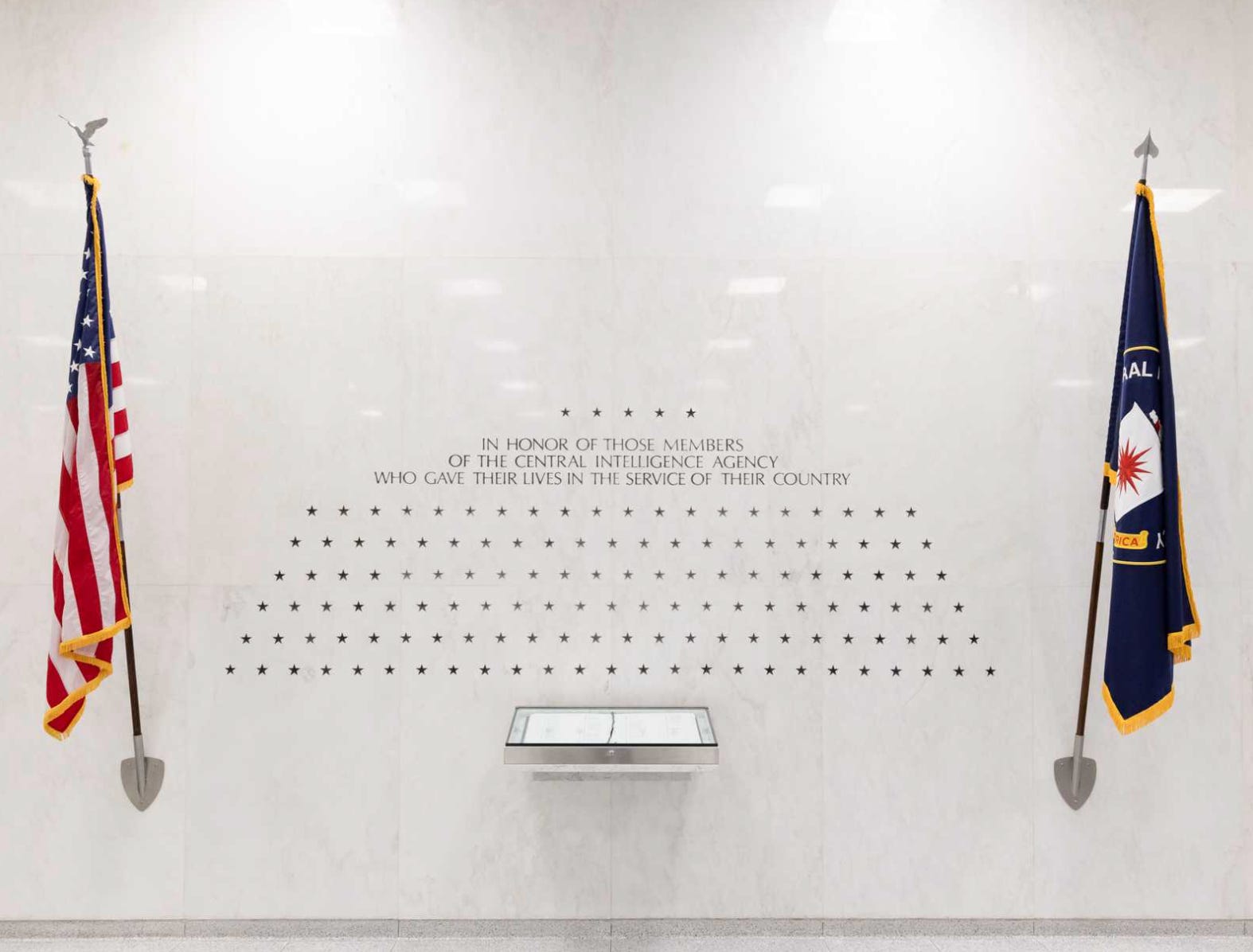
The CIA Memorial Wall at the agency's headquarters in Langley, Virginia. Photo courtesy of the Central Intelligence Agency.
The Strait of Hormuz has been closed or barely passable to commercial shipping since the United States and Israel struck Iran at the end of February. Tim Weiner’s account of how that happened does not begin in Tehran. It begins at the Resolute Desk. The CIA’s analysts, he says, called the consequences correctly and in advance — the closed strait, the empowered Revolutionary Guards, the regional war — and it changed nothing, because intelligence is worth only what a president is willing to hear.
That is the argument at the center of a career now in its fifth decade. He says it took him awhile, at the start of those forty years, to understand a simple fact: the CIA belongs to the president. What follows is a conversation about how he arrived there, and about the unglamorous craft that got him there — hanging around long enough that people who have spent their working lives concealing things agree to sit down in a restaurant in Concord, New Hampshire, and talk.
This interview has been edited for length and clarity.
HOW A REPORTER ENDS UP COVERING THE CIA
Benjamin Wolf: You’ve stayed on the same beat, The CIA, for almost forty years. Where did it start?
Tim Weiner: I’m the firstborn son of parents who fled Hitler’s Europe. They met on a blind date in 1953. I was born in 1956. They became distinguished professors in their respective fields — history and brain science.
I went to Columbia, took degrees in history and journalism, and started out as a newspaper reporter in 1979. I had a lot of luck and a lot of good fortune.
I covered the fall of Ferdinand Marcos in the Philippines in 1986. Then, in 1987, I went to Afghanistan to write about the CIA’s introduction of the Stinger anti-aircraft missile during the Soviet occupation. It was the first time in the Cold War that American weapons were being used to kill Soviet soldiers and airmen. Plausible deniability in American support for the Afghan mujahideen had cracked.
I went backpacking with the mujahideen. I saw a Stinger fired in anger.
All of this was happening as Iran-Contra was boiling over. For readers who don’t remember: President Reagan authorized the sale of weapons to the Iranian Revolutionary Guard, and the proceeds were skimmed to support the Contras after Congress had outlawed military aid to them. That is what can happen when presidents use secrecy to cloak unlawful action. In that case, the secrecy didn’t last long enough.
So I got deeply interested in Iran-Contra, and in what the CIA was doing.
Before I went to Afghanistan, I called the public information officer at the Central Intelligence Agency. There is such a person; there always has been. I said: I’m going to Afghanistan to write about this secret weapons shipment you’re conducting to the mujahideen. I understand people at the CIA sometimes give background briefings to reporters heading off to strange places. How about it?
He said absolutely not, and hung up on me.
But I had been back from Afghanistan less than a day when the phone rang. Guess who. My new best friend at the CIA. He asked how my trip had gone, and then he said, “How would you like to come in for that briefing now?”
So I drove out to headquarters, seven miles outside Washington, in the leafy suburban glades of Virginia. I walked into the lobby, and there on the wall, engraved in gold leaf, was the Gospel of John, 8:32: And ye shall know the truth, and the truth shall make you free.
And I thought, in the immortal words of The Dude: that’s fucking interesting, man.
I more or less decided then and there that I would make a career of covering the CIA. That was almost forty years ago.
“THE CIA BELONGS TO THE PRESIDENT”
BW: You’ve now written the CIA’s history twice — the first sixty years in Legacy of Ashes, the last twenty-five in The Mission. What do you understand about the agency now that you didn’t understand the first time?
TW: I think the better question is what I didn’t understand forty years ago, when I started out covering them.
The CIA belongs to the president. With rare exceptions, it does what the president tells it to do.
It isn’t as though a couple of CIA officers were sitting around Miami in 1960 over martinis and one of them said, “Hey, I’ve got a good idea — let’s go kill Fidel Castro.” It was President Eisenhower and President Kennedy who wanted that done.
The CIA is an instrument of American foreign policy. And often what are deemed intelligence failures are really policy failures — failures of presidents and secretaries of state to form coherent foreign policies.
So when the CIA becomes the pointed end of the spear — in Afghanistan, say — the question is: what’s the mission? To win a war against a ragtag bunch of dudes, the Taliban. And the United States, in all its majesty, could not do it, in part because the military and the CIA could not get it through their heads that killing civilians does not endear you to the population of an occupied country.
Why were we in Vietnam? Why were we in Iraq? To what end? Ostensibly we went into Iraq and Afghanistan to fight terrorism. But terrorism is an idea, not an army, and it is not susceptible to the logic of force.
The government of the United States, in all its majesty, never came up with a coherent answer.
Go back through the history and you’ll see a litany of tactical successes accompanied by enormous strategic failures.
BW: Make that concrete for me. Where is that pattern operating right now?
TW: The CIA is tasked with locating the supreme leader of Iran and targeting him so that he can be killed by the Americans and the Israelis. That is a tactical success. You have supposedly decapitated a government.
And what have you done? You have empowered the more radical elements of the Revolutionary Guard. The strait is closed. You have ignited a regional war. You have succeeded at none of your strategic aims, and there is no way out.
When the CIA is given an order, it salutes smartly and tries to execute it. But the question is always: to what end? That is the question policymakers have to answer, and it is the one they keep failing to answer.
HOW YOU GET SPIES TO TALK
BW: The Mission is built on six former directors and scores of officers whose entire careers depended on not talking to people like you. What actually turns one of those noes into a yes?
TW: It is much harder to interview a CIA operations officer who has lived his entire professional life undercover than it is to interview a director. Bill Burns, who ran the agency under Biden, is a really impressive man, and he was happy to give an interview.
Now take the man who was put in charge of setting up the secret prison system. You’d think that would be the tougher get. His name had never been published. I found it in the transcript of a deposition given at Guantánamo.
I tracked him down and called him at his home in New Hampshire and said I’d like to come interview him. He said, “Sure. Come on up.”
So I got in the car and drove to a restaurant in Concord. I arrived fifteen minutes early, as one should. About five minutes later he walked straight up to me and said, “Hi, Tim. How are you?”
We talked for four hours. At the end I said, “I know you’re a trained intelligence officer, but how did you know it was me?”
He said, “From the author photo on the jacket of Legacy of Ashes. Good book.”
Here’s the key. If you hang around long enough, and if your work is accurate, and if you deal fairly with people, they’ll talk to you.
The sitting chief of the clandestine service, Tom Sylvester, gave me an interview. As far as I know, no sitting chief of the clandestine service had ever given an on-the-record interview to a reporter.
I’m not a jerk. I’m not an ideologue. I’m not a polemicist. I try to write carefully.
More important than any personal quality, though: covering the CIA — covering any institution imbued with secrecy — is like covering a foreign country. You have to learn the language, the argot, the jargon, the customs of the tribe. You have to understand its history and its traditions.
And if you hang around long enough, perhaps you earn a modicum of trust. Trust is the coin of the realm. Just as a CIA officer recruiting a foreign agent has to win that person’s trust, a reporter has to win the trust of the officer in order for the officer to talk.
Why anyone ever talks to a reporter, I still don’t entirely understand, after nearly fifty years in the business. But it comes down to trust. Looking people in the eye and asking intelligent questions.
LEARNING TO INTERVIEW BY HITCHHIKING
BW: Is that instinct, or did you build it?
TW: When I was a teenager, back in the 1970s, I used to hitchhike across the country. I went to school back East and my parents were teaching at UCLA. Every summer I’d work a job, put a couple hundred bucks in my pocket, strap on my backpack, and try to cross the country. Then I’d hitchhike back East for school.
People pretty much always picked me up. And people don’t pick you up out of the milk of human kindness. They’re bored. It’s a big country. It’s a long way from Indianapolis to Salt Lake City.
They want to talk. And they want to talk about the most fascinating thing in the world, which is themselves.
But often as not they’re inarticulate. You have to draw them out. You have to ask questions. You have to engage.
I didn’t know what I was doing. I was fifteen, sixteen years old. But I was learning how to conduct an interview, and it has stood me in good stead.
THE GOLDEN TICKET
BW: Is there a book you wish you’d written, or someone you wish you’d gotten in a room?
TW: I’ve been very lucky, Ben. I became a newspaper reporter at a time when, if you could write a simple declarative sentence and had an inquisitive mind, you could get a job at a newspaper.
Three years in, I was extraordinarily lucky to be hired by The Philadelphia Inquirer. The paper was run by Gene Roberts, the only person I have ever met in journalism who may conceivably have been touched by genius.
After I’d been there about four years I went to Gene and said I’d like to go to Afghanistan and write about the mujahideen. American reporters did not, as a rule, go to Afghanistan during the Soviet occupation. Only a handful did. There were no hotels. There was no electricity. There was very little to eat. But I was thirty years old, and I thought it was worth a shot.
Gene listened, and he said, “Sounds real interesting.”
If you could interest Gene Roberts in what interested you, you were good to go. That was the paper he ran. We had the freedom to pursue things we found genuinely interesting, and the Pulitzers followed.
By and by I got to The New York Times, in 1993, hired to cover the CIA among other things. The Cold War had just ended, and the agency was in real trouble. It had lost its great enemy and, with it, its reason for being. How do you remain a great intelligence service without a great enemy?
So the CIA was in a continual state of crisis — which meant enormous opportunity for a reporter at The Times.
I did not become a better reporter when I joined The Times. People just returned my telephone calls.
I had a very good run. On a fairly regular basis I’d do parachute jobs — fly off to a garden spot like Sudan or Afghanistan or Pakistan or Haiti or Cuba, or Liberia at the end of its fourteen-year civil war, and report for weeks or months.
It was a golden ticket to see the world. The journalist, like the spy, can parachute into a foreign country and say, in so many words, “Take me to your leader.” And often as not, you will be taken to the leader.
The ability to see the world beyond America — and beyond what we used to call the Western world — is an ennobling experience.
BW: Then Legacy of Ashes comes out in 2007, and not long after, you walk away from thirty years of newspapers. What did the book make possible?
TW: After about twenty years of off-and-on work, I finished and published it in 2007. Who the hell is going to take a 700-page book about the CIA to the beach? But by God, people did. It sold very well. It’s still selling nearly twenty years on. It won the National Book Award.
That let me say to myself, at fifty-two: I’ve been a newspaperman for thirty years. I’ve done pretty much everything I could have dreamed of doing. I think I’ll take a leap and see if I can write books for a living.
And by God, it worked out.
None of this should count as career advice for young people, because the path is very different today. But I think the moral of the story is: figure out what you love to do, and then figure out how to do it.
“FIRST, YOU HAVE TO KNOW”
BW: There are thousands fewer newspaper jobs than when you were hired. What take aways from your time in the work still hold true today from the way you learned this?
TW: Between the internet, our tech overlords, and a lot of other causes, the newspaper business has suffered enormously. There are thousands fewer journalists at newspapers than there were twenty years ago.
But there are also incredible opportunities to write what you know and get it out there.
First, though, you have to know. You can’t write writing.
If you’re a reporter and you don’t have the information, fancy writing is not going to do it for you. Your opinion is not terribly valuable in and of itself — although there are doubtless people who believe their opinions are the purest gold.
I was a history major. My mother was a history professor. I think history is the best training conceivable for this. The past has a pattern. It informs the present. It doesn’t predict the future, but it gives you good grounding from which to look out over the horizon and understand complicated things.
And a lot of good writing is boiling an ox down into a bouillon cube that still tastes like ox. Understanding complexity well enough to explain it in simple, direct terms.
MAKING THE HIDDEN VISIBLE
BW: You’ve spent a career on institutions that exist to keep things from being known. Strip away the beat and the books — what is that work actually for?
TW: Our job is to make the hidden visible.
News is what somebody doesn’t want you to know. Particularly when the people who don’t want you to know it are in power, it is your job to know it.
TRUST BETWEEN COUNTRIES
BW: You say trust is the coin of the realm inside the agency. What about between countries — is there anyone left who is genuinely an American ally?
TW: We have squandered our alliances. We have betrayed allies who trusted us. Can you name one?
BW: Israel, certainly. And much of Europe still behaves like one, despite everything this administration has said about NATO. If Washington genuinely needed help and asked for it, wouldn’t it come — if only because those governments know America outlasts any one administration, and because so much of their prosperity runs through ours?
TW: Trump has done everything in his power to destroy the North Atlantic alliance.
And trust, once broken, is very hard to repair.
THE DANGER AHEAD
BW: If the CIA is an instrument of the president, what is it when the president doesn’t want the intelligence?
TW: The CIA was created not to serve as an instrument of death, but to gather information around the world, analyze it, and present it to the president in the hope of enlightening American foreign policy — of forging coherent policy as America projected its power.
Intelligence means nothing to this president. When he uses the word, he puts it in scare quotes. You cannot brief Donald Trump. He does not want to hear anything that doesn’t fit his preconceptions.
The agency’s analysts predicted quite rightly that if the United States and Israel went to war against Iran, everything that has since happened would happen — the closure of the strait, the empowerment of the Revolutionary Guard, a regional war of all against all. It made no difference.
And there has been an ideological purge throughout the institutions of American national security — CIA, FBI, State. Hundreds of people have been fired because they would not swear fealty to the president. At the beginning of this administration people were grilled: Who did you vote for in 2020? What did you think of January 6th? Who really won the election? If you couldn’t pass that test to the satisfaction of the people running these institutions, you were gone. I would put it on a scale with the Red Scare of 1950 to 1954, when Joe McCarthy ruled the earth, and in some respects worse.
I don’t know whether the institutions that have been damaged can be rebuilt in my lifetime.
The second great purpose behind creating the CIA in 1947 was to prevent the next Pearl Harbor — to protect the United States against strategic surprise. Much of what the CIA, the FBI, and our cybersecurity agencies built after the Russians attacked our democracy in 2016 has been torn down, along with the people who did the building.
I’ve studied American intelligence since the 1980s. Looking around today, I think the danger of a third Pearl Harbor, twenty-five years after 9/11, is immense and growing. The danger signs are flashing much as they did in the summer of 2001.
That is the sobering note I’ll leave you on.
About the guest.
Tim Weiner is a Pulitzer Prize–winning journalist and author who spent decades reporting on American intelligence and national security, including as a correspondent for The New York Times. He won the 1988 Pulitzer Prize for National Reporting for his investigation of secret Pentagon spending, and the 2007 National Book Award for Legacy of Ashes: The History of the CIA. His latest book is The Mission: The CIA in the 21st Century.
About The Pathway Review.
The Pathway Review is an interview publication about how consequential people think, work, and build their careers across foreign policy, politics, business, law, journalism, and public life. Subscribe for new conversations.
This interview was conducted in August 2026 and has been edited for length and clarity.