


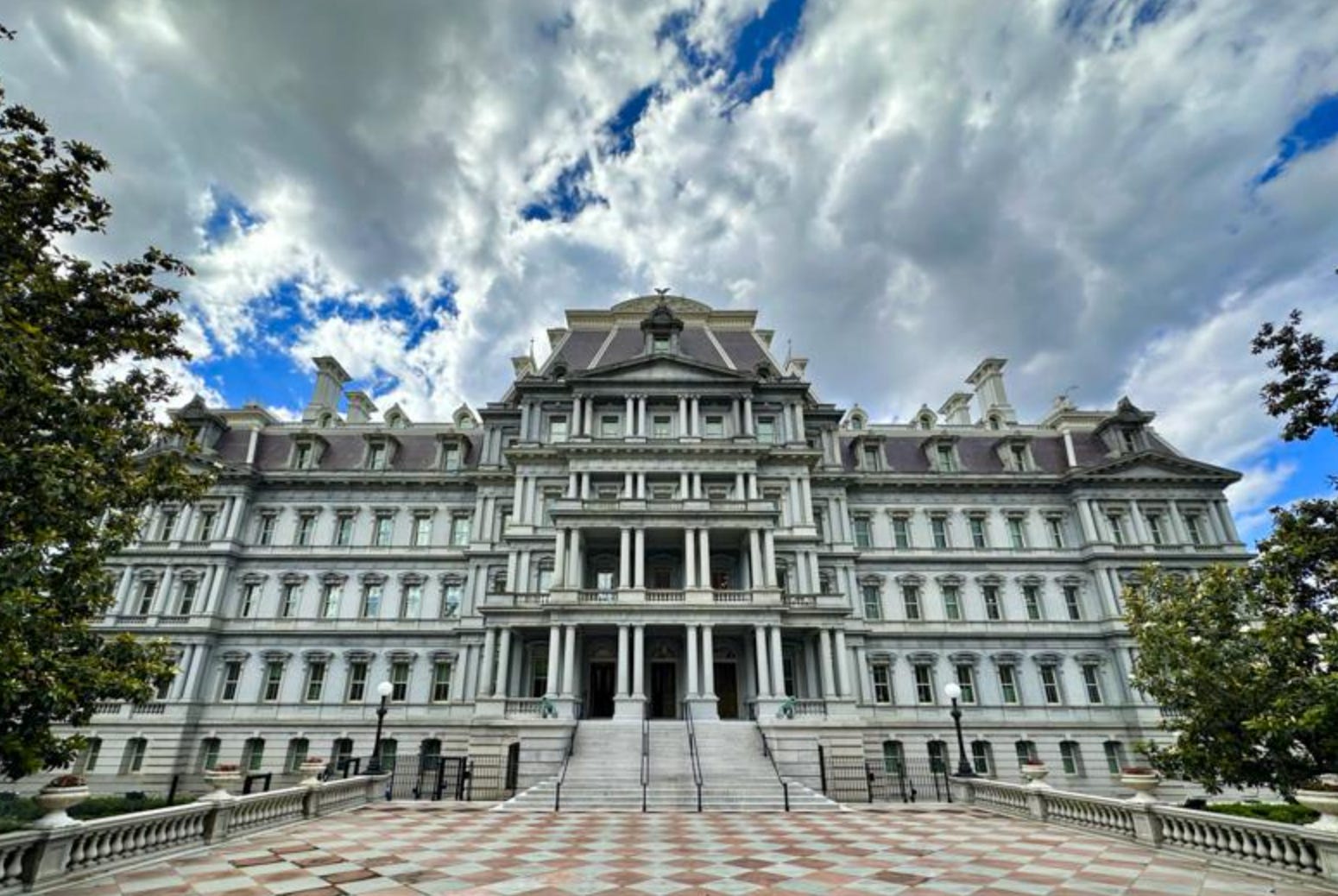
The Eisenhower Executive Office Building, part of the White House complex in Washington
The Code of Federal Regulations runs nearly 200,000 pages. Congress did not write most of them. Lawmakers pass a statute, set the broad strokes, and go home. What happens next—the fine print that decides who qualifies for a loan, what a company has to disclose, whether your apple can legally call itself organic—gets written largely inside federal agencies, often by people whose names never appear on the document. That gap between the law and the rule is, from Rachel Potter's account, where much of American governance actually happens.
Rachel Augustine Potter has worked that gap from both sides. She reviewed regulations at the White House before they went public, then became the political scientist who argues that rulemaking is not the neutral process it can appear to be. It is politics with the byline removed. Her next book pushes the argument somewhere less visible: into the growing army of contractors now doing more and more of the government's work.
This interview has been edited for length and clarity.
What Happens After the Bill Passes
Ben Wolf: By most estimates, a huge amount of binding federal law comes from agency rules rather than statutes themselves. For a reader who has never thought about this, what actually happens between Congress passing a law and a rule showing up in their life?
Rachel Augustine Potter: In the space between a law passing and a regulation being enacted, you have hundreds of people inside the federal government coming together to think about how to implement the details. The way they do that is they write a proposal. That could take a short amount of time or a very long amount of time, depending on how complex the policy is.
Then, in most cases, they put that out for comment. You can look on FederalRegister.gov and actually see what the current administration is planning in terms of regulatory policy. And you can write a letter, which many Americans do. Often it is businesses or trade associations or organized public interest groups that participate in this process.
So the agency gets these written comments, and there might be ten, or there might be a million, depending on how much public interest there is. Then they deliberate over them. It is not a temperature check to see what the public wants and then do that. They deliberate on the comments and decide what the best policy is, given their expertise.
Then they write that up and publish the final rule. Again, on the Federal Register, you can see what is actually going to come out. And about thirty to sixty days after it appears on FederalRegister.gov, it becomes law. That regulation carries the same force and effect as if Congress itself had passed a law.
The Organic Apple Problem
BW: Your book argues that rulemaking is not clerical work; it is political work. Walk me through where the choices actually get made, and by whom.
RAP: It is hard in any one rule to know. It is an interesting question, because I cannot give you the names. It was not Joe Smith who did this or that.
What happens is that Congress gives a choice to an agency. It says: make a policy on a very specific area. But there is always going to be latitude in that, because the reason Congress delegated the authority in the first place is that it said, this is too much for us. We are a body of 535 members between the House and the Senate, but we deal with all the policy areas. You are the experts in environmental policy or agricultural policy. Here is a specific topic. Make some policy about student loan repayment time frames, or about what actually counts as an organic apple.
And within that choice of how quickly students should repay a specific type of student loan, or what an organic apple is, there are a lot of choices to be made. The people making those choices are the people in these agencies, and they are working in teams.
It is a political choice because it creates winners and losers. Think about something like an organic apple. There are lots of companies in the United States that would like their apples to qualify as organic, and they might be what we would consider on the border of that. If the USDA is making a policy about organic apples, they get to decide which firms are winners and which are losers, who gets to call their apple organic without having to do too much, and who does not.
That is itself a political choice, because it decides who wins and who loses. When I say it is a political choice, I mean it is not value neutral. We would like to think about administrative policymaking as value neutral, where people just apply their expertise and there is always a clear call. But there are always winners and losers in public policy. That is what I mean by a political choice.
“There are always winners and losers in public policy.”
Inside the Regulatory Office
BW: When you were at OMB, were you conscious of being inside that process? Or did the strategic logic only become visible after you left?
RAP: At the Office of Management and Budget, I worked in the regulatory office, which oversees draft proposals and draft final rules. They have a lot of purview into what agencies are doing before it becomes public knowledge.
Did I know this was political? Of course. These issues are often touching on subjects very close to political fights happening that day, even if they are not referred to in The New York Times or The Washington Post as rules or regulations. You might work on a regulation about Medicaid that shows up in The Washington Post a week later. The fact that it is showing up on the front page means there is a political interest in it. It is inescapable. And the amount of political interest from the White House in different regulations makes it very clear that these are politically relevant policies.
If I think about what academia thinks differently about this than policymakers do, there is a lot of theory about the separation of politics and administration. That is where the idea from Woodrow Wilson came about, that we could segregate the politics and the decision-making from the actual administration. That theory has had so much play in how we have developed the American state. But it is basically impossible to implement in practice, because we are all humans, and if we know there is politics involved, it is hard to ever be neutral.
And I do not mean partisan politics. I just mean thinking about who is winning and who is losing, and what my beliefs as an individual are about who should win and who should lose.
BW: You came to political science after working at both the Government Accountability Office and OMB. How did those experiences lead you toward the research you do today?
RAP: I worked at the Government Accountability Office when I was in my master’s program, as a graduate intern. GAO is part of the legislative branch. They work closely with Congress to evaluate and provide oversight over the executive branch and the programs being implemented in federal agencies. That formal internship program is a terrific opportunity to get a sense of the nuts and bolts of what happens in government. When I was there, I worked on a report on contracting and acquisitions, and I learned a lot about that process, which has actually informed a lot of my research today.
After I finished my master’s degree, I went to work at the Office of Management and Budget as a desk officer in the Office of Information and Regulatory Affairs, which is the regulatory oversight part of OMB that deals with agencies and their regulations. I got hired through the Presidential Management Fellowship, which I believe no longer exists, but it was a program to get talented young people into government quickly. It was a great program, and I learned a lot about really intricate processes and how they work in government.
[Editor’s note: The Presidential Management Fellows Program, created in 1977, was terminated by executive order in February 2025. OPM formally rescinded the governing regulations in August 2025.]
So this time I was focusing on regulation. If I think about my research today, I have written a book about rulemaking and a new book about contracting. How does work in the real world inform academia? I learned a lot about how these things actually work on the ground, and why they matter to the broader things that happen. A lot of people think, oh God, regulation and contracting out, how boring. But these are what make government hum and sing, and we need these things. The fact that so few people want to understand them gives bureaucrats even more authority and leeway, because no one really wants to engage with the detailed substance.
When the Reasoning Is Not Human
BW: I have to ask about AI, because both drafting rules and generating comments about them seem to strain some of the assumptions this process was built on. Where does AI enter into rulemaking?
RAP: The role of AI is, obviously, like the rest of society, something we are figuring out.
What we know is that we require agencies, in rulemaking, to reason and to defend. They have a duty to reason. That means they have to say not just that we are going to make this policy through regulation, but that we are going to make this policy and here is why, and it has to be thoughtful and evidence-based. The courts provide a pretty significant check on agencies acting in an arbitrary and capricious manner.
The problem AI introduces is this: If an AI bot reasons, is that sufficient to substitute for human reasoning? And second, do we, as the public, know? If an agency has used AI to reason, we might just encounter a rule and have no idea who did the reasoning. As I mentioned, I do not know who worked on a specific rule. They do not give a list of contributors to each rule. So we do not know when AI is being used, or exactly how.
One way the Trump administration is using AI right now, especially, I believe, at the Department of Housing and Urban Development, is to identify which regulations they should get rid of. They are using AI to help figure out which regulations are ineffective or could be streamlined. Again, we do not know much about the algorithm they are using, or whether it is a good algorithm, or whether it shares the same values you and I might have about what kind of housing and urban development policy we have. But that is the current state of the world.
[Editor’s note: Internal documents first reported by The Washington Post in July 2025 described a “DOGE AI Deregulation Decision Tool” that had been used to evaluate more than 1,000 regulatory sections at HUD in under two weeks.]
It is a very evolving world. I think we are figuring it out the way we are figuring out everything else, the way higher education is figuring out student work. We are figuring out what we think is appropriate. The technology is ahead of the thinking about values and about what we want, and we are catching up. There is some good scholarship coming on this. But it is not clear.
And on the contracting side, there are also a lot of efforts to use AI in more mechanical ways, and in more generative ways, to streamline the procurement process, which has for decades been considered pretty clunky. I think a lot of improvements can come out of that, just using the bare-bones technology to do a lot of the things people were doing before.
“The technology is ahead of the thinking about values and what we want.”
Writing for Two Audiences
BW: What did seeing the process from the inside let you notice that political scientists working from the outside tend to miss?
RAP: I imagine a lot of your readers are students, and they know what it is like to read something about government that is a little dry, or not that interesting seeming. What my government experience did was force me to engage with these really esoteric processes of government, like procurement and rulemaking, and really get into the process and the procedure in ways I firsthand got to observe: how this works, who is important within this process, and what the values are that come into it and come out of it.
That experience gave me a lot of insight into how this could inform broader theories that political scientists have about how policy is made in Washington, who has input, and how public values enter, or do not enter, what comes out of government.
BW: You also write for Brookings and the Miller Center, which is a different kind of writing for a different audience. How do you decide what belongs in a journal article versus a piece meant for people making decisions right now?
RAP: There is a difference in the writing. Academic research is full of jargon and full of really technical statistical detail. Political science articles have a lot of that kind of thing. That is not what your modal policy person in Washington cares about or has time to engage with. They also cannot even access a lot of academic research, because it is gated behind paywalls.
So when I am writing for the Miller Center or for Brookings, I am thinking: Who is going to care about this? What parts of it might they care about? What are the policy implications, if any, and what do we not know? And how can I write this in a way that captures the true essence of what I was trying to say in the academic piece, without the jargon and statistical detail that these readers do not have the time or bandwidth to engage with?
Should You Still Go Into Government?
BW: For someone in their early twenties who wants to do the work you do, does a government job still make sense as a first career move? Or has that calculation changed?
RAP: I think working for the government and doing public service is tremendously important for all young people, to get a sense of what government is and why it matters to your life. Because it matters a lot, even if you are not paying attention.
It is a strange moment to take jobs in the federal government, because the federal government is undergoing a transformation, and we do not know what that is going to look like. We know that the federal workforce is decreasing right now, and it has also been long established that the federal workforce is graying. That is going to be an opportunity in the next decade for young people to come in and help reshape what comes next.
So I do not think that the pathway is at all closed. I just think it is different than we thought before. That is, in some ways, a little scary. But it is also really exciting to help shape the next generation of what government could be. So absolutely, I do not think jobs in the federal government should be ruled out.
I also think state government is a place where states are doing a lot of really exciting work. They are taking up a lot of the policy work that used to be done at the federal level. It is important work, and again, these are opportunities. These are jobs that are often held by much older people who will be retiring, and these are places where you might be able to take on a lot of responsibility at a relatively young age, which is kind of cool.
Rachel Augustine Potter is an associate professor of politics at the University of Virginia, a senior fellow at the Miller Center for Public Affairs, and a nonresident senior fellow in Governance Studies at the Brookings Institution. Before academia, she worked at the Government Accountability Office and as a desk officer in the Office of Information and Regulatory Affairs at the White House Office of Management and Budget. She is the author of Bending the Rules: Procedural Politicking in the Bureaucracy (University of Chicago Press, 2019), which won the APSA Theodore J. Lowi, Richard E. Neustadt, and Herbert A. Simon awards as well as the National Academy of Public Administration's Louis Brownlow Award. Her second book, Going Private: Outsourcing the Administrative State, is forthcoming from the University of Chicago Press in December 2026.
The Pathway Review is an interview publication about how consequential people think, work, and build their careers across foreign policy, politics, business, law, journalism, and public life. Subscribe for new conversations.