


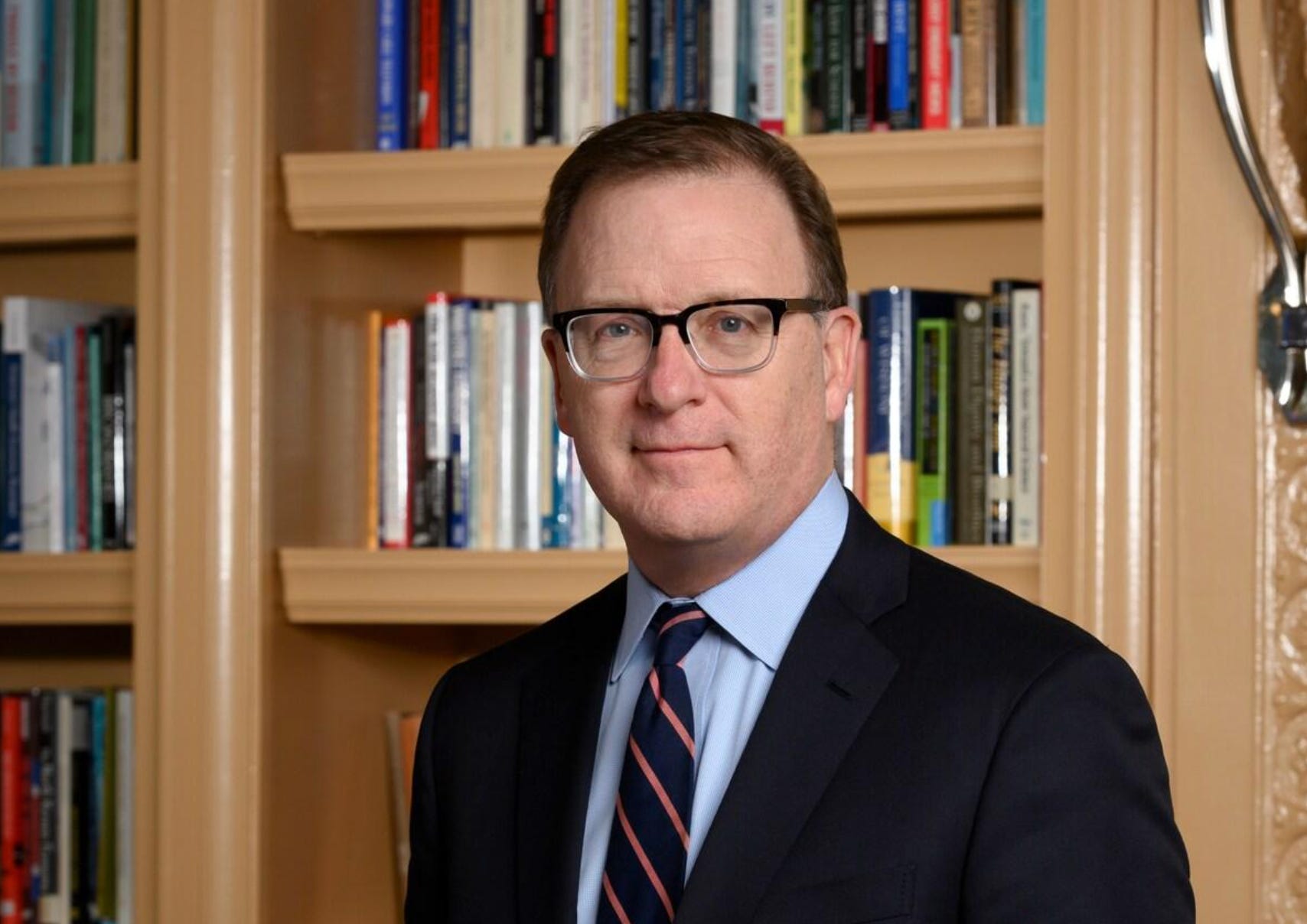
Robert Doar, president of the American Enterprise Institute. Photo: Aaron Clamage / American Enterprise Institute.
This month marks the 30th anniversary of the 1996 law that replaced open-ended cash welfare with work requirements. Congress marked the occasion with a September 1 hearing on what those lessons should mean for the newer work requirements just added to SNAP and Medicaid. Robert Doar ran the New York State and New York City programs that had to make the original law function on the ground, more than two decades in social-service administration before he ever analyzed policy from the outside.
That order, doing the work before writing about it, runs through everything he told me, from twenty years of managing people in government to the advice he’d give a college sophomore who doesn’t yet know where any of this leads.
On Execution
Ben Wolf: You spent more than two decades running social-service programs before moving into think tanks and policy research. What did you come to understand about poverty and administering those programs that you could not have learned simply by studying them?
Robert Doar: The number one thing I learned is that what matters often is how you implement and execute various policies.
There are a lot of great policies and great ideas, but if you don’t have people actually working in the field who know how to get things done, how to lead people, communicate, hold themselves accountable to results, change when things aren’t working, and respond to a crisis, then good ideas don’t necessarily lead to great public-policy outcomes.
Execution or implementation is a much more important aspect than I think gets enough credit, especially here in Washington, where we talk a great deal about ideas and policies and not enough about how they are going to be properly implemented, often at the state or local level, closer to the people.
That is especially important with safety-net programs because most of them are partnerships among the federal government, state governments, local governments and, sometimes, nonprofits and faith-based organizations. All of them participate in whatever effort you are making to help people who are struggling economically.
BW: Was there a policy you entered government believing would work, only to discover that the people affected by it behaved very differently than policymakers expected?
RD: I can think of something almost in the opposite direction. I believed work requirements in cash assistance would work when a lot of people thought they wouldn’t, and I thought they worked much better than many people expected.
When people were told that, in order to receive assistance, they needed to do something for themselves and make an effort, they made that effort. They had more resilience and more ability to work than people gave them credit for.
A lot of people on the left argued that work requirements wouldn’t work because these individuals couldn’t work, didn’t know how to work or needed significant training first. My experience was that many were very capable of entering work, earning a wage and connecting themselves, with government assistance, to programs that increased their income through what we call work supports.
But where things can go awry most flagrantly in public policy is when you are far away from where you are trying to get something done.
The most obvious example is foreign policy. You think you can control and direct outcomes in Afghanistan or Iraq, but it turns out that is pretty hard to do from thousands of miles away.
Good ideas and high aspirations, directed from that far away, often do not lead to the outcomes you want. Leaders such as George W. Bush or John F. Kennedy had great ambitions about helping countries develop freedom and democracy. But it wasn’t our country. It was someone else’s country. We were far away, cultural values could clash, and we did not always understand the ethnic rivalries or other forces involved.
The best-laid plans don’t always work out. The key is that, when that happens, you have to be willing to admit something isn’t working and do something different. It often takes a long time for people in public policy to face up to that.
On Leaving Government
BW: What prompted you to move from government into think-tank work?
RD: Michael Bloomberg decided not to run for another term as mayor. That was one big reason.
Sometimes decisions are made for you. I had to think about what I was going to do next, and AEI came to me and offered me an opportunity to take what I had learned, write about it, think about it and communicate about it in the public-policy world of Washington.
That seemed like a great opportunity. It gave me a chance to stop for a minute and think through, write out and describe what I had learned in almost 20 years of government service on issues concerning low-income Americans.
It was just a different phase in my life.
I think people your age, and people generally, need to know that an interesting, satisfying career is successful partly because you are willing to change and do different things during different periods of your life.
If you want things to remain exactly the same for your entire 35- or 40-year working career, that is pretty hard to pull off while keeping the career both successful and compelling.
On Management
BW: What did those years in government give you that later made you effective in the think-tank world?
RD: Management.
If you learn how to manage an organization and treat people properly, how to listen, hire, remove people when necessary, select the right people for jobs, evaluate their performance and hold them accountable, those disciplines are useful no matter where you work.
You could be in manufacturing, an airline, a think tank or a social-services agency. Management skills are transferable across many domains.
When I first came to AEI, I was a scholar, so those skills weren’t really being utilized. I was using my ability to write, think and participate in the national debate. But I missed managing.
When the AEI presidency came up, I realized: That’s what I’m really good at. I’m good at managing and leading and encouraging people to do their best work.
Every day, I do something here at AEI that is informed by leadership lessons I learned either in New York state or New York City.
It is a little ironic. You look at a big government bureaucracy and think, “What could you possibly learn there?” But you learn how to treat people, how to behave, how to lead, how to communicate, how to pace yourself, when to press hard and when not to.
Those are things you really can only learn through managing and experience.
On Finding What to Work On
BW: A lot of ambitious college students feel pressure to choose their path very early. How much should somebody at 20 actually know about what they want to do?
RD: In my case, I was driven by what I thought was one of the biggest problems in America. I didn’t need to know all the answers. I didn’t know exactly how I was going to get there. But I knew what I wanted to work on.
That is important.
Some people choose climate. Some choose energy policy. Some choose economics. I chose welfare and poverty policy. Some people choose national defense.
Young people should begin by asking what they think needs their attention and what also intersects with their own interests.
In my case, I thought our poverty policies in the United States were broken. I thought it was disappointing that we weren’t helping people move up in the way I thought we could and should. I also liked cities, urban politics and people. Those things came together.
When you find the thing you care about, focus on having the biggest impact you can on it.
If you are smart, hardworking and a decent person, over time that can become very satisfying. You get responsibility. People turn to you because you chose something, worked on it and learned it. After five or 10 years, you know more than most people. After 15 years, maybe you are a leader in your field.
Then you can broaden out.
I learned a lot about poverty alleviation. Then, when I became president of AEI, I could focus on education policy, foreign and defense policy and other areas as well.
For me, the driving question was: What does the country need in order to be better?
On Public Service
BW: There is a lot of uncertainty among college students about entering public service right after graduation, especially around salaries and job security. How seriously should they take those concerns?
RD: People at your age should not be thinking, “I need to make a million dollars right away.” You need to get into the game and start making something.
Government jobs can be an opportunity to learn and to get started.
The key ingredient is to pick something that interests you in the long term. If you are not interested in foreign or defense policy, don’t go work at the State Department or Defense Department. But find a broad topic that interests you.
For people your age, it is going to be a very dynamic working world. Think about what you are interested in, what you care about and what will make you feel as though you are working on something that could have a positive impact.
I wouldn’t worry too much about the economic situation at first. Get a job. Get started. Keep your eyes open. Look for other opportunities. Learn the lay of the land.
If you overthink the first job too much, you can delay your entry and waste time.
My mother used to say, “Nothing is irredeemable.” You can try something, discover you don’t like it and do something different.
Institutions need good people. If you are good, hardworking, show up, are kind and are smart, people are going to want you around.
Have confidence in those qualities. You will learn from things, make contacts and go from there.
BW: Let me make that more specific. Suppose someone is deeply interested in foreign policy but is also considering beginning in the private sector, in investment banking, markets or another internationally oriented business, and entering public service later. How should they think about that choice?
RD: I’m not a foreign-policy expert, so I want to be careful about prescribing a career path.
There is the Foreign Service. There are intelligence agencies. You can enter those institutions, establish a track record and be involved in foreign-policy analysis and foreign affairs. Those are viable paths.
You may feel you are starting pretty low and working your way up. You may also feel like you are forsaking some income. But you are learning something.
In the private sector, on the other hand, you might work for a company doing a lot of foreign investment that sends you to London or Paris or Munich or Taipei. That is valuable experience. Living in another country and working in business and commerce in an international context can teach you a lot.
If you do that for 10 years, though, it may be harder to return and begin a Foreign Service career.
At that point, if you really want to have authority in foreign affairs, you might pursue another route into government.
If you want real authority in public policy, politics also matters. Political appointees are there because somebody won an election and has the ability to bring people into those roles. That is part of democracy.
Career officials also have authority and do important work, and some later move into political appointments.
The main point is that if you know you want to work on foreign affairs, put yourself somewhere where you are actually doing work connected to foreign countries, whether that is in the private sector or government, and get started.
Look at the people who currently have the kinds of positions you might want someday. Figure out what their paths were and see what you can learn from them.
On What He’d Do Differently
BW: If you were a college sophomore again, knowing everything you know now, what would you spend the next few years doing differently?
RD: I would work harder in school.
I did not get my jobs because I was a straight-A student or a Rhodes Scholar, and maybe that made it take a little longer for me. I didn’t know as much as I should have known.
I kept reading. I read and read and read, especially biographies. But grades do matter.
Not just because of the grades themselves. Hopefully, a good grade means you learned something.
There is nothing wrong with doing well in school because you have mastered the subject. An A means you have mastered the material better than if you get a C or a B-minus.
Looking back, I wish I had worked a little harder in college.
On What to Read
BW: Finally, for readers interested in a career similar to yours, what piece of literature would you recommend?
RD: Eric Sevareid’s Not So Wild a Dream.
It would be good for you to read, Ben, because it involves a career in international affairs and journalism.
Sevareid grew up in North Dakota, went to the University of Minnesota and entered journalism. He became one of the young correspondents covering Europe during World War II and was part of Edward R. Murrow’s team.
He did amazing reporting, and he was a beautiful writer.
I read Not So Wild a Dream when I was about your age, and it inspired me because it showed me that there are all kinds of ways you can make a great career.
Go get that book.
About the guest: Robert Doar is President of the American Enterprise Institute, a position he has held since 2019 after more than two decades running social-service programs for New York State and New York City, including as Commissioner of the city’s Human Resources Administration. His work focuses on poverty, welfare reform, and how safety-net programs function on the ground, and he co-chaired the National Commission on Hunger from 2014 to 2015.
About The Pathway Review: The Pathway Review publishes long-form interviews with people in politics, policy, journalism, law, diplomacy, markets, history, and public service about the work they do and the path that brought them there.
Subscribe to receive new interviews in your inbox.