


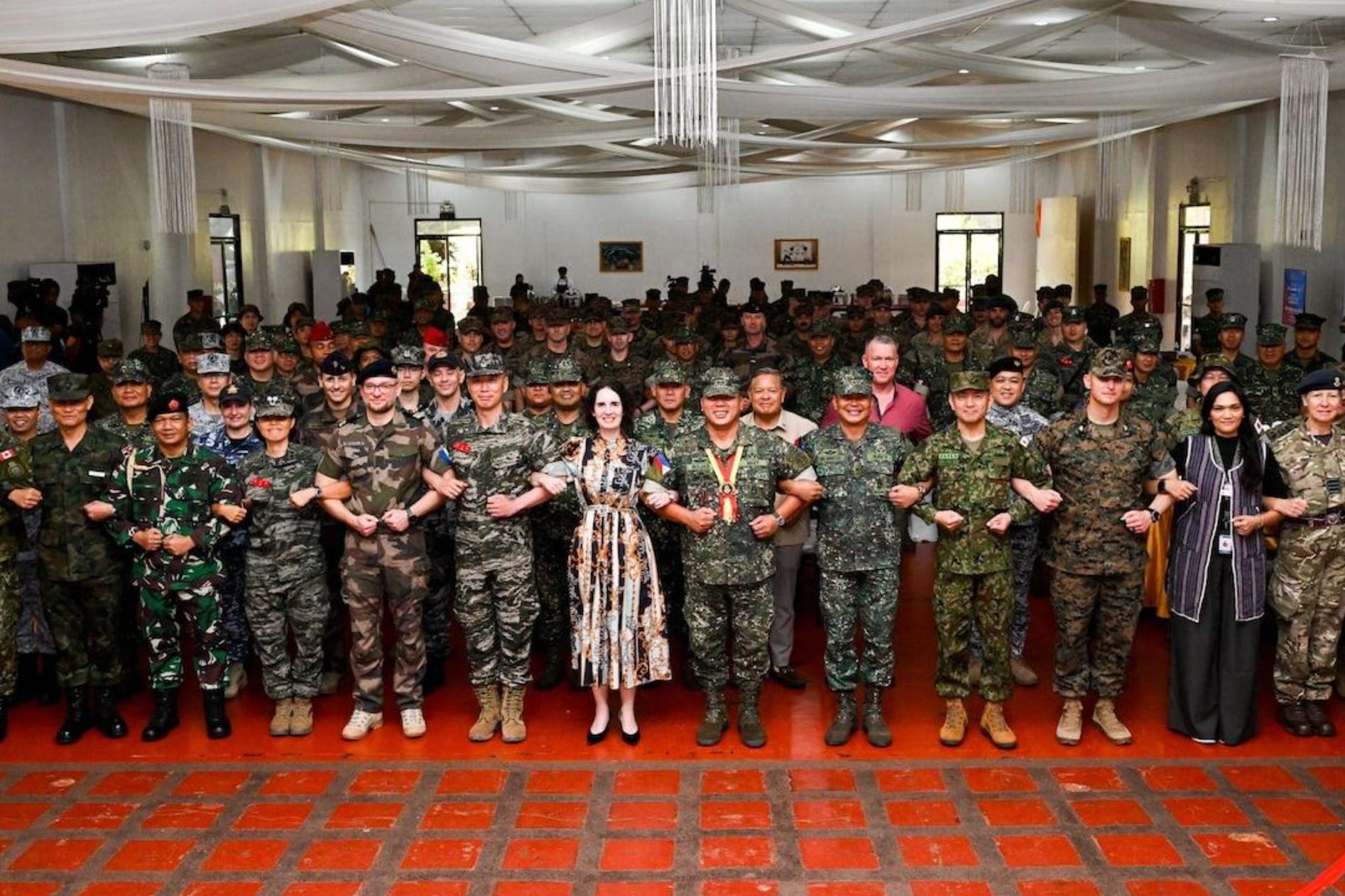
Philippine and international leaders at the KAMANDAG 9 opening ceremony at Fort Bonifacio, Manila, May 26, 2025. Courtesy photo provided by the Japan Ground Self-Defense Force / U.S. Marine Corps, public domain.
Richard Fontaine has spent much of his career moving between the rooms where strategy is debated and the rooms where it has to be made real. He has worked on Capitol Hill, at the State Department, at the National Security Council, and now from the outside as head of one of Washington’s major national-security think tanks.
That gives him a useful kind of caution. Fontaine is not arguing for retreat. He is arguing for prudence: the kind that comes after Iraq, Afghanistan, Libya, Syria, and years of watching good intentions run into the hard limits of local politics, bureaucracy, and American attention.
This conversation is about what experience does to confidence. Fontaine explains why alliances remain America’s great advantage, why China’s power is not just military, why soft power matters more than Washington sometimes admits, and why young people entering national security should be honest about both the rewards and the costs of the work.
This interview has been edited for clarity and length.
From the Archive · originally published in The Pathway Blog, December 2025.
Judgment, experience, and caution
Benjamin Wolf: When you look back at your early career, what’s a judgment you were confident in then but would approach much more cautiously now, not because you were wrong, but because experience complicated it?
Richard Fontaine: I think, big picture, many of us who lived through the wars in Iraq and Afghanistan, the Arab Spring, Libya, Syria, and other interventions have become more cautious about American engagement, especially military engagement aimed at changing the politics of another country.
Earlier in my career, I had greater faith in the efficacy of American power and probably underappreciated the complexity of domestic politics in other societies. That experience has made me dispositionally more cautious than I was twenty years ago.
Careers, chance, and serendipity
BW: Early on, did you overestimate or underestimate anything important when trying to break into this field?
RF: I underestimated the role of serendipity. In foreign policy and national security, as in many fields, you simply don’t know what jobs will exist, what issues will matter, or even what will capture your interest in the future.
If you had told me twenty years ago that I’d spend time thinking about artificial intelligence and geopolitics, my first question would have been: what is artificial intelligence? The lesson is to remain open to chance and not believe you need to follow a rigid path that inevitably leads to a specific job.
Mentors and Tulane
BW: Were there influential experiences in college that shaped your interests?
RF: Absolutely. My academic and thesis adviser, Dr. David Clinton, was disproportionately influential in teaching me the substance of international relations and American foreign policy. I graduated in 1997, and I still keep in touch with him. I literally received his Christmas card today.
I also spent my junior year abroad at Oxford, which was life-changing academically and personally. Through that program, I met my wife, another Tulane student who was studying at the London School of Economics. We’ll soon celebrate our twenty-fifth wedding anniversary, along with our four kids. Tulane shaped both my professional and personal life in profound ways.
From analysis to decision-making
BW: What distinguishes those who move into real decision-making roles from those who remain permanent analysts?
RF: The ability to get things done within whatever system you’re operating. It’s usually clear who is effective and who isn’t, and those who are effective tend to get promoted into decision-making roles.
Hard work still matters. The ability to write clearly and persuasively matters enormously, even in an era of AI. Those basic skills meaningfully increase your chances of advancement.
Where power actually resides
BW: You’ve worked inside and outside government. Where does real leverage over U.S. foreign policy reside?
RF: Foreign policy is made by the government. Outside actors, think tanks, analysts, journalists, can influence debates, but the deciders are in government.
That said, who the actual decision-makers are varies by administration. Power can reside at the White House, State Department, Pentagon, or elsewhere depending on process and personalities. For young people, the most important thing is to get into the field, whether in government, on Capitol Hill, or at a think tank. Over time, most careers move across several of these arenas.
Avoiding the fear of being pigeonholed
BW: Many students worry that committing too early will lock them into a path. How should they think about flexibility versus focus?
RF: I used to worry about being pigeonholed, but that worry changed as my jobs changed. If you love a specific issue deeply, you probably don’t mind specializing. For everyone else, especially generalists, do work that feels meaningful and intrinsically fulfilling.
You can’t plan a career with precision. Particularly in foreign policy, people move between journalism, government, think tanks, and the private sector all the time. Cut yourself a break. It’s going to be okay.
Peace deals, credit, and reality
BW: How do you assess President Trump’s claims about brokering peace deals?
RF: It’s a mixed bag. There are cases where Trump deserves real credit. For example, I don’t think there would have been a Gaza ceasefire and hostage returns without his involvement. There are other cases where he’s taken credit for outcomes he didn’t produce, or for conflicts that weren’t actually resolved.
When you enter a war and then take credit for ending it, that’s a curious formulation. Presidents don’t need to advertise their achievements. If they’re real, others will do that for them.
Alliances as assets
BW: Alliances are increasingly criticized. Are they still America’s greatest strength?
RF: Absolutely. The United States has treaty allies across Europe and the Indo-Pacific and close partners worldwide. We’ve relied on allies in Afghanistan, Iraq, and elsewhere.
Compare that to China or Russia, whose alliances are limited. That doesn’t mean allies can’t do more. They should. But seeing alliances as a liability rather than an asset is a mistake.
China and the uses of power
BW: What does China understand about power that the U.S. sometimes underestimates?
RF: China understands that power has many forms: economic influence, trade, investment, military power, foreign aid, broadcasting, cyber operations. It uses a broad toolkit.
The United States has weakened many of its soft-power instruments. When you strip those away, you’re left with military power on one side and rhetoric on the other. China’s more comprehensive approach should be instructive.
The personal costs of national-security work
BW: What is the least discussed cost of working in national security?
RF: Domestic politics matter enormously. The policies and job opportunities available to you change with administrations, often in ways outside your control. Working in foreign policy during different administrations can feel like entirely different professions.
Your partisan identity can shape opportunities, particularly for political appointments. That volatility is something young people should be honest with themselves about.
Reading for perspective
BW: Is there a book you’d recommend to students entering the field?
RF: A Peace to End All Peace by David Fromkin. Even if you think you’re not interested in the Middle East, the Middle East will be interested in you. History, more than theory, often provides the most useful context for understanding today’s foreign-policy challenges.
BW: Mr. Fontaine, thank you so much for your time. It’s been an honor.
RF: Thank you. I really enjoyed the conversation.
About the guest: Richard Fontaine is the Chief Executive Officer of the Center for a New American Security. He previously served as foreign-policy adviser to Senator John McCain, worked at the State Department and National Security Council, and served on the staff of the Senate Foreign Relations Committee. He is the co-author, with Robert Blackwill, of Lost Decade: The U.S. Pivot to Asia and the Rise of Chinese Power.
About The Pathway Review: The Pathway Review publishes long-form interviews with people in politics, policy, journalism, law, diplomacy, markets, and public service about the work they do and the path that brought them there.
Subscribe to receive new interviews in your inbox.
This interview was conducted in December 2025 and has been edited for length and clarity.