


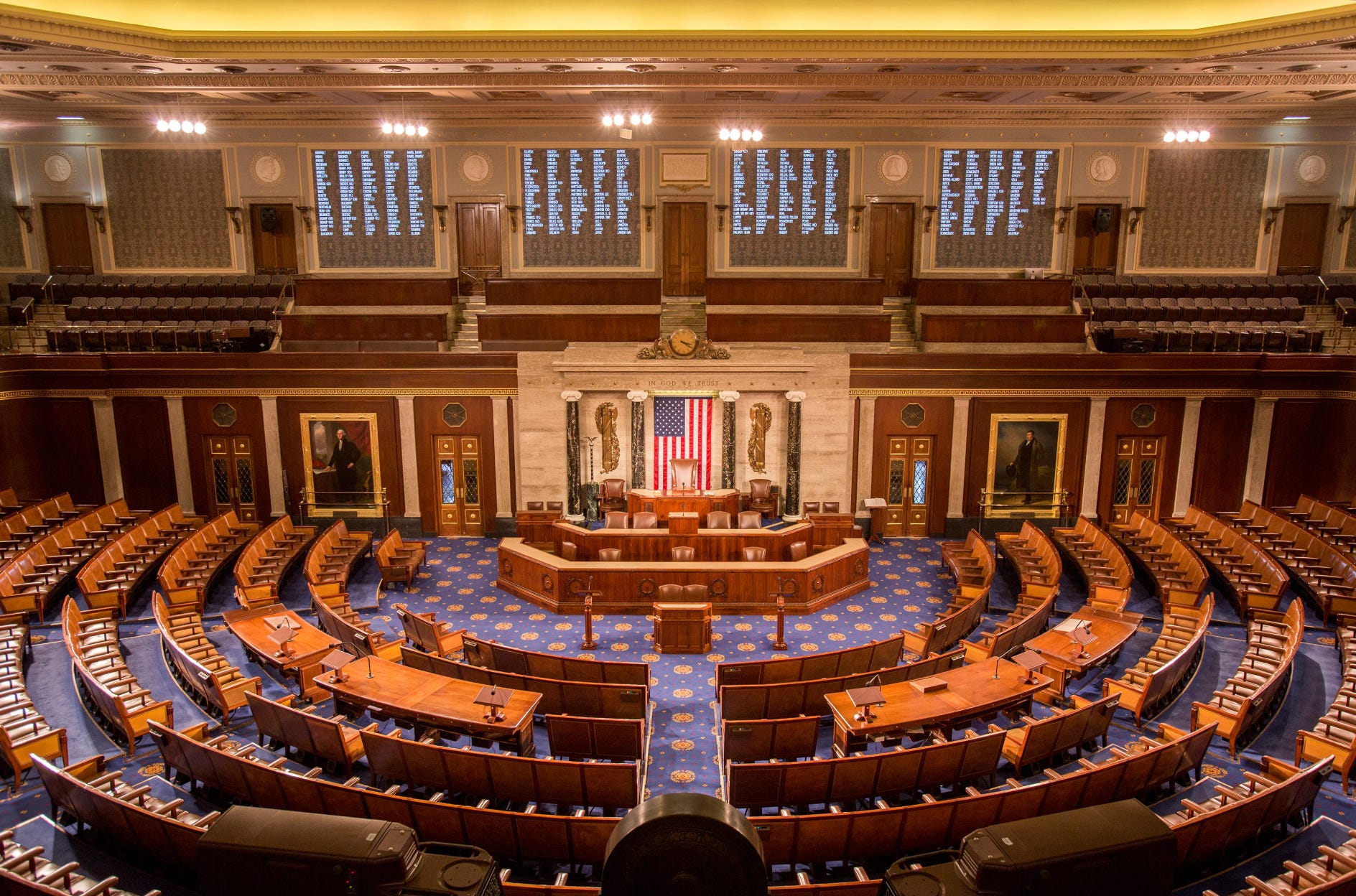
The chamber of the U.S. House of Representatives. Photo courtesy of the Office of the Historian and the Clerk of the House’s Office of Art and Archives.
In February, the Supreme Court told the president he could not impose tariffs under emergency authority. Members of Congress who had spent a year declining to vote on those tariffs were, by most accounts, relieved. The branch holding the constitutional power to lay duties had been rescued from a fight it did not want to have.
Philip Wallach thinks that pattern is the central fact of American government right now. Congress is slow, sprawling, procedural, and permanently unpopular; presidents look decisive by comparison, and courts look principled. But when Congress stops making the country’s hardest decisions, the power does not evaporate. It migrates to presidents, agencies, and courts — none of which can manufacture the kind of legitimacy a legislative bargain produces. Congress’s frustrating “manyness,” as he puts it, is the function, not the defect.
A Career Shaped by Happenstance
Benjamin Wolf: Before you became known for your work on Congress and the separation of powers, what did you imagine your career would look like?
Philip Wallach: As I was finishing my undergraduate work, I felt like I wanted to come to Washington. I was pretty unclear about the particular direction, so I looked at a range of places where I might be able to do policy research.
Through some happenstance, I got a job as a research assistant at the American Enterprise Institute. I worked for Michael Greve, who studies federalism and is a very broad and interesting thinker. I learned a great deal from him.
Research-assistant jobs at AEI tend to be positions where you come in for a little while and then move on. They’re not usually climb-the-ladder jobs. Some people go work on the Hill or for an interest group. A lot go from being an RA to graduate school.
I was debating among law school, a history PhD, and a politics PhD. I chose politics largely because I wanted to read many more books. I didn’t think I had the appetite to become an archival historian, although I’m not sure in retrospect whether I made the right choice.
People advised me that if I went to law school, I would become a lawyer, and I didn’t want to do that. In retrospect, law school keeps a lot more doors open in the public-policy world, because there are many jobs for lawyers. Being a political scientist makes you a little more of a strange bird. Government agencies generally aren’t looking to hire political scientists.
I imagined I would become a professor at a school like Wesleyan. I like teaching, and that would have been all right with me. Then I put my résumé on the American Political Science Association’s jobs board and received an email from the Brookings Institution saying it was interested in hiring people finishing their PhDs. That is very unusual. Think tanks do not usually hire newly minted PhDs.
The person who became my boss at Brookings was experimenting with doing that, and I was one of the beneficiaries. I also had reservations about academia because I felt somewhat politically out of place. I wasn’t a super-conservative person; I probably thought of myself as a moderate libertarian. But I thought it might cause me some problems.
I was drawn back to Washington. Brookings made me a good offer, and I have been in think-tank land ever since. That was in 2012.
It was all a little happenstance. I suppose that happens to many people who do not have a perfectly clear vision of what they want to do professionally. I have written very few peer-reviewed academic journal articles, and I mostly don’t feel like I’ve been missing out. I try to answer big questions. I have been very fortunate to be in positions where I felt I could take on genuinely important questions and try to address them. That is a very good feeling to have about your work.
Trump, Party Loyalty, and Constitutional Responsibility
BW: President Trump has embraced an expansive understanding of executive authority, while many Republican members of Congress have been reluctant to challenge a president of their own party. At what point does party loyalty become a failure to uphold Congress’s constitutional role?
PW: President Trump does not really make arguments. I am almost tempted to stop the sentence there.
He tends to state his sense of things and his feelings, and he is a master at stirring up the feelings of his supporters. When people say he has made an argument for executive dominance, it is more that he assumes he won and therefore should get to do what he wants.
He brings his sensibility as a business manager to the federal government. He was in charge of the Trump Organization, and now he sees himself as in charge of the United States. It is obnoxious to him that all these constraints prevent him from operating as the boss of the country, because he believes he could accomplish much more without those obstacles.
He tends to view every obstacle to his progress as a nuisance. He does not have much appreciation for the worth of constitutional government in its own right.
That is the kind of chief executive the American people have elected twice. Ambitious executives willing to push the boundaries of presidential power are nothing new in American history. In some ways, the constitutional logic pushes presidents in that direction. But Trump — and especially the second Trump administration — has been willing to set aside norms of mutual respect between the legislature and the executive more aggressively than any previous president.
Trump has also been quite successful in driving out people he considers insufficiently loyal. He has reshaped the Republican Party so that personal loyalty to him is probably the first qualification for being a Republican today.
That is very different from 2017, when the party felt more like a tense coalition between its old establishment and the new Trumpist elements. Reince Priebus began the first administration as chief of staff. He was an orthodox Republican Party functionary. Paul Ryan was speaker of the House. The party of 2025 and 2026 feels quite different.
Does loyalty to Trump mean members are failing in their constitutional responsibilities? There is a very serious tension.
In their defense, I think many people on the Hill conceive of their careers as lasting much longer than Trump’s presidency. They believe the best way to serve the constitutional order in the long run is to ride out this moment rather than sacrifice their careers and be replaced by people who are even more personally loyal to Trump, or more committed to an oppositional MAGA movement that wants to discard everything that came before it.
They think the most useful thing they can do is keep their jobs and help steer what comes next. I have a fair amount of respect for that position.
I also respect someone like Liz Cheney. But there is no question that she blew up her career. She is no longer a figure with influence inside the Republican Party.
We live in an extremely partisan age. I wish we lived in a less partisan one. I am not much of a partisan myself, so I tend to admire politicians who create room for independence. But there is a tradeoff between styling yourself as above partisan dynamics and remaining directly influential within the party organizations that shape American politics. Every politician has to work that out.
The people who win elected office have already aligned themselves with one party or the other. Politically ambitious people tend to give party loyalty a significant place because they do not see another practical way to make a difference.
The Tariff Decision and Government by Impulse
BW: On February 20, in Learning Resources, Inc. v. Trump, consolidated with Trump v. V.O.S. Selections, the Supreme Court held 6–3 that the International Emergency Economic Powers Act did not authorize the president to impose tariffs. Did the Court reach the right result? And does a decision like that restore congressional authority, or merely rescue Congress from a confrontation it was unwilling to have itself?
PW: There were many members of Congress who were very glad about the Court’s decision. It relieved them, to some extent, of having to take responsibility for deciding those questions themselves.
I was a big fan of the decision. I am also a big fan of what is called the major questions doctrine, which the Court has been developing over the last decade.
It is essentially a judicial attempt to articulate the principle that Congress has to be the branch making the really big decisions. We cannot sidle our way into enormously consequential policies through executive-branch lawyers making strained arguments about what old laws allow the president to do.
That does not mean the executive branch can never make a major decision. But if it is going to do so, it needs a strong congressional delegation clearly establishing that the executive is supposed to make that decision. The executive cannot simply arrogate the authority to itself.
Editor’s note: The major questions rationale did not command a majority. Chief Justice Roberts, joined by Justices Gorsuch and Barrett, concluded that the tariffs implicated the doctrine and therefore required clear congressional authorization. Justices Kagan, Sotomayor, and Jackson reached the same result on the narrower ground that IEEPA’s text does not confer tariff authority at all. Justices Thomas, Alito, and Kavanaugh dissented.
I think the Court got the tariff case right. If it had allowed the IEEPA tariffs to stand in the form Trump created, it would have permitted public policy by executive impulse.
There were no meaningful standards. It was clear that Trump liked that tariff regime precisely because it gave him complete flexibility.
When the executive branch takes it upon itself to fashion an entire legal regime without real constraints, government tends toward arbitrariness.
The Court made a similar point in West Virginia v. EPA when it rejected the carbon-emissions framework the Obama administration constructed under an older provision of the Clean Air Act. The Court did not want the executive branch creating a major regulatory system largely from whole cloth.
Leaving that door open invites abuse and lacks legitimacy in a basic sense. We should want the country’s biggest decisions made in a way that broad legislative majorities are willing to support.
That is the formula for doing politics in a way people can accept, rather than doing politics in a way that sets everyone’s hair on fire and puts the country into an almost apocalyptic frame of mind every four years.
Editor’s note: The ruling ended IEEPA as a tariff authority but not the tariffs themselves. The administration has since shifted to other statutory tools, including a ten percent across-the-board duty under Section 122 of the Trade Act of 1974 and new investigations under Section 301. Questions about refunds of previously collected IEEPA duties remain unresolved in the lower courts.
The Financial Crisis: Law, Speed, and Legitimacy
BW: That tension — between acting quickly and acting legitimately — is the subject of your first book, To the Edge, on the government’s response to the 2008 financial crisis. Why did that crisis capture your attention, and what most surprised you during the research?
PW: The financial crisis was an education for me that ran parallel to my formal graduate education.
I arrived at Princeton for graduate school in 2007, and I was interested in banking regulation before the crisis happened. I had started learning about it, and then — voilà — banking regulation became one of the most interesting things in the world to study. All these brilliant people were trying to figure out exactly what had gone wrong and how we could fix it. It was extraordinarily fruitful to follow that conversation in real time.
I am not a trained economist, so I did not feel I had much to add on that front. But I was thinking about the political and legal sides of the response. It began as a side project in graduate school. I wrote a paper trying to tackle questions of legality and legitimacy that I felt other people were not examining as closely.
A great deal of what happened in the fall of 2008 and the years afterward was legally dubious. It was also an education for me that so few people seemed focused on those legal problems.
The thing that caused perhaps the greatest public backlash was the payment of bonuses to bankers. Those payments were largely made in fulfillment of contractual obligations that had not been voided. In that sense, they were legally regular. But that did not matter to people.
People do not always care about what the law says. They think separately about what justice demands.
That was the puzzle that drew me into the project, and the literature that developed did not really fill the gap I was trying to address. It therefore became a natural book project when I arrived at Brookings, which was a good place from which to do it. People who had been directly involved in the crisis were willing to speak with me and help educate me about what had happened from their perspective.
The book might have received more attention if I had managed to write it faster. It was published in 2015, seven years after the first and most intense stage of the crisis, when American politics was already turning toward new chapters. But I still think it is a good book.
Why Congress Matters
BW: In Why Congress, you argue that Congress matters not simply because it passes laws, but because it forces different parts of the country to negotiate with one another. How did the research change your understanding of the institution?
PW: I am not a lifelong congressional scholar.
There are many great scholars who fit that description — people naturally drawn to Congress who want to know everything about its history, members, and parliamentary procedures. I learn a great deal from them. I see myself more as a student of American policymaking in general, especially how the constitutional separation of powers works in practice.
I was drawn to specialize in Congress because, when we think about our government’s legitimacy problems today, many of them seem to go back to Congress not functioning very well. So many of the country’s major problems are addressed through executive action instead of bipartisan compromises fashioned by Congress.
Immigration is a paradigmatic example. We seem to have largely given up on congressional action resolving our difficult immigration problems. Instead, we improvise executive-branch approaches. But by the nature of our constitutional system, those actions cannot be as enduring or legitimate. We end up with policy whiplash as control of the White House passes from one party to the other. We spend years fighting in the courts.
When I look at American policymaking in the 21st century, that is the picture I see. Figuring out how to make Congress function better seems like the way to make the entire system more functional.
That has led me to spend a lot of time studying congressional history, which has been very rewarding. There is a congressional angle to almost every important subject in American history. Engaging with the lives of legislators is a good way to enter that history.
The conventional way for an educated person to understand American history is often through presidential biographies. There is nothing wrong with that. I do it myself. It is tidier. There have only been so many presidents, and you can hope to get your arms around them and tell a story.
Congress is so big and sprawling that, in a sense, nobody can ever know it. Nobody can ever know its history in the same way. That can be frustrating if you want a clear narrative, but it gives you a feel for the complexity of American life that presidential stories do not always provide.
It also helps you resist reading history as a morality play.
Take the conventional story of the civil rights movement: Lyndon Johnson’s moral sense and force of personality produced landmark civil rights legislation. That is reductive. Once you examine how those laws actually moved through Congress, you encounter a more complicated story.
You learn about the patience of Senator Mike Mansfield, the Senate majority leader after Johnson left the Senate and during the period when the major civil rights laws passed. You learn about his ability to work with Southern segregationists, give them an opportunity to slow the bills down, and treat that process as part of cementing the legislation’s legitimacy once it passed.
I have become an appreciator of Congress and of the way legislative relationships provide a different understanding of how America has worked for nearly two and a half centuries.
That is immensely important. Legislatures around the world are challenged at the moment. My current research is turning beyond the United States toward France, Britain, Germany, and Italy. I am trying to understand the challenges facing legislatures more broadly.
It has made me appreciate the complexity of political problems in ways that fixating only on the top leaders can cause people to miss.
Don’t Go Straight to Graduate School
BW: You have moved across academia and think tanks, and you also spent time working with the House Select Committee on the Modernization of Congress. For people considering similar careers, what are the tradeoffs?
PW: I would not really say I was a congressional staffer.
While I was at the R Street Institute, I became a fellow with the House Select Committee on the Modernization of Congress. I was there for about five months, and I describe it as a very long field trip. I went to Capitol Hill every day, but I was not central to the decision-making process. It was not the most successful experience for me, although I learned a lot. Plenty of congressional staffers probably have a similar experience.
More broadly, I generally counsel young people against going directly into graduate school after college. People know how to be students, so continuing to be a student feels safe. But they should give themselves the chance to go into the broader world, hold down an adult job, and see something else. They may discover that they are good at something different, or more attracted to work outside school.
The opportunity cost of getting a PhD is quite high. It sounds appealing: you get to continue going to school, and they pay you rather than your having to spend enormous amounts of money. There are certainly good things about it. But spending five or six more years as a student rather than doing other things in the world carries a real cost.
The best reason to earn a PhD is that you genuinely want to become a professor. That is the paradigmatic case.
I also tell young people that working on Capitol Hill can be an excellent thing to do after college. Congress has plenty of problems, but it tends to give young people opportunities — especially those who are ambitious and willing to socialize and network without always knowing what the immediate payoff will be.
People make connections on the Hill that can serve them for years, even if they do not stay there very long. You can receive substantial responsibility and meet many other ambitious young people.
The jobs can be irregular. Congress does not offer the clean career progression that appeals to people who want to fill out forms X, Y, and Z, present their credentials, and know exactly what comes next.
But I see ambitious young people receive opportunities and advance quickly when they show themselves to be willing and able. It is a good place for people who can simply decide that they are going to become experts.
People who are willing to raise their hands and say, “How about me?” can do very well on Capitol Hill.
Build Hard Skills — But Think for Yourself
BW: For a young person who wants to build a career studying or improving public institutions, what should they prioritize early? What do you wish you had understood before beginning your own career?
PW: Young people with access to a broad range of university offerings have an opportunity to build hard skills that become more difficult to acquire later in life.
Languages are one. Coding would traditionally have been another, although the new era of AI-assisted coding may make that seem somewhat less urgent. A real understanding of statistics is enormously valuable.
Many people can master those things during their undergraduate education and use them for the rest of their lives. It is a very good sign when students invest in hard skills. I wish I had done more of that myself.
For what it is worth, I wish I had taken statistics in high school. I learned mathematics in high school better than I ever learned it later because I did homework every day. I was pretty good at calculus, and I wish I had received the same kind of grounding in statistics.
But learning to think for yourself and write for yourself is also extraordinarily valuable. That is something I did get from college.
I worry that many young people are depriving themselves of that development by leaning so heavily on artificial intelligence. They should learn to write in their own voices, take a position, think their own thoughts, and articulate them in a way they are willing to stand behind.
There is no substitute for that.
Do not let the computer steal it from you.
BW: Philip, thank you for the time.
PW: Thanks, Ben.
About the guest: Philip A. Wallach is a senior fellow at the American Enterprise Institute, where he studies the separation of powers, Congress, regulatory policy, and the administrative state. He is the author of Why Congress (2023) and To the Edge: Legality, Legitimacy, and the Responses to the 2008 Financial Crisis (2015). He previously held senior research roles at the Brookings Institution and the R Street Institute and served as a fellow with the House Select Committee on the Modernization of Congress. He earned his bachelor’s degree from Wesleyan University and his master’s and doctorate in politics from Princeton University.
About The Pathway Review: The Pathway Review is an independent interview publication about public life and the people who help shape it.
Next in The Pathway Review: Luke Nichter, presidential historian at Chapman University and author of The Year That Broke Politics, on the 1968 election, the Nixon tapes, and what the archives reveal that memoirs conceal.