


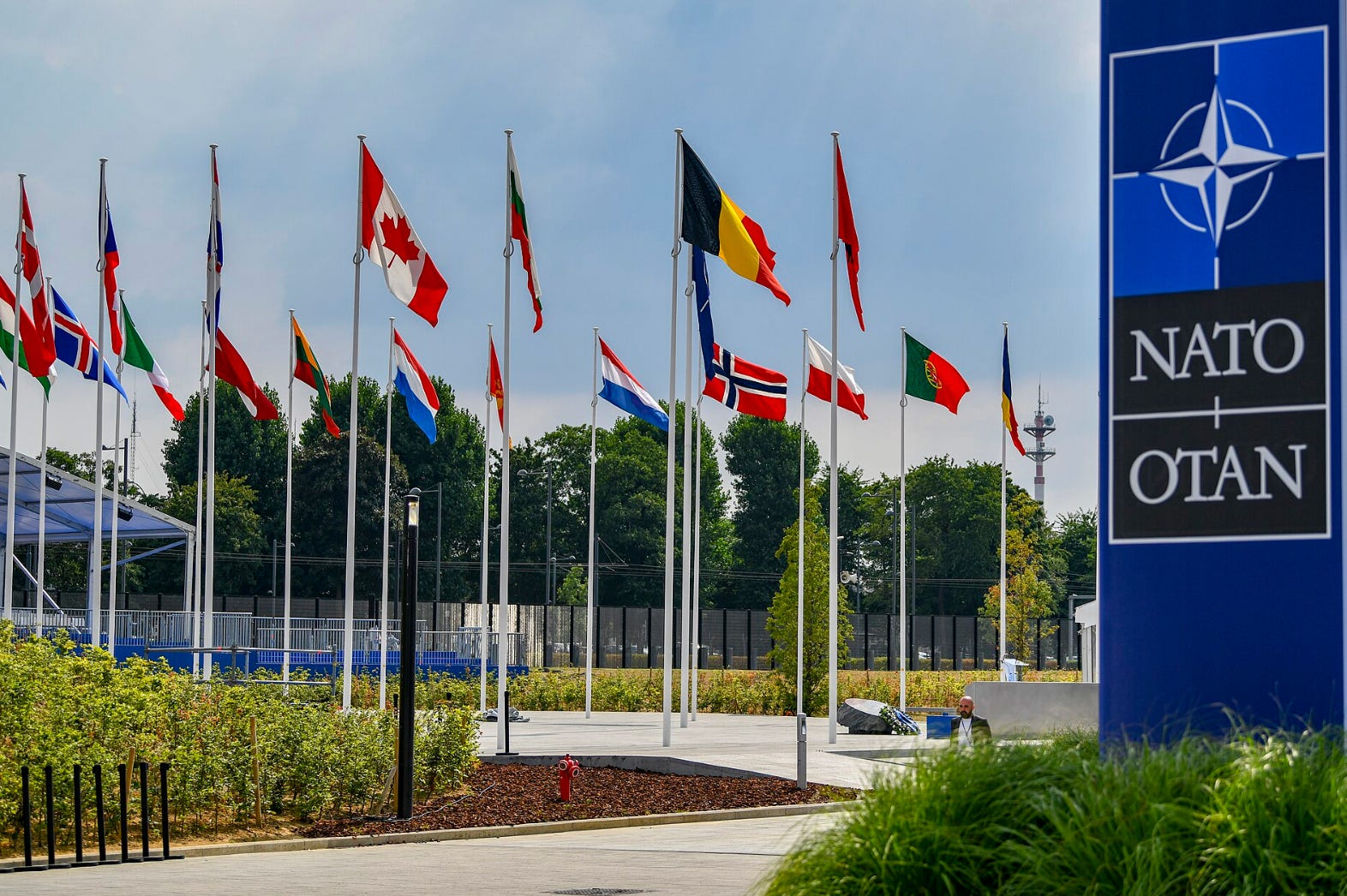
NATO headquarters in Brussels during the 2018 NATO Summit. Photo by the U.S. Department of State, public domain.
Paul Poast came to international security through gas prices.
As a child in southwest Ohio, he watched people assume his father, who owned a gas station, must be making a fortune as prices climbed during the summer of 1990. What they missed was the constraint underneath the price: Iraq’s mobilization against Kuwait, the looming Gulf War, and the way a security crisis thousands of miles away could reach a small town through the global oil market.
That connection became the architecture of Poast’s work. At the University of Chicago, he studies international relations with a political economist’s eye for tradeoffs: what states want, what they can afford, what they can credibly promise, and what they can actually sustain. In his public writing, he brings that framework to alliances, NATO, Ukraine, war financing, industrial capacity, and the institutions built after catastrophe.
This conversation is about how security really works when rhetoric meets scarcity. It is also about academic craft: how to move between scholarship and public argument, why teaching sharpens research, and how students can avoid becoming trapped inside a single intellectual monoculture.
This interview has been edited for clarity and length.
From the Archive · originally published in The Pathway Blog, January 2026.
How Economics and Security Collide
Benjamin Wolf: For readers who may not be familiar with your career, what has been the through-line, and what is the question you have consistently been trying to answer throughout your work?
Paul Poast: Great question. What has been driving me throughout my career? One way to answer that is to share how I got interested in studying this subject matter.
In many ways, it goes back to when I was very young — elementary school, junior high, somewhere in there. I can’t remember exactly where I was on my school path, but I remember one summer when my older brother and I were getting a hard time in our small town in southwest Ohio. People were joking that our dad was “rolling in the money now,” making all sorts of money.
And we were like, why would they say that? My dad owned a gas station. The reason people were making that comment was because the price of gasoline kept going up and up and up that summer. Of course, my dad was not rolling in money. He had to pay more to get the gasoline he was pumping out. But the point is that people saw the prices and made assumptions.
That was the summer of 1990. Iraq was mobilizing against Kuwait and then, on August 2, launched its invasion. That set the path for the first Persian Gulf War.
So for me, as a very young person, it was fascinating to see a security event on the other side of the world have a direct impact on small-town Ohio through gasoline prices. I became very interested in that process: how interconnected we are, and specifically the economic angle to security affairs.
That has been a key theme in my work. As an undergrad, I studied political science and economics. Then I got a master’s degree focused on international political economy. A lot of my research is in what I call the political economy of security, the intersection of economics and security. You can draw that through-line back to that formative experience.
Mentors, Institutions, and the Senior Thesis
BW: You have trained in a variety of academic environments. What parts of your development came from people — mentors, peers — what came from institutions, and what was your own self-discipline and ambition?
PP: It is all of those things mixed together, and it is hard to disentangle people from institutions because the people are there because of the institutions.
As an undergraduate, I had great professors and got my first real experience doing research. I went to Miami University in Oxford, Ohio, and I participated in the honors economics program my senior year. I wrote a senior thesis on the influence of economic sanctions, again, right at the intersection of economics and security. That was my first real foray into research, and it set me up to pursue a master’s degree at the LSE.
At the LSE, it was an intensive immersion into thinking deeply about a topic. That is what set me on the path of realizing I wanted to earn a PhD and become a scholar.
Then once I entered the PhD program at the University of Michigan, I viewed myself as a product of that program as much as I was a product of my dissertation committee. I had a great committee, but there were many people not on my committee who supported my intellectual development.
So the common theme is: yes, there were absolutely people I can point to, but those people were within an academic setting, supported by the structure of it.
I tell undergrads all the time: if you can write a senior thesis, it is a great capstone experience. It pulls together what you have learned and gives you the chance to do deep thinking about a topic. That is an institutional feature, but it is positive because of the people guiding you. Same with my PhD program. I had a very positive experience, and a big part of that was the faculty support.
The Dream Job
BW: Looking back now, are there experiences or choices you wish you had changed or done differently?
PP: I don’t think there is anything I would have done differently as an academic.
Sure, you can always think: I could have worked on this research project or that one, focused on this instead of that. There are alternative paths. I don’t know if I would have been better off or worse off.
Because the reality is that being a tenured professor at the University of Chicago is my dream job. If you asked me when I started where I would want to be, it would be doing exactly what I am doing right now. Given that, it is hard to say I should have gone another path.
Study Abroad and International Experience
BW: What about, for example, the experience of studying abroad in undergrad? Especially in a field like international relations, how much value do you place on it?
PP: Study abroad is a great experience. It is interesting you mention it. Part of the reason I went to the London School of Economics was because I didn’t do a study abroad. It was like, here is my chance to not just study abroad, but get a degree from a university outside the United States.
And it was the LSE — technically the London School of Economics and Political Science — so as a political science and economics double major, it felt like bringing those two things together.
For me, I didn’t do study abroad as an undergrad because I was a collegiate athlete. That is an all-year commitment, including summers, so you don’t really have the opportunity.
Miami University also has a campus in Luxembourg and makes a big deal about it, so it was definitely an opportunity for students. It just wasn’t one I could take advantage of. But I was fortunate to have what I would call an even enhanced experience by pursuing my master’s degree at the LSE.
Since then, I have advised students: study abroad is great, but if you are thinking about a master’s, consider applying to programs outside the U.S. There are great programs in the U.K., and many elsewhere.
“Professor Poast” vs. “Pundit Paul”
BW: You move between academic research and public-facing writing. How do you decide when a question deserves a journal article versus a piece for a broader audience? And what do you refuse to simplify even when editors want you to?
PP: I joke that there is Professor Poast and there is “Pundit Paul.” Sometimes the two get into arguments, and they don’t always agree.
Your question gets at: when do I put on the professor hat, and when do I put on the pundit hat?
There are times they are fully aligned, where I am making a public argument that draws directly on scholarship. If I am talking about commitment problems or international organizations, I can explain why an administration might find certain organizations unattractive and choose to exit them. Or NATO — Article 5 and what it means — those are squarely in my research, and I can bring them into a public explanation.
But there are other times where “Pundit Paul” and “Professor Poast” don’t correspond. A good example: as a professor, I wouldn’t say, “Ukraine must be part of NATO.” That is a public-policy statement. I may have an opinion, and I wrote a column arguing it is time for Ukraine to join NATO.
That is “Pundit Paul.” “Professor Poast” would come in and tell you: that is not going to happen. Then I would step back and say: what does it take to join NATO? What are member states’ interests? What are the commitment problems? What is the history? It is not happening, at least not in the way people imagine.
So sometimes “Pundit Paul” is making the argument I would like to see, while “Professor Poast” is explaining what is likely given the incentives and constraints.
How Alliances Stay Credible
BW: Without turning this into punditry, what does your framework imply are the most important stress tests for an alliance system — signals that it is adapting well versus drifting into ritual commitments?
PP: This has been on a lot of people’s minds: concerns about NATO cohesion, concerns that the U.S. might not want to be part of NATO, frictions created by the war in Ukraine, Hungary, Turkey, and so forth.
The first thing I tell people is that NATO is a data point, not a comparison point. NATO is extremely unusual in the history of alliances. Most alliances don’t last nearly as long. Most aren’t nearly as institutionalized. Most alliances don’t have a building in Brussels as headquarters. Most don’t have a mutual-defense provision like Article 5.
And even then, the strength of Article 5 is weaker than people assume. Most alliances are written on paper, commitments to protect or work together, so the question becomes: what ensures follow-through?
The key thing is that it is not really about what is on paper. A lot of times, treaties are intentionally written with flexibility in interpretation.
That is why a comment President Trump made in a New York Times interview the other day stuck with me. When asked whether he would adhere to international law, he replied, “Well, it depends on your definition of international law.” And honestly, that is exactly right in the sense that so much of what we call international law is written with enough ambiguity to permit wide discretion.
What makes alliances credible is action beyond the treaty, often enabled by the treaty but not contained in it. Forward-deployed troops matter. The best way to show I will protect you is to have forces ready to protect you. There is no better way to show the U.S. cares than an aircraft carrier showing up. Troops on the ground matter.
That is why debates about security guarantees for Ukraine often turn to: should there be NATO troops on the ground? From Ukraine’s standpoint, without troops, it can feel like a promise Russia won’t believe. With troops, it is a more credible commitment, what we would call a costly signal of commitment.
So for me, an alliance is credible because of actions, not just the text of a treaty.
BW: I think David Sanger may have asked that international law question in the New York Times interview. He is someone I have had on the Pathway Blog recently, so it was cool to see him pressing on such an interesting and relevant topic.
PP: Oh yeah. That interview is a treasure trove. I could write my next six columns just on different aspects of it.
When Resources Are Real Constraints
BW: Last policy-focused question before we move to advice for students. You work on the political economy of security. Where do resource constraints — budgets, industrial capacity, war financing — change strategic outcomes, and where are they mostly rhetorical? Any historical examples?
PP: I like how you phrase that: real constraints versus rhetorical constraints. A historical example I have been researching recently is U.S. entry into World War II.
The resource constraint was huge. At the end of the day, FDR and Churchill were aligned that Germany had to be stopped. But they were also like: we can’t get into a war with Japan because we don’t have the naval capacity. We can’t fight two wars at once. In 1941, that was a real constraint. By 1943 or 1944, U.S. production had shifted and the U.S. could prosecute a two-front war. But in 1941, buying time with Japan mattered.
That is part of why I don’t buy the argument that Pearl Harbor was a “back door” plan to enter the war. If you look at it, they were trying to stall war with Japan because it would suck up resources needed for the Atlantic.
More recently: the war in Ukraine. When the war in Ukraine and the war in Gaza were both at peak intensity, the U.S. was trying to support both Ukraine and Israel. At one point there were cases of diverting munitions that would have gone to Ukraine to Israel because stockpiles weren’t sufficient to supply both at the same rate. That is a real constraint, and it creates real tradeoffs and controversy over who needs what more.
But then you have moments where the constraint is less clear. For example, when the Trump administration temporarily paused shipments of arms to Ukraine, the justification involved concern about low stockpiles for U.S. defense. My view is that there was some truth to it, but by and large that was more rhetorical, a justification used to support a policy pause. And as we know, that decision was reversed within about a week.
Teaching and Research Feed Each Other
BW: How has teaching shaped your research and thinking? And more broadly, what do you try to teach students that you wish someone had taught you earlier?
PP: I view teaching and research as going hand in hand. Sometimes that is direct. I run a program here at the University of Chicago that creates opportunities for undergraduates to get involved in faculty research, learning methods and participating in research.
Faculty should also bring research into the classroom and use classroom discussions to shape research. If you are having good discussions, interesting questions come up. And frankly, one of the key things about research is not just the finding, but how the finding is framed. Is someone going to read your paper? They will if they think it is a compelling thing to study.
One of the best ways to test whether something is compelling is to run the idea by undergrads. Explaining ideas also helps you learn how to frame them for people who want to be informed but aren’t yet steeped in the field.
Teaching also trains you for public speaking. A lot of being a successful academic is being able to give a research talk. Teaching helps you get used to communicating clearly.
A great example is John Mearsheimer, my senior colleague. He is a beloved teacher, he is a renowned scholar, and he does a lot of public engagement. He is the same in all environments: classroom, public speaking, research presentations. They feed into each other.
For what I try to teach students that I wish someone had taught me earlier, it depends on the class. But for undergrads, one of my key courses is Intro to International Relations. I approach it from an intellectual history standpoint.
There is one way to teach intro IR where you say: here are today’s big questions. That is great. What I try to do is help students understand: why is there even an academic discipline called international relations?
The modern discipline is a product of World War I. That is when funding emerges: philanthropists donating to found places like the Council on Foreign Relations in New York, Chatham House in London, the School of Foreign Service at Georgetown in 1919, the Department of International Relations at Aberystwyth in 1919, the Chicago Council on Foreign Relations in 1921.
You see this cluster in 1919 through the early 1920s because people looked at World War I and said: what just happened, and how do we prevent it from happening again? Could the League of Nations solve it?
They didn’t solve it. We got World War II. Nuclear weapons then heighten the stakes. So the discipline grows out of the problem of war.
Students respond to that because they realize immediately: we haven’t answered these questions. The first question was: why do we have war? And we still haven’t fully figured it out, so we still need the discipline.
Read Broadly, Avoid Monocultures
BW: As we close, if a student wants to do serious security research but doesn’t know where to start, what should their first-year habits be? What should they write, read, practice, who should they speak to, and what should they avoid?
PP: I am around students like that a lot. Each summer I teach a program where high school students come to the University of Chicago for a three-week class in international politics. And, of course, I teach undergrads.
There are great resources students should read: Foreign Affairs, Foreign Policy, World Politics Review, where I write a weekly column, and War on the Rocks. Those are terrific for international relations and security issues.
As for what to avoid: I am not big on saying “avoid this.” Maybe that is very Chicago of me. The essence is: let’s stop and think about that, rather than shutting something down.
But I do recommend not being reliant on one source. Don’t be the person who only reads CNN or only watches Fox. That is not going to get you anywhere. Get a variety of sources and angles. Avoid becoming someone who only listens to one person to formulate your views.
Why The Prize Still Matters
BW: Final question: what book has influenced you the most, or what should a student read if they want a career path similar to yours?
PP: I am not going to recommend my own, even though I am very happy with my books, including my newest book, Wheat at War, which I co-authored with Rosella Cappella Zielinski. You can see the political economy angle in it.
But one book that influenced my thinking — and it makes sense given my origin story — is The Prize by Daniel Yergin. The prize is oil. It is the history of oil influencing the global economy and the global security environment from the late 19th century through the 20th century.
That book gave me the macro view: a security event affects oil markets, which affects small-town Ohio. The Prize helped me understand those processes and made me want to study them more. It is a book I recommend to students all the time.
BW: Professor Poast, it has been a real honor.
About the guest: Paul Poast is an associate professor in the Department of Political Science and Committee on International Relations at the University of Chicago, where he also serves as Deputy Dean of Doctoral Education for the Social Science Division. He is a senior nonresident fellow at the Chicago Council on Global Affairs and a foreign affairs columnist for World Politics Review. He is the author or co-author of several books, including Arguing About Alliances and Wheat at War: Allied Economic Cooperation in the Great War.
About The Pathway Review: The Pathway Review publishes long-form interviews with people in politics, policy, journalism, law, diplomacy, markets, and public service about the work they do and the path that brought them there.
Subscribe to receive new interviews in your inbox.
This interview was conducted in January 2026 and has been edited for length and clarity.