

Mara Karlin on War’s Long Shadow, the Cost of Deterrence, and How Young People Can Learn to Decide
Former Assistant Secretary of Defense for Strategy, Plans, and Capabilities Mara Karlin has served in national security roles across six secretaries of defense.

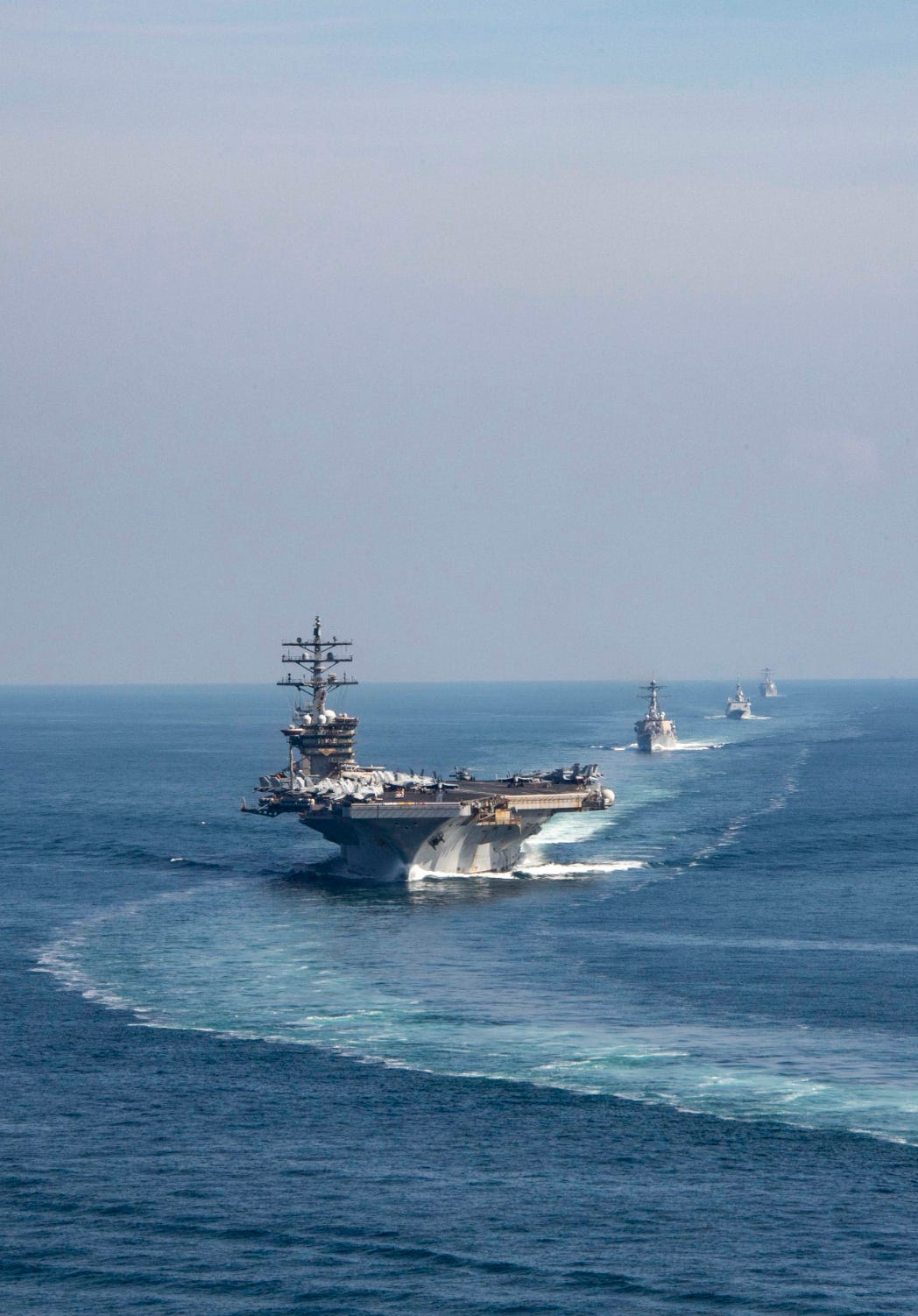
The Dwight D. Eisenhower Carrier Strike Group transits the Strait of Hormuz in 2023. Photo by Mass Communication Specialist 2nd Class Merissa Daley, U.S. Navy.
Mara Karlin’s career began with a question that many people ask casually and few pursue seriously: why is the world the way it is?
At Tulane, she was a political science student supposedly headed for law school. Then she studied abroad in the Middle East at the end of the 1990s, watched a hopeful vision for the region collapse, and came back wanting to understand what had happened. The answer, she came to believe, had something to do with security: who had it, who lacked it, and what followed when political futures unraveled.
That question took her to Washington and then deep inside the Pentagon. Karlin served in the Department of Defense across administrations, both as a career civil servant and as a political appointee. She worked for six secretaries of defense and helped shape how the United States thinks about strategy, deterrence, force posture, and the military’s inheritance after twenty years of war.
This conversation is about what national security work actually asks of the people who do it. It is about the gap between operational excellence and strategic frustration, the quiet costs of deterrence, the moral weight of choosing among bad options, and the discipline required to turn complexity into something decision-makers can use.
For students entering a world mid–paradigm shift, Karlin’s advice is direct: build depth and breadth, learn to synthesize, communicate clearly, and get comfortable making decisions when none of the options are clean.
This interview has been edited for clarity and length.
From the Archive · originally published in The Pathway Blog, February 2026.
The Through Line
Benjamin Wolf: Could you start us off with the through line of your career? Has there been a consistent question you’ve tried to answer, and what led you to it?
Mara Karlin: It’s a real treat to be here, Ben. Thanks for having me.
I guess the through line has always been curiosity: figuring out why things are as they are.
I showed up at Tulane as a political science major, and political science majors are kind of told we should go to law school. So that was the plan, obviously. And then I studied abroad. I did two incredible programs. I was on Semester at Sea and then in Jerusalem. And while I was there in ’99 and 2000, there was this vision a lot of folks had building of what the Middle East was going to look like: prosperous, peaceful.
Then I came back to school for senior year, and that all melted. And I wanted to understand why and what had occurred. Trying to understand those questions is what took me into a career focused more on security issues, because it seemed to me that a lack of security, by a variety of parties, is what propelled the region into further and further violence.
So: trying to understand why things are the way they are, and then how to reshape them.
Washington, Defense, and the Pentagon
BW: What was the first step after college? What took you from that question into a career?
MK: After convincing my parents I wasn’t going right to law school — and spoiler alert, I never made it — it was trying to understand the different visions folks across the Middle East had of what the region could be, and the role of U.S. policy.
The United States is a really big actor politically, economically, and above all on security issues in shaping that region, sometimes in good ways and sometimes in less good ways. So I came to Washington, D.C., the hub of U.S. policymaking, to try to understand that.
Not long after getting here, I realized defense issues were where I wanted to focus. While I was in grad school at Johns Hopkins, I started interning in the Office of the Secretary of Defense. People picture a handful of folks outside the secretary’s office. That’s not accurate. It’s thousands and thousands of people.
I was responsible for shaping policy ideas the United States would take toward the Levant — Syria, Lebanon, Jordan, Israel — and issues involving the Palestinians. I just thought it was the neatest thing. The U.S. comes with a lot of resources and energy, and I was intrigued to figure out how to more positively influence all that.
So when I finished grad school, I went to the Pentagon full-time. I have since been in and out of there, working for six secretaries of defense across Republican and Democratic administrations. And I also learned there is a world beyond the Middle East and ended up covering a wide variety of topics.
Working Across Administrations
BW: You’ve worked across different administrations and political parties. How did that affect your work?
MK: There are two ways civilians serve in the Pentagon. One is as a career civil servant: you’re there no matter who is in office. The other is as a political appointee: you’re appointed by the president, and you’re there until the president is done with you or finishes the term.
I’ve served in both roles. I was a career civil servant in the Bush administration, and then a political appointee in the Obama and Biden administrations.
Frankly, the execution of the roles is more similar than not. It’s helping formulate a vision of the U.S. approach to the world and to defense and security issues, and trying to realize that vision in line with what leadership is trying to achieve: the secretary of defense, the commander in chief, the president.
What Two Decades of War Left Behind
BW: You’ve written about what America’s military inherits after two decades of war. What do civilians most consistently misunderstand about how Iraq and Afghanistan changed U.S. institutions? What habits stuck, and what capabilities quietly went away?
MK: My second book looks at what the military inherited from being at war for the longest time in American history: twenty years. That’s astonishingly long. It’s probably around the age of many of your listeners.
What I find so interesting talking to your generation is that, for you, this is ambient noise. You’re used to an America always at war, which is not the case at all for folks like me who grew up in the ’90s, or the generation before me.
One thing that has come out of these wars is a real gap between the American public and the military. The military slogged through these conflicts for twenty years, and most of the public didn’t pay much attention. It didn’t need to. Nothing was really asked of the public, and only one-half of one percent of the public serves in the military anyway.
It’s easy to grow up not thinking much about these issues, even though they profoundly affect those who serve and America’s role in the world.
I also talk about how the character of these conflicts was fundamentally inconclusive at best. That’s often how it works when you’re fighting insurgents or terrorists, especially absent an existential threat, which characterized most of this period. That was hard for a lot of the military: What am I achieving? What am I doing?
What was unique about the post-9/11 wars is that you saw people deployed to the same places over and over, across the twenty-year stretch. They could see the effects they were having, and often the effects they were not having.
Operationally, the U.S. military is hands down the best military in the history of humanity. Period. Most capable. And yet at the strategic level, it hasn’t been successful at some major things it tried to accomplish. Wrestling with that is something the military needs to do, and the American public should as well.
The Secret Sauce Behind U.S. Military Capability
BW: People often can agree that the U.S. military is among the most capable in the world. This may seem naïve to ask, but what exactly has allowed it to be that way? Is it merely spending and strategy, or is there something more to it?
MK: Superb question.
The U.S. defense budget is around a trillion or so dollars. But I don’t think it’s the exact number that is determinative of operational success. How you spend it matters a lot.
And who serves in your military — sometimes a less glamorous topic than the cool tech — is the secret sauce. The U.S. military brings together extraordinary Americans from across the entire country and operates in a system where people are empowered to figure out the best way to solve a problem, and then do so.
This is worth watching because there is a lot of attention on what the military buys, and less attention on who serves and who chooses to serve. It’s worth focusing now because we are seeing notable changes, particularly with the Trump administration pushing out senior women, senior people of color, and senior military lawyers, who help ensure the military is professional and follows the law, which is one of the most important things you can ask of your military.
BW: How do you think that affects capabilities?
MK: It affects unit cohesion. If you can’t totally trust and feel comfortable with the folks next to you in conflict, and if you can’t pull from all demographics across the country, you’re going to be less effective.
There’s a great book by a friend of mine, Kori Schake, on civil-military relations. She has a section about efforts to integrate African American men into the U.S. military. Senior military leadership pushed hard against it, even when mandated by civilian leadership. It wasn’t until the Korean War heated up that they realized: we need more capable people, and there are a whole lot of capable Americans who want to serve who weren’t given equal opportunity.
So we know there is a relationship between who serves and the efficacy of the military. And right now, that’s up in the air in a not-great way.
What Deterrence Really Requires
BW: My generation is very used to the U.S. being at war, but lately another word has been repeated constantly: deterrence. People use it almost like a mantra. In practice, what does deterrence require during peacetime? And what does it cost beyond money?
MK: Deterrence is saying to someone: don’t do this thing. Don’t do it because if you try, you won’t be successful, or if you try, we’ll respond so harshly that you’ll feel a lot of pain.
What’s interesting is that for a lot of the post-9/11 wars, deterrence wasn’t the dominant concept. Trying to deter violent non-state actors like al-Qaeda or ISIS doesn’t really work. Deterrence is more about state actors. So the concept went into a bin, and it has resurged as Russia and China and Iran and North Korea have gotten sportier.
For effective deterrence, first, you have to tailor it to who you’re trying to deter. The things that convince you not to act are different from what convinces me. You have to understand: who am I trying to shape, and how?
Second, you need a feedback loop. Have they picked up on the fact that I’m trying to deter them? Is it working?
A simple analogy: if a teacher is trying to deter cheating, they might use major punishments so you don’t want to fail the class. Or they try to make it impossible, blocking internet access during the exam. You tailor it to the person and context.
A real-world example: after Russia invaded Ukraine in February 2022, there was a massive effort across Europe involving the U.S. to deter Putin from attacking NATO territory. That included surging U.S. troops, joint exercises, harsh language, and around fifty countries sending military aid to Ukraine.
The message was: don’t cross this line. If you do, we’ll respond, and we’ll also counter you aggressively in the place you invaded.
Credibility: Capability and Will
BW: A word that goes with deterrence is credibility. How do you think about credibility? What makes adversaries believe we’ll act, and what erodes that belief?
MK: To deter effectively, you need capabilities and you need will. You can have the most extraordinary military in the world, but if you never show willingness to use it under problematic circumstances, people won’t fear it.
There were long stretches where the U.S. would park carrier strike groups in the Middle East and not really do anything. Some would say they were there to deter, but they were just sitting there. Over time, they became almost like a sunk cost.
Credibility means being clear about what you are willing to do and not willing to do, and then being willing to actually do those things. Not just make threats, but make them real. Sometimes it is in your interest to be fuzzy for this reason.
This is particularly interesting right now as we examine the Trump administration. Over the last few weeks, there were massive protests in Iran, and President Trump tweeted about “help” being on the way. The regime massacred a huge number of people. We don’t know the exact number, but rumors go as high as 20,000. And despite signaling he might use force, he hasn’t yet.
I’m not necessarily advocating that he should, but he put American credibility on the line by signaling and then not acting. That affects whether people go back into the streets, and what they believe will happen.
And what happens in one place is watched elsewhere. If you’re sitting in the Indo-Pacific, you’re watching how the U.S. responds in the Middle East and wondering what it would look like if China starts to bully others: what the U.S. might threaten and what it might actually do.
I’d add one more piece: President Trump did use the military to strike Iran over the summer, so his threats had a different level of credibility than previous presidents’ threats. That’s part of what has shaken people. There was an assumption there was real credibility, and now it’s unclear.
The U.S. has sent at least one carrier strike group to the Middle East, arriving later this week. So it’s not impossible this issue isn’t over. If it is, it will hit U.S. credibility in a problematic way.
Analysts vs. Deciders
BW: As we wrap up, what distinguishes people who move into real decision-making roles from those who remain permanent analysts? What do the deciders do differently day to day?
MK: Both groups ingest massive amounts of information, synthesize it, and pick out what’s significant.
The difference is that deciders have to accept they are choosing among bad, awful, and catastrophic options. They have to pro-con those and make a call.
In international security and foreign policy, it is rare that you get butterflies and unicorns as options. You get a rumble in your belly, and you still have to choose. You accept there will be problems with whatever you recommend, and yet you believe, with the information you have at that moment, that it is the best among those options.
Depth vs. Breadth in College
BW: Students hear “learn as much as possible” and equate that with breadth. Others worry committing to a region or issue too early will lock them in. How do you weigh studying something specific versus broad?
MK: Isaiah Berlin has this great piece about the fox and the hedgehog, and it argues both sides. There is no right answer.
The best response is “yes, and.” Get smart on something and build breadth.
Even if you never end up working on the topic you went deep on, learning a subject inside and out equips you to learn other topics. You know what questions to ask. You know what you don’t know. Find the thing you’re interested in, get really smart on it, and be comfortable looking around.
Also focus on skills: taking in a lot of information, synthesizing it, deciding what matters — not for large language models, but for you. Learn to communicate orally and in writing. You’re conveying complex topics to busy people. Taking something complicated and conveying it in three pages or three minutes is tremendously important.
The Least-Discussed Cost, and the Best Part
BW: What is the least-discussed cost of working in national security, personally or professionally? What do you wish more young people understood before jumping in?
MK: It is an all-consuming field. People ask about work-life balance, and I have no good answer, particularly in public service, because foreign affairs are unpredictable. Something is always happening somewhere, often things you didn’t predict or prepare for.
In the Pentagon, it can become all-consuming. You make plans, and something pops up and becomes your sole focus. Figuring out how to operate in that space in a healthy way is really important.
BW: And what has been your favorite part?
MK: Security issues are fundamental to every human being, whether you’re in New Orleans thinking about personal security, whether you’re a refugee returning to Syria after a decade and a half of civil war, whether you’re a foreign leader fighting an insurgency, or a state worried another state is trying to eat up your country. So much comes down to security.
What I’ve always found fascinating is how one can relate to it no matter where you’re sitting. And serving in government is an extraordinary honor. You’re responsible for protecting the lives of hundreds of millions of Americans and, hopefully, putting the world on a safer, more prosperous path.
A Book for a Paradigm Shift
BW: If there is one piece of literature you’d recommend to someone interested in a pathway similar to yours, what would it be?
MK: The title is clunky, but it is totally worthwhile: Thomas Kuhn’s The Structure of Scientific Revolutions. It’s about paradigm shifts: when we’re in one, what to do, and how to picture the future.
That’s relevant because your generation is graduating into a very different world than five or ten years ago. Post–World War II, there was a relatively stable political, security, and economic order for about eighty years. It wasn’t pristine and it wasn’t for everyone, but it was remarkably prosperous and secure. That’s not where we are now.
Things are shifting, and it will be incumbent on you to help figure out what the new paradigm looks like, and to shape it.
BW: Dr. Karlin, thank you so much for joining me. It’s been a real honor.
MK: My pleasure. Best of luck.
About the guest: Mara Karlin is a former Assistant Secretary of Defense for Strategy, Plans, and Capabilities and has served in national security roles for six U.S. secretaries of defense. She is a Professor of Practice at Johns Hopkins University’s School of Advanced International Studies, faculty co-lead for the Security, Strategy, and Statecraft focus area, and a visiting fellow at the Brookings Institution. She is the author of The Inheritance: America’s Military After Two Decades of War and Building Militaries in Fragile States: Challenges for the United States.
About The Pathway Review: The Pathway Review publishes long-form interviews with people in politics, policy, journalism, law, diplomacy, markets, and public service about the work they do and the path that brought them there.
Subscribe to receive new interviews in your inbox.
This interview was conducted in February 2026 and has been edited for length and clarity.