

Lindsay Chervinsky on Washington, Adams, and Inventing the Presidency
Executive Director of the George Washington Presidential Library Lindsay Chervinsky studies the presidency, political culture, and the institutions of American government.

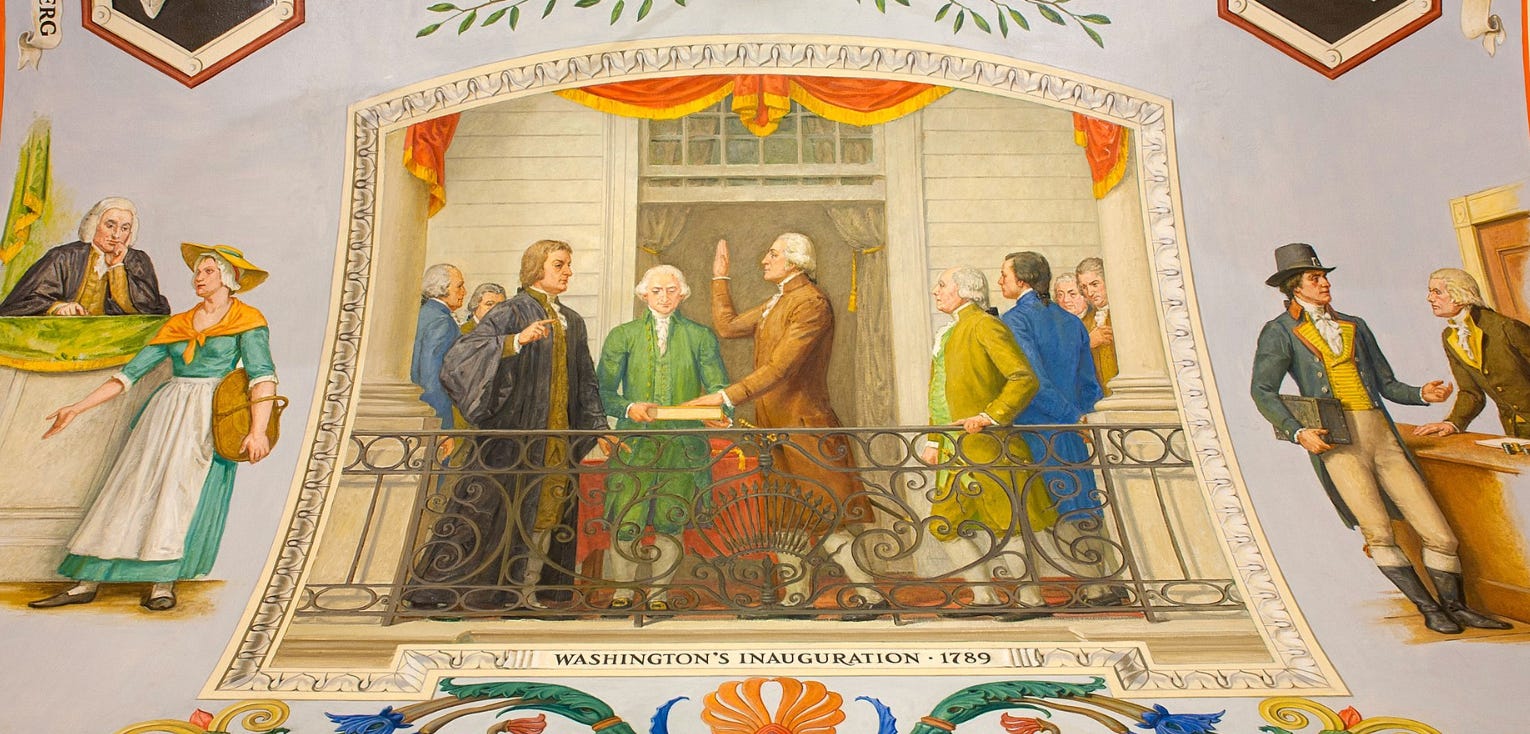
George Washington is sworn in as the nation’s first president in New York City, April 30, 1789. Image courtesy of the Architect of the Capitol, public domain.
A note to readers: This is the first new interview published under The Pathway Review name. After moving the full archive over from The Pathway Blog, I wanted the first new conversation to reflect what this publication is trying to do: ask serious people how important institutions actually work, how careers take shape, and what readers can learn from both.
The American presidency can feel very structured, even habitual. Cabinets will meet. Power will — hopefully — transfer. Presidents will represent the country abroad, manage executive departments, consult advisers, and inherit rituals that seem older than politics itself.
But almost none of that was obvious at the beginning.
The Constitution says surprisingly little about the day-to-day life of the presidency. The office had to be built through behavior and educated assumptions before it could become tradition. George Washington did not simply occupy the presidency; he gave it form. John Adams did not merely follow him; he tested whether the office could survive succession, party conflict, and defeat.
Lindsay Chervinsky has spent her career studying those formative years, when the executive branch was less an established institution than an experiment unfolding in real time. Her work on Washington’s cabinet and Adams’s presidency shows how much depended on judgment, restraint, symbolism, and personality.
This conversation is about the presidency before it was defined. It is also about the founders’ legacy: an unfinished system built by people who knew they were improvising. Chervinsky argues that the founding generation expected future Americans to revise, repair, and improve what they had begun.
The question is whether we are still willing to do that.
This interview has been edited for clarity and length.
When Institutions Are Not Yet Settled
Benjamin Wolf: You’ve written about two presidents who had to invent parts of the executive branch in real time: Washington through the cabinet, and Adams through the second presidency. What drew you to moments when institutions are not yet settled?
Lindsay Chervinsky: I think what interests me most is the concept of how people can leave their thumbprint on history, and how individuals can affect the world around them.
If we look at the founding of the nation, not only were they creating institutions from scratch, but because there were so few people in government, each personality really mattered. That caused me to look at power and how it affects people, and what they do with it.
That is why I was interested in the early presidency. And then as my career has progressed, the presidency feels incredibly relevant to almost all of us all the time. Having an understanding of where the institution came from and how it connects to what we’re seeing today is, I think, essential.
BW: How does it connect to what we’re seeing today?
LC: In every way, because the presidency is largely unwritten.
The Constitution is incredibly short. It was only about 4,000 words when it was first written, which made it one of the shortest constitutions in the world. Now, with amendments, we have about 7,700 words. And most of those words are focused on Article I.
So much of the presidency — how the president acts on a day-to-day basis, how they interact with different branches of government, how they interact with foreign nations, how they represent the country abroad — what I would call the squishy stuff of the day-to-day part of being president, is based on norm and custom.
And those all started in the beginning.
Washington as Institutional Designer
BW: Washington is often remembered as a figure above politics, almost symbolic. But your work shows him constantly managing conflict, ambition, and faction. How should we understand Washington as an institutional designer rather than just a symbol?
LC: There’s no doubt that Washington wanted to be president for all people. He was referred to as the father of the country before he even became president. He had an unparalleled stature and a position above the fray in a way that no president since has had. Even our most popular and beloved presidents are still viewed as part of the political process.
Yet he was also incredibly savvy. He was much more political, and much more politically minded, than people think he was.
He was quite good at politics, and he was brilliant at the symbolic, the theatrical, the tangible and intangible things that make up an institution and give it significance and credence in front of the American people.
That is because he had extraordinary emotional intelligence. And that is a skill that is very difficult to teach.
Adams and the Peaceful Transfer of Power
BW: The peaceful transfer of power is now treated as a basic democratic norm. But it had to be created through behavior before it became tradition. What did Adams’ departure from office establish?
LC: That’s right. The peaceful transfer of power is one of, I think, two foundations of what it means to be a republic. The other is civilian control of the military.
If you take away either of those, it’s not necessarily a bad government. It’s just not a republic.
The Constitution mentions elections, but how the transition is supposed to happen is not spelled out. It is not backed up by military power, and it is not backed up by divine right through monarchical, hereditary power. The American people had to be taught that this was something important, that they had to care about it, participate in it, uphold it, and give it strength so that it would endure.
The first transfer, in 1797 from Washington to Adams, is often overshadowed by what came later because they were nominally of the same party. But the people there recognized that it was an essential moment in making history.
Washington attended and then left the room after Adams, and Washington had not walked behind another man in probably three decades. That was a gesture that the office is much bigger than the person.
That was step one.
Step two occurred in 1800 because it was a transition from one party to another. Adams did two things that were essential.
The first was that he lost and went home. And I think he gets a really bad rap for the going-home part. Most people don’t know that the precedent of a losing president attending his successor’s inauguration was not established until 1845. No one expected him to be there. No one asked him to be there. Jefferson did not ask him to be there.
And that election had very nearly resulted in violence and the destruction of the Constitution. I genuinely believe Adams thought his presence would be a distraction, and he was trying to turn the page.
It’s important to remember that this is the age of Napoleon. This is the age when people fight back from islands to avoid giving up power. For Adams to lose relatively gracefully, go home, and establish the tone of a transition that was quite gracious was essential.
He invited Jefferson to the White House. He introduced him to staff. He told him he believed Jefferson was the rightful winner. As the votes were being counted, Adams said he believed Jefferson was the people’s choice and that he would not do anything to get in his way.
Then he instructed his cabinet secretaries to cooperate with Jefferson, to give him briefings on what was happening in the departments, and to not make any major decisions.
There are now a bunch of statutes on the books that require some of that behavior as part of the transition process. But it was not required in 1801. It was a remarkable thing to do, especially given that most of the cabinet members were not particularly big fans of Jefferson.
The last thing Adams did was send Jefferson a letter after he got home. He said everything was peaceful there, and he wished Jefferson a safe and happy administration.
That is the tone of what we want a transition to be. And he was the first one to do it.
The Cabinet Was Not Inevitable
BW: Earlier, you talked about the brevity of the original Constitution. Now the cabinet is one of the most familiar institutions in American government, but it wasn’t clearly spelled out in the Constitution. How did something so informal become such a permanent feature of American politics?
LC: It’s not just that the cabinet was not spelled out. The delegates at the Constitutional Convention explicitly rejected it from the Constitution.
They considered various executive councils and different cabinets, and ultimately decided that they would be too much like the British cabinet. They thought it would obscure transparency and responsibility. It wouldn’t be clear who was making decisions, and it could lead to corruption and cronyism.
So they rejected those proposals.
Instead, they put in place an expectation that Washington would meet with the Senate as a council of foreign affairs and would request written advice from department secretaries on issues pertaining to their departments. Department secretaries were mentioned, but not how many, what kind, or what they were going to be doing.
Washington, as the head of the Constitutional Convention, understood these expectations and tried to comply with them.
The Senate, it turned out, was a terrible advisory body. Washington went to meet with them once and never again.
Then he very quickly realized that corresponding with department secretaries on massive issues of state policy with parchment and quill was highly inefficient and not going to work. So he started having one-on-one consultations with the secretaries and convened the first cabinet meeting on November 26, 1791, which was two and a half years into his administration.
That is really important. The reason every president has had one since is because Washington did it.
It turns out that it is really helpful to have a handful of people who, ideally, you have picked and therefore trust, who are highly qualified, experienced, and knowledgeable, to advise you on big decisions that require many different perspectives.
What Washington established was an institution that is very flexible. It reveals the very best of presidential leadership, like Lincoln and Roosevelt. It also highlights the worst, because the cabinet can completely walk all over or derail a presidency, as with Madison or Harding.
Because it is so flexible, because it is really what the president wants, presidents get to talk to who they want to talk to. They get to consult with who they want to consult with. They can listen or not, depending on what they wish, with almost no oversight.
That institution has had enormous enduring power, even as it has evolved significantly over time.
Precedent and the Burden of the First President
BW: You keep talking about how these early presidents made choices that are now viewed as tradition, almost as facts of American political life. Were they aware that they were setting precedents at the time, or were they just trying to get through the day?
LC: Intensely and keenly aware, sometimes to the point of paralysis.
When Washington was going to his first inauguration, he wrote to Henry Knox that he felt like a prisoner going to the place of execution. About a year later, he wrote to his friend Catharine Macaulay Graham that he was very aware every decision he made was establishing precedent for those who followed, because he walked on untrodden ground.
He was very aware that everything he did and everything he repeated was going to establish precedent.
Adams was also keenly aware that one of his jobs was to fight for that precedent. If it was really important that Washington did it, Adams had to continue it in order to ensure that it survived.
He was also keenly aware that if he did something different from Washington, he was going to be criticized for it. So he was in a bit of a catch-22.
What made Jefferson’s decisions so powerful was that once he repeated something Washington had done, basically an entire generation of Americans was used to it: eight years of Washington, four years of Adams, then eight years of Jefferson.
And because Jefferson was from a different party, and because he had been quite critical of Washington, once he repeated key elements of Washington’s presidency, like the cabinet, those practices were essentially locked in.
The Founders’ Real Legacy
BW: Americans often use the founders as a constitutional baseline for how America should look today. Alongside that, there is increasing distrust in American politics and government. Do you think that distrust comes from a misinterpretation or misuse of what the founders intended by politicians today, or from the founders not properly anticipating how to maintain trust in what America would become?
LC: I actually think the founding legacy is one of innovation and experimentation.
They did not think they were creating things that would survive for 250 years. They thought they were creating things that, if they were lucky, would last for a generation and put the nation on firmer footing. Then future generations would come up with something more creative than they could possibly imagine.
There were many problems they knew they had not addressed, like slavery, and they intentionally swept them under the rug. There were many other problems they knew they could not possibly anticipate because they could not predict the future.
We think of them as these genius, all-knowing beings. And on one hand, they absolutely were genius. They had no roadmap. They had no guidelines. They didn’t know what was happening next. They were building the plane while flying it, and they knew it.
So when we look at what they intended, it is, at best, an intention with the expectation that once the plan hit the circumstances on the ground, it might go completely haywire.
And it did.
The Articles of Confederation, the nation’s first constitution, failed spectacularly. They wrote the Constitution, which was the second constitution, and then they passed ten amendments to it two years later. They passed another amendment, the Twelfth Amendment, in 1803, once they realized there was a loophole around electing presidents.
They were not afraid to admit, “We got that wrong. We better try something else.” That is what they expected their legacy to be, and what they hoped future generations would do.
For the most part in American history, future generations have done that. After the Civil War, there was another batch of amendments. The Nineteenth Amendment gave women the right to vote. The Civil Rights Act, the Voting Rights Act — these all picked up the mantle of what the founding generation started, attempting to make the nation just a little bit more perfect.
I think in the last 50 years, we have stopped doing that. That has led to the sense that the institutions aren’t working, and therefore we don’t trust them.
It’s not because I think the founders have failed us. It’s because we have failed them in trying to continue to improve this thing.
How to Restore Trust
BW: If you were advising a president-elect on how to get back to that original founding spirit, what would you tell them to focus on?
LC: People need to believe that democracy works for them.
They need to believe that their interests are represented, that people are hearing them, and that leaders are trying. They don’t need to solve everything. They just need to be making small, tangible bits of progress.
There are a lot of things representatives, presidents, governors, and state legislators can do to improve trust, and a lot of it is just being more responsive to people and more amenable to making small progress.
One of my hobby horses is that I think we should effectively double the size of the House of Representatives.
When the Constitution was passed, each district was about 30,000 people. Today, it’s almost 900,000. One person cannot represent 900,000 Americans. You can’t have a people’s house when representatives are representing that many people.
It would almost eliminate the gerrymandering problem. It would almost eliminate the problem with the Electoral College because it would align the popular vote much more closely with the Electoral College vote. And I think it would dramatically increase the ability of the House to get things done.
It also is not a solution that favors one party or the other, because Texas and Florida would get many more seats, just like California and New York.
It does not require a constitutional amendment. It requires a bill. Congress passed a bill in the 1920s capping the size of the House. They can pass another bill increasing the size.
BW: You mentioned it helps solve the gerrymandering problem. How so?
LC: If you have twice as many districts, it’s harder to gerrymander. It’s not going to completely eliminate it, but it makes it much harder.
Let’s say you have a square and you’re trying to create four districts out of that square. Now imagine you have to create eight. It becomes much harder to get into all kinds of shenanigans when you have to fit so many more districts in there.
It’s not a perfect solution, but I think it is an elegant one. Again, it doesn’t advantage one party over the other. It affects both. And it would have the byproduct of making people feel that they are better represented because each representative has to speak for fewer people and fewer factions in their district.
From Law School Plans to Public History
BW: As we get close to the end, I want to shift the conversation to how you got involved in the work you’re doing today. What got you fascinated with Washington, Adams, the founders, and the creation of the Constitution, and how did that lead you to where you are now?
LC: I’ve always loved history.
When I was little, my family went to a bunch of historic sites. We went to museums, house sites, places where history comes alive in a way that is really important for kids especially. I was a voracious reader, so I read a ton of historical fiction. But I do think seeing the actual space makes a huge difference.
I was going to go to law school. I did a ton of public speaking and debate exercises in high school and college with the intention of going to law school. I took the LSAT. I applied to law schools. I got into a bunch of them.
Then at the very last minute, I decided I would rather stick needles in my eyeballs.
I ended up working at a museum for a year and then getting my master’s and PhD in history. It was really clear to me by the time I decided not to go to law school that my heart was in the history space. I just had to think creatively about what that work would look like.
I got my master’s, got my PhD, got a postdoctoral fellowship, which was a two-year program. I was in school for approximately a million years. But I loved school, so it was okay.
Then I got a public history job, and I’ve had a series of those positions. It was clear to me pretty early on that my strength lay in speaking to a public audience as opposed to a classroom audience. Those are very different things. It is a very different skill to speak to a public audience than to create a curriculum for a semester.
The type of work I was doing, working on the early presidents and institutions, was less in vogue in the academy. Public history was much more interested in that kind of work, because the public audience actually doesn’t need to be convinced that this work is relevant. They already think so, and therefore they want to read it and learn about it.
My current job is Executive Director of the George Washington Presidential Library. I started about two years ago. I had been a fellow here in 2015 when I was working on my first book, on George Washington’s cabinet. I continued to work with them on teacher programs and leadership programs.
I had been doing my own thing. I had a sort of history business. I was doing a lot of speaking and writing, some teaching, a lot of media, and I loved it. I had no intention of doing anything else.
Then the job came up here sort of unexpectedly, and they asked me to do it. It was the right place at the right time for the 250th anniversary and for thinking about what the next step for the library is. It opened in 2013, so it’s in its second decade, and the sky’s the limit in terms of potential. That was super compelling to me.
But the main takeaway is that I did not follow a path everyone else followed. I did not follow a path that existed.
I pursued what brought me joy, where I sensed there was interest, focused on what I was good at and what I could lean into, worked really hard at those things, and opportunity presented itself.
I’m a big fan of that quote that luck is opportunity plus preparation.
When the Plan Changes
BW: For readers who are interested in history but perhaps considering law school, too, what was the turning factor for you? What made you pursue history rather than law?
LC: There were a lot of red flags.
I didn’t particularly like the pre-law classes I was taking, and I really loved the history classes. So that probably should have been step one.
I was on a very competitive mock trial team in college, and I loved being the expert witness. Being the attorney made me very stressed out. So that was red flag number two.
I ignored both of those.
The final red flag I could not avoid was when I was working on a writing supplement for the University of Pennsylvania Law School application. The question was: discuss a piece of art or literature that has inspired you to pursue law.
I couldn’t bullshit that essay. I could not find a way to bullshit it.
So I was brainstorming various things with my then-boyfriend, now husband. He said, “What about the book John Adams? You love that book.” I was doing dishes and not really paying attention to my answer, and I said, “Yeah, but I loved it because of the history, not because of the law.”
He looked at me like, duh.
And I was like, oh.
It was such an honest answer that I realized I couldn’t ignore it. That was really scary because I had had this plan for twelve years. This was what I was going to do. I chose my majors based on it. I crafted my internships around it. That was my plan.
My life has turned out really, really great, even though I diverged from the plan. So it’s okay to diverge from the plan. It’s much better to figure it out before you go to law school than after.
And you can still take all of those skills and apply them to other things. My public speaking is what it is because I did so much public speaking with law school in mind. Those skills are not things you lose or that become unimportant later on.
Where to Begin
BW: Finally, if a young person wanted to understand the presidency beyond elections and personalities, or just wanted to better understand the work that you do today, where would you tell them to begin?
LC: My books are probably an obvious answer, so I’ll start there. I am proud of them, and I hope they are enjoyable.
Another place to begin is the Mount Vernon website: MountVernon.org/library. We have unbelievable online resources.
We have a George Washington encyclopedia, so basically every subject you could imagine. We have podcasts, databases, videos, and we stream our book talks and events.
There are nearly limitless resources to learn more about Washington’s presidency in particular. That is probably a good place to start, and hopefully it will launch other exploration for you.
About the guest: Lindsay M. Chervinsky is Executive Director of the George Washington Presidential Library and a presidential historian whose work focuses on the presidency, political culture, and the institutions of American government. She is the author of The Cabinet: George Washington and the Creation of an American Institution and Making the Presidency: John Adams and the Precedents That Forged the Republic, and co-editor of Mourning the Presidents: Loss and Legacy in American Culture.
About The Pathway Review: The Pathway Review publishes long-form interviews with people in politics, policy, journalism, law, diplomacy, markets, history, and public service about the work they do and the path that brought them there.
Subscribe to receive new interviews in your inbox.
Reading an interview is like listening to a description of a Manet. Make the audio available, please.
Any Lindsay Chervinsky interview is enlightening and this is no exception. Glad it went into Lindsay’s path to historian. Very interesting, especially as a history loving lawyer.