


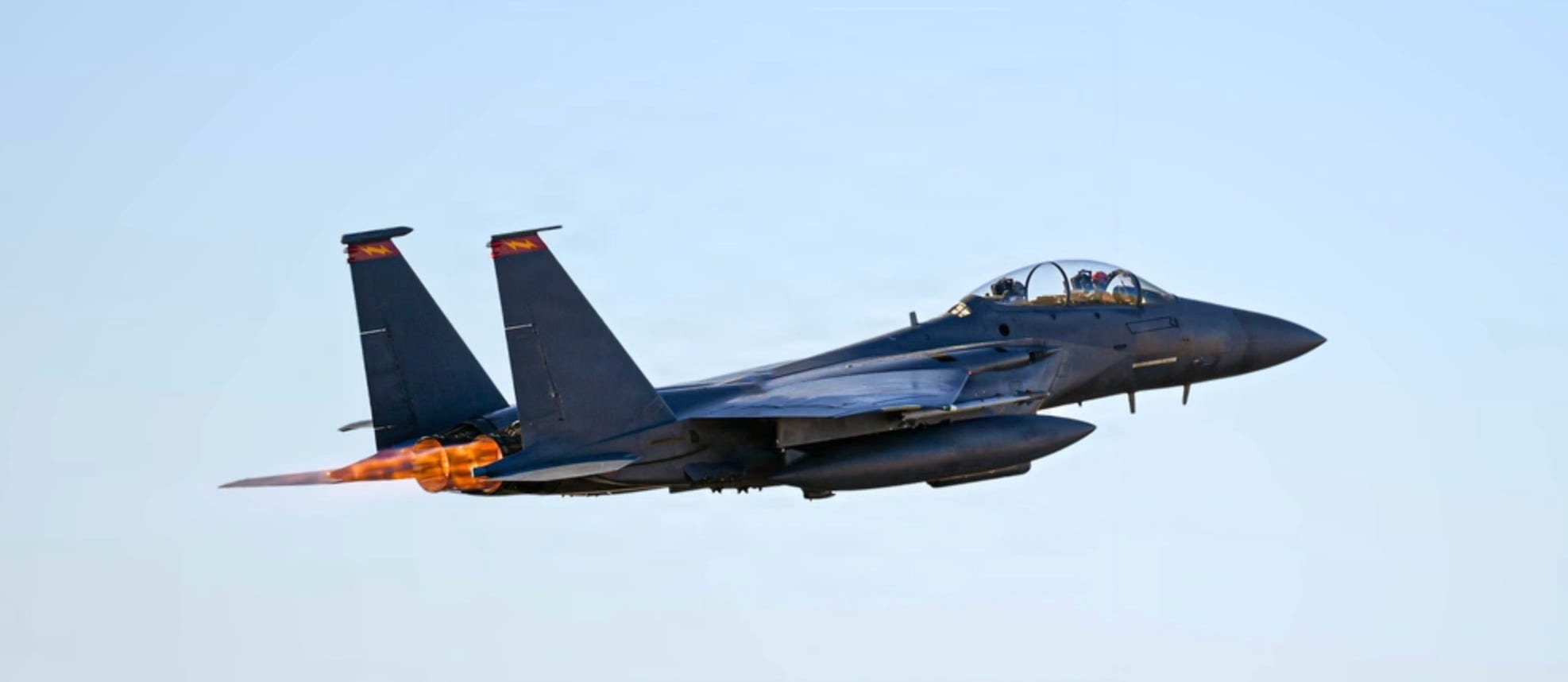
An F-15E Strike Eagle departs on a combat mission during Operation Epic Fury, March 16, 2026. U.S. Air Force photo.
Four weeks into Operation Epic Fury, the scoreboard was overwhelming. American aircraft had struck more than 10,000 targets inside Iran, destroyed roughly 80 percent of its air defenses, and eliminated its navy as a fighting force. Iran, by Kelly A. Grieco’s count, managed to get one aging fighter into the air.
Despite this domination, none of it reopened the Strait of Hormuz.
Iranian drones costing a fraction of the weapons used to stop them had struck roughly twenty commercial vessels and brought traffic through one of the world’s most important chokepoints to a near standstill. Tehran could not contest American control of the skies. It had discovered that it did not need to.
Grieco has called that outcome the “most successful failure in U.S. airpower history”: America won the air war it had spent decades building itself to fight and lost the one Iran ultimately chose to impose. Their diagnosis turns on the “air littoral,” the term the two coined in Parameters in 2021 for the contested low-altitude airspace between ground forces and high-end fighters and bombers. It is the band where cheap drones now do their work, and where American control, Grieco argues, no longer extends downward the way it once did. She thinks the Air Force is about to take the convenient lesson from Iran instead.
This conversation took place on July 27, 2026, and has been edited for length and clarity.
THE WAR AMERICA WAS BUILT TO WIN
Ben Wolf: Before we get to Iran, give readers a sense of the job. What questions are you trying to answer at Stimson, and how did airpower and alliances become the center of your work?
Kelly Grieco: I’m a senior fellow at the Stimson Center in Washington, where I work with the Reimagining U.S. Grand Strategy Program. The program is dedicated to examining the assumptions that underlie U.S. foreign policy and defense policy and testing whether they still hold. Sometimes we test a core assumption and find that it’s right. Other times we find that the assumption no longer holds, and that has significant implications for foreign policy.
Within that, my work focuses on two areas. One is airpower and the future of warfare—how air warfare in particular is changing. The other is alliances and coalition-building, with a specific focus on the Indo-Pacific.
BW: You and Max Bremer called Iran “the most successful failure in U.S. airpower history.” That is a deliberately provocative phrase. When did the contradiction become clear to you—that the United States could dominate the skies over Iran and still fail to produce the strategic effect it needed?
KG: I don’t think I’d say there was a specific moment. But one thing that was really striking was a stretch when Secretary Pete Hegseth and Gen. Dan Caine [the chairman of the Joint Chiefs of Staff] were doing briefings at the Pentagon in the first month or so of the war. The messaging was really about all the targets we’d hit and the things we’d destroyed—a lot of emphasis on missile launchers we’d attacked, particular sites we’d struck, sinking the navy, grounding the air force. All of that was presumably true.
And it seemed so disconnected from the utter disruption that was taking place throughout the region as a result of Iranian airpower—not traditional Iranian airpower, not fighter jets, but the way Iran was using drones and missiles. If you think back to that first month or six weeks, even as the United States was destroying these things, Iran was launching its own systematic campaign against U.S. bases in the Gulf, against Gulf infrastructure, and of course against the Strait of Hormuz. It was really that disconnect, for Max Bremer and me, between one war we seemed to be excelling at and another where we didn’t seem to have an answer for Iranian airpower.
BW: You write that the United States entered the war with a detailed plan for destruction and essentially no plan for Iran’s campaign of disruption. That sounds less like an execution problem than a planning failure. What does a blind spot that large tell you about how the Pentagon defines success?
KG: You can see it particularly early on, and I think it’s important to emphasize that the campaign evolved. In the first 72 hours of the war, there was emphasis on rolling back air defenses, but a lot of the targeting was on the leaders themselves. It was extraordinary how successful that was. I can’t think of another campaign—essentially decapitation—that has been so effective at the tactical level of killing that many leaders in such a short period of time.
That was clearly the early plan. And when it didn’t bring the Iranian regime to say uncle, the effort seemed to move toward degrading Iranian capabilities. That’s something the military, and the Air Force in particular, has excelled at: conducting the standard air campaign that degrades the integrated air defense system so you can gain increasing levels of control, and then going after targets, whether fixed ones like the nuclear sites we know about or mobile ones.
If you look at where the bulk of the effort went, it was around that. There was far less attention to striking things near the strait. If you really look at where we were concentrating operations, it was heavily focused on the mainland and further in, rather than on things like the speedboats and the launchers much closer to the strait. I think you can infer something from that about where the priorities were in the planning.
BW: You’ve warned that the Pentagon could come away from Iran having learned the convenient lessons rather than the correct ones. What is the most dangerous convenient lesson you think officials could take from this war?
KG: The most dangerous one, and the one I’m concerned about, is that we look at the traditional air war the United States fought—what Max and I call the war of destruction—and point to signs of success in terms of what was destroyed. Again, the sinking of the navy, Iran’s air force. I think there was one example where they seem to have gotten an old fighter in the air, but that’s about it. You can look at the fact that the United States was able to gain increasing air control over parts of Iran, particularly the south and west. There have been casualties—we know about the F-15 that was shot down—but remarkably few U.S. casualties from aircraft flying over Iranian airspace. In some sense, you can say that validates much of what the Air Force in particular has done.
My concern is that we look at that and say, okay, this validates our model, and we’re not paying attention to where the adversary has been able to exploit the gaps—where we excel versus where we’re vulnerable. Those vulnerabilities are in a messy area. They’re much closer to the surface, in that lower-altitude airspace. And there are definitely going to be those who want to dismiss that as insignificant, maybe even dismiss it as not being part of the role or the job of airpower at all—being able to control that lower-altitude airspace.
Max and I are airpower zealots, in a sense. We think this is part of airpower’s mission, and a mission and responsibility it has to the joint force: to be able to provide that level of control, including at lower altitudes.
THE FIGHT OVER AIRPOWER
BW: Retired Lt. Gen. David A. Deptula, dean of the Mitchell Institute for Aerospace Studies, has attacked the framework directly. His argument, in essence, is that the “air littoral” is an artificial distinction—airpower already extends from the surface upward—and that Hormuz was a joint-force problem, not proof that American airpower failed. What does that critique get wrong?
KG: There are really three charges there, so let’s start with the first: that it isn’t a useful term, that it’s an artificial division of the airspace. In some sense I think that’s a strange critique, because I don’t hear anyone making a similar argument about the maritime world. Nobody suggests that because we have the term “maritime littoral,” we’re creating a new domain. That term exists to recognize that where domains overlap—in that case the sea and the land coming together—there are more interdependencies, and harder areas for the joint force. It recognizes a really important and longstanding operational problem about where that seam is, and it brings attention to that problem.
What Max and I wanted to point out is that we have this growing problem of low-altitude threats from missiles and drones, and that even if you’re gaining control at higher altitudes in the more traditional sense, control was not extending downward in the same way it had in the past. That’s something we need to be attentive to. And it’s particularly challenging because, like the maritime littoral, it’s where the air domain and the surface domain—maritime and land—interact. It becomes far messier, harder to identify, harder to define roles and missions, harder to afford cooperation across the joint force.
So what the term does is bring attention to an operational problem, and one that many other people would like to forget, because it is a really challenging operational problem. I think the best evidence of that is that the term itself has gotten traction: it gives people words for an operational problem that matters and that’s increasing. Iran and the Strait of Hormuz is the clearest evidence of it. It isn’t the only example. But it’s a problem where the United States does not have a ready, effective operational answer.
The second charge is the double standard—this idea that we’re somehow not giving U.S. airpower credit for certain things while giving Iran credit. We’re counting as airpower the traditional airpower the United States has: fighters, bombers, and all the support aircraft that go into that. We’re also counting drones and missiles. So it’s airpower whether it’s an Iranian Shahed or an American clone of a Shahed, the LUCAS, or a Reaper, or missiles. Our standard is the same across the joint force and across both sides.
BW: But let me press you on that. Even if Hormuz was unquestionably a joint failure, why is it important to call it an airpower failure too?
KG: That’s the final piece of the critique: the notion that this really isn’t airpower’s fault—that the Strait of Hormuz cannot be opened, but that this is a joint problem. And I’ll say that I consider that a charge worth answering directly. It may be true. It is true. This is a joint failure, and I acknowledge this is a joint fight. But even if it is a joint failure, it’s also an airpower failure, and a specific kind of airpower failure. If you look at Air Force doctrine, one of the things it emphasizes foremost is that the responsibility of the Air Force is to provide air superiority to the joint force so the joint force can conduct the missions it needs to do. If you look at the Strait of Hormuz, because Iranian drones and missiles are still firing, the Navy is not able to escort ships and commercial shipping is not able to go through the strait. That’s a failure of airpower—of the Air Force as it defines its own role and its own responsibilities to accomplish what the joint force needs.
WHAT HORMUZ EXPOSED
BW: Iran has used comparatively inexpensive drones and missiles to impose enormous costs on the U.S. military and the global economy. If you were sitting in Tehran, what would this war have taught you about how to fight the United States?
KG: There are a couple of things worth emphasizing here. One is just that the Strait of Hormuz is so unique, even compared with other chokepoints throughout the world. There really is no alternative to it. It’s not the situation you had with the Houthis in the Red Sea—which is sort of starting again—where commercial shipping said, this is too dangerous, we don’t like this, and was able to find alternative routes. Certainly those took more time and were more expensive. But the problem with the strait is that there isn’t an alternative maritime route you can take. Some people will draw the concern that now we have to be thinking about chokepoints everywhere. Hormuz is very unique in the degree of disruption it allows.
But if I were in Tehran looking at the strategy, you could see that they’ve had success. This validated many of their concepts—their notion of mosaic defense, of being decentralized and distributed and able to deny U.S. objectives. They’re not trying to control the airspace or the strait. They’re trying to deny the control that the United States needs and that shipping needs. I think that’s an important distinction.
And you can see it in their firing decisions, because they seem to recognize that they don’t actually need a lot of missiles and drones every day to keep the strait closed. It’s a remarkably small number, so it’s sustainable. The biggest thing, if you were looking at this situation and taking a lesson, is that they’re imposing a lot of costs. In individual exchanges, it’s cheaper for them to keep doing this: the drones and missiles are cheaper than what it requires for the United States to intercept them and try to suppress them. That’s a very favorable exchange.
BW: Who does time favor now—Washington or Tehran?
KG: That’s the real question today, isn’t it—which side is favored by time. I think it favors Tehran, for some of the things you mentioned, like the global economy. It’s being held hostage by the disruption. We’re entering this second period of resumed conflict, though maybe we’re getting a pause now, with oil reserves having already been drawn down, so our ability to weather this is going to be harder. The midterms have to be, to a degree, a calculation in the White House—this is a very unpopular war, including with the president’s own base. And the Gulf states that are deeply affected by this are almost certainly putting pressure on the administration to find some way to conclude it. Those pressures are more acute on Washington than they are on Iran.
The only thing I’d add is that long term, we’ve already started to see construction in different Gulf states to try to figure out ways to bypass the strait. So long term there may be some expiration date, if you will, on how long Iran has this source of leverage, or the same degree of leverage. But I think the clock on Washington expires before we get to that point.
HOW A STRATEGIST GETS MADE
BW: You finished your Ph.D. at MIT and then went into professional military education rather than taking the more conventional academic or Washington think tank route. Why? What did you think you could learn from teaching military officers that you couldn’t learn in another academic department?
KG: I spent years at MIT getting my Ph.D. in political science in the Security Studies Program—really excellent training, and I feel grateful that I was able to do my studies there. But one of the things that occurred to me while I was in the program was that I’d originally thought I wanted a very traditional academic job, teaching predominantly civilians, probably undergraduates. At a certain point, I knew I didn’t necessarily want that path.
I had spent all these years studying these issues of military conflict from a more academic perspective, but I wasn’t an operator myself, and that was not the path I was going to choose. So I found professional military education a particularly attractive option, because it allowed me to bring my more academic, book experience and meet it up in the classroom with officers who had ten to fifteen years of experience already in the military and were actively involved in operations. I could learn from their operational experience, they could learn from some of my academic experience, and in the classroom those two perspectives got to meet. I found it an incredibly valuable experience—those conversations, and the learning that went both ways, let me understand these issues in a different way and learn a tremendous amount about airpower. I’ll just say that my greatest teachers on airpower were actually my students themselves.
I was down there for five and a half years. At a certain point I decided that I wanted to have a bigger impact on policy, and that it was probably time to go to D.C. and do something in the think tank space. I was able to bring that experience and knowledge with me, and I’m happy to say that I often run into my former students, who are either at the Pentagon doing a tour or, in the case of international officers, back home and now attachés at their embassies.
BW: People hear “think tank fellow” and probably imagine a lot of reading and writing. In practice, how much of your job is original research versus talking to reporters and congressional staff, preparing testimony, or participating in private diplomacy? What does the calendar actually look like when a war breaks out?
KG: I don’t think there is necessarily a typical week, and that’s one of the things about the think tank space: your week is, to a degree, determined by what the news looks like. When the war kicked off in February, as someone who studies airpower, there was much more interest in trying to understand these issues from the media. So at that time, especially early in the war, a lot more of my time was spent talking to media and journalists, because that’s when they want that information.
I do spend a good amount of my time on reading and research and writing. I write regularly and make sure that I do that. I try to carve out specific time for it, because otherwise so many other demands come into that space. So it’s hard to say I do a third, a third, and a third. It doesn’t really work that way, and it depends on the week. But one portion is certainly talking to media or journalists, or doing outreach to congressional staff—bringing your expertise to others. Another part is original research and writing. And another part is more private work: events, Track II diplomacy where you might be meeting informally with your counterparts from another country to discuss issues, private workshops to try to understand better what’s happening in foreign policy.
BW: Of all of that, what part of the job gives you the most energy?
KG: Probably the variety, in some sense. I like that it’s varied and that I’m not necessarily doing the same thing every day. But my favorite thing about my job is that I’m able to ask really interesting questions and try to understand them. The world is a really interesting place, and I like that I have a job where I’m allowed to ask those questions and try to really understand it.
BW: In a field that rewards people for reacting quickly to whatever happened this morning, what separates durable expertise from simply being good at the news cycle? What did you build early in your career that still compounds today?
KG: Looking back, the most important thing for me has been having really strong foundations. I’m not really someone to chase trends. I think theory is really helpful—and I know theory sounds boring to most people, who want to talk about what’s actually happening right now in policy. But having a really strong foundation in theory, in international relations theory and also military theory, means that any time a different situation arises or something happens in the world that looks new, I already have a set of concepts in place that allow me to work through that problem set.
I’ve found that really valuable: having that set of theoretical concepts to lean on to make sense of things that to other people may look like they completely don’t make sense, or look completely new. To be able to think, well, actually, this is very similar to something that Thomas Schelling wrote in the sixties, or something that Carl von Clausewitz wrote about the Napoleonic period. To make order out of what looks like disorder.
BW: For somebody finishing a Ph.D. who ultimately wants to influence policy, how should they think about the first move—academia, government, or a think tank? Are there doors that become harder to open depending on where you start?
KG: I think this is a very individual decision. I don’t think it’s necessarily the case that one is better than another. They’re just different paths. So people need to be really honest about what it is they want to do, and what they want their time to predominantly be used for. There’s real value in both. I like being able to engage with policy and policymakers, but there’s also real value in people who are a bit away from that scene, in academia, who are able to think through these issues without the noise of D.C. and the existing conversation. Both of those are valuable. So people have to think about what they truly want their career to look like, and what they want their days to look like.
To some extent it’s true that you can move across these. I would say, though, that if you’re serious about wanting an academic career, you probably should start there, and then you can move into the think tank space. That’s an easier trajectory than starting in the think tank space and then moving to academia.
BW: Your path was hardly linear—you were a government major and pre-med, spent two years doing clinical research, went to MIT, taught military officers, and eventually came to Washington. Looking back, is there any detour you would erase, or did the detours turn out to be part of the education?
KG: I think we all would like there to be things we could change—that we’d gotten through something faster, or that we’d written something else. But the most important thing I’d say is that all of the experiences you have shape you in ways you don’t realize at the time.
Coming out of undergrad, I was a government major at Dartmouth, but I was also pre-med, and I was thinking about going to medical school. So I worked for two years as a clinical research assistant in medicine, really planning to go. And it was those two years working in medicine as a research assistant that made me realize that really wasn’t what I wanted. The sign was that when I was supposed to be doing my research for the medical group I was working for, I kept checking the news to find out what was happening with negotiations with North Korea. I was more interested in that. I knew I loved research, but I was more passionate about international affairs.
You could say, in some sense, that those two years working in clinical medicine were wasted. I don’t think they actually were. They shaped me, and I still learned things about research. So I’d just say: always look at what the opportunities are in an experience—the skills you’ll gain, the knowledge you’ll gain. You never quite know down the line when you’ll find that you’re able to use it in some way that might surprise you.
WHAT TO READ
BW: If you could put one thing on the syllabus for someone who wants to think seriously about war—not simply follow it—what would you assign, and why?
KG: That’s a tough question. I really like the foundational theory, so I feel like everyone should read Clausewitz at some point. But it’s a very difficult book, particularly to read on your own. It’s definitely worth struggling through, and a companion helps. The military historian Michael Howard wrote a short introduction to Clausewitz [Clausewitz: A Very Short Introduction]—it’s actually a very thin book, but it does a really good job, especially as a companion while you’re reading, of helping you understand what he actually says. And I think there’s a lot of wisdom in that book.
About the guest. Kelly A. Grieco is a senior fellow with the Reimagining U.S. Grand Strategy Program at the Stimson Center and an adjunct professor in Georgetown University’s Center for Security Studies. Her research focuses on U.S. foreign and defense policy, military strategy and force structure, alliances, air operations, and the future of war. She previously taught at the Air Command and Staff College and holds a Ph.D. in political science from MIT.
About The Pathway Review. The Pathway Review is an interview publication about how consequential people think, work, and build their careers across foreign policy, politics, business, law, journalism, and public life. Subscribe for new conversations.