


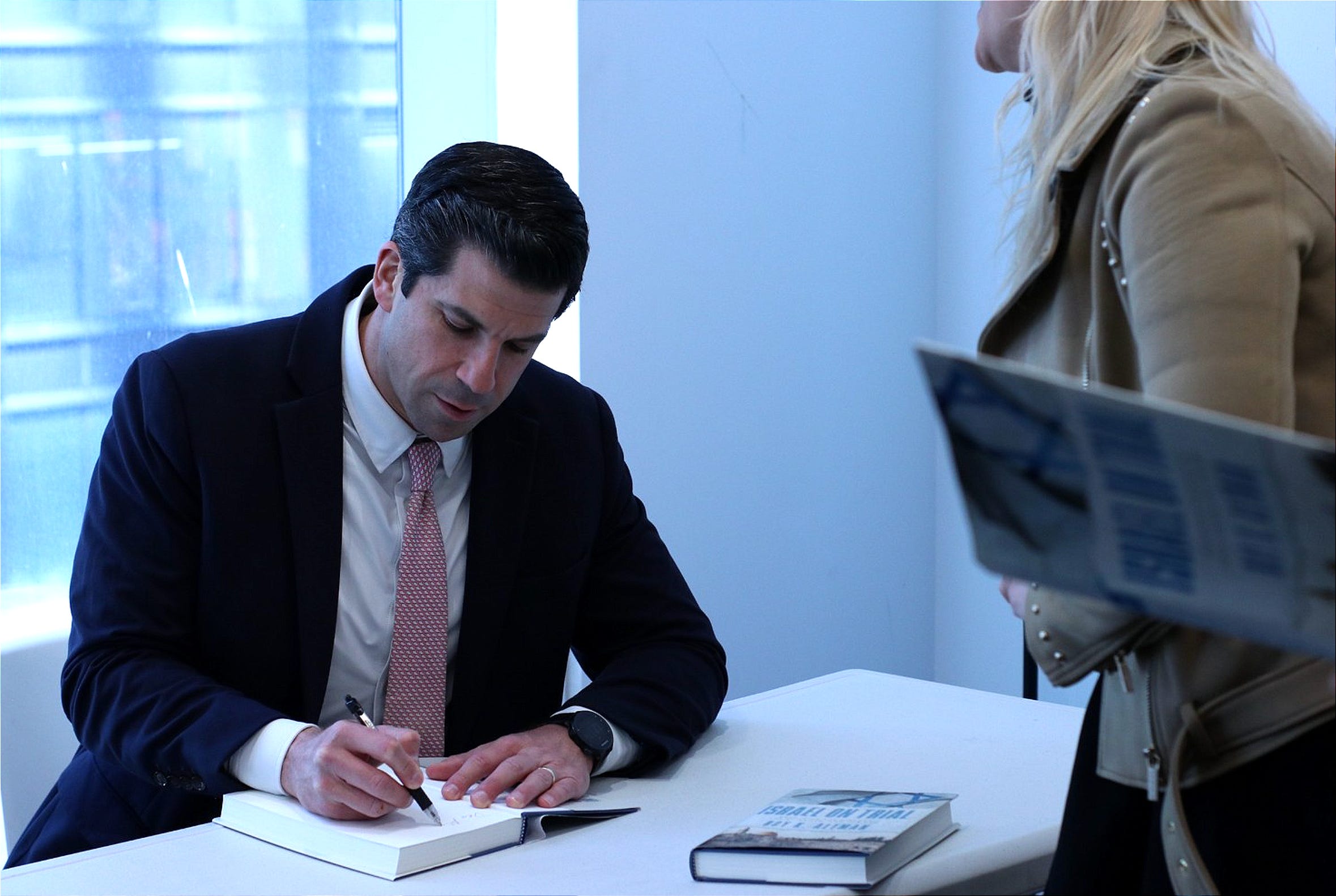
Judge Roy K. Altman signs a copy of Israel on Trial at Touro University in New York, May 2026. Photo courtesy of Touro University.
Benjamin Netanyahu says he is coming to New York in September for the United Nations General Assembly, as he usually does. This year, though, New York’s mayor has made clear that he would rather Netanyahu stay away.
Zohran Mamdani has called the Israeli prime minister a war criminal, said he is not welcome in the city, and urged Washington to arrest him under a warrant issued by the International Criminal Court.
There is an obvious problem with that demand: the United States is not a member of the ICC and has never recognized its authority in the way its member states do. For all the attention the proposed arrest received over the summer, the real question was never whether Netanyahu would be taken into custody. It was whether the warrant carries any legal force here at all.
Roy K. Altman has spent his career thinking about questions like that. A federal judge in the Southern District of Florida since 2019, Altman has now written Israel on Trial, a book that examines six of the most serious accusations made against Israel through archaeology, genetics, military conduct, history, and international law. The book approaches those claims less as political talking points and more as arguments to be weighed and tested, much like they would be in a courtroom.
The book is also deeply connected to Altman’s own story. Born in Venezuela and raised in Miami, he spent summers in Israel and winters traveling with his family to Civil War battlefields and Revolutionary War sites. When he was eight, standing at Missionary Ridge and seeing snow for the first time, his father gave him a lesson about what a free society demands of the people who inherit it. From that moment forward, Altman says he knew he wanted to enter a career in public service.
In this Pathway Review conversation, Altman and I talked about the case he makes for Israel, why he believes the West is losing an information war, how he navigates public debate as a sitting judge, and what his path to the federal bench taught him about character, service, and ambition.
Judge Altman spoke in his individual capacity, not on behalf of the judiciary.
The Country His Parents Chose
Ben Wolf: Judge Altman, thank you for doing this. For readers unfamiliar with your background — where does the story start?
Roy Altman: I was born in Venezuela and moved to Miami when I was a little boy. My parents always taught me that in this country we could be or do anything we wanted, so long as we worked hard, followed the law, and treated people with respect.
Every vacation was the same when we were little. Summers we spent in Israel. Winters we spent traveling around the South to Civil War battlefields — I’ve been to hundreds and hundreds of battlefields — and to Revolutionary War sites, like Colonial Williamsburg and Yorktown. Learning about the country we had come to.
I tell one story a lot about what that meant to me. I was eight, and my father and I were at Missionary Ridge in Chattanooga, where a teenage Arthur MacArthur Jr. — later the father of General Douglas MacArthur — changed the course of the battle. He saw the standard-bearer shot, and he couldn’t bear the thought of the flag touching the ground, so he charged up that ridge by himself carrying it, against orders. The rest of the Union army charged up after him. They won. There’s a marker at the top.
We were standing there and it started to snow. It was the first time I’d ever seen snow. And I said to him, isn’t this fun? Isn’t this beautiful?
My father turned to me very sternly and said: We’re not here because it’s fun. We’re here so that you and your sister can understand the character of the country we brought you to. We brought you to a place where six hundred thousand men had to die so that part of the country could be free. That is the level of devotion and dedication a free and fair democracy demands.
From that point forward, I always wanted to be in public service.
I grew up in Miami and went to Columbia, where I was a quarterback on the football team and pitched on the baseball team. Then Yale for law school. I clerked for a federal appellate judge, and then I became a federal prosecutor, handling some of the most serious cases in America — human trafficking, child exploitation, and some of the most violent drug-trafficking organizations anywhere in the world.
After that I became a partner at Podhurst Orseck, doing a very particular kind of work. I represented most of the families of the passengers aboard the Malaysia Airlines flight that disappeared in the Indian Ocean, and the Latin American families affected by the Germanwings plane that was deliberately crashed into the French Alps in 2015.
Those cases made me feel as though I were working for the government again. My clients were people who had been victimized, who had done nothing wrong, and who deserved redress, and a shoulder to lean on, and somebody skilled in the art to be a voice for the most vulnerable people in our society. I think I did that. The Malaysia Airlines litigation, incidentally, came before Ketanji Brown Jackson, who was a district judge at the time and is now on the Supreme Court.
Then the president nominated me to the federal bench. That process is long and arduous, and in some ways justifiably so. If five or six hundred federal judges are going to decide whether our democratically elected legislatures and executives can pass certain laws — whether those laws comply with our constitutional framework — we ought to make sure they’re the right kind of person. The judiciary is the only branch that can’t be removed except by impeachment, and the only branch with the power to tell the other two that they acted unconstitutionally. That is precisely why the Constitution requires the other two branches to select the federal judges: the president nominates, the Senate confirms. It took almost two years. I was confirmed in 2019.
Putting Israel on Trial
Before turning to the book, I want to ask about the ICC warrant for Benjamin Netanyahu. New York Mayor Zohran Mamdani has said Netanyahu should be arrested if he enters the city, even while acknowledging that a mayor may lack the authority to enforce the warrant. As a matter of law, what force—if any—does an ICC warrant carry inside the United States?
I can’t comment on politicians, because of my role.
As for the authority of a local official to enforce an ICC warrant, there is no such authority, for two reasons. First, even if we had signed a treaty with a foreign country, that treaty would be enforced by the federal government, which has plenary authority over international affairs. Second, and most importantly, the United States has never been a party to the Rome Statute that created the ICC to begin with. The warrant therefore has no effect in the United States whatsoever.
Israel on Trial examines six of the most serious accusations made against Israel. Which claim required the greatest intellectual effort to evaluate fairly—not simply to rebut, but to test against the evidence for yourself?
None. All six are frivolous.
The point of the claims, as I discovered going deeply into this, is not actually to say something true about Israel. None of the six even approaches reality. The point is to destroy the State of Israel. Many of them were constructed by the Soviet Union long before this whole issue with the Palestinians developed, as a way of contesting American influence in the Middle East.
We were locked in a Cold War, and much of its inflection point was the Middle East, where so much of the world’s natural resources were coming out of the ground. We had geostrategic interests there and so did they. We supported Israel; they supported and militarized the Arab states, including Egypt and Syria, Israel’s most important adversaries. They built those adversaries up to destroy Israel so that America would be pushed out of the region entirely.
Those plans failed. A few million Israelis, against surrounding populations numbering in the hundreds of millions, won in 1948, won in 1967, won in 1973 — where they surrounded the Egyptian Third Army in the Sinai until it was starving in the desert. That is how badly the Arab armies were beaten, in war after war after war that they initiated for the destruction of Israel.
At that point the Soviets said: we’re not going to destroy them militarily, so we need to destroy their logistical support network in the West. There was an ideological framework supporting Israel — the narrative that Israel is necessary because of what was done to the Jews — and the plan was to break that chain. So they created a set of claims and passed them into the Arab world, first through the PLO, then through Nasser in Egypt and Assad in Syria, and ultimately throughout the Arab world they were funding and arming. Narratives that twisted the logic of the Jewish claim to the land. That inverted reality, precisely in order to confuse people in the West about whether it made sense to support Israel at all.
Take the first claim, that the Jews are colonists who took land that wasn’t theirs. It is frivolously absurd.
Set the Bible aside — although the Bible remains an important source for hundreds of millions of people, teaching page after page that the significance of the Jewish people is their connection to the land of Israel. Set it aside, and you still have three independent categories of evidence that don’t depend on the testimony of anyone with a bias or an interest in the outcome.
Rocks in the ground: the archaeology. Words on the page: the documentary record. Blood in the veins: the genetic evidence. All three confirm that the people who lived for thousands of years in the land between the Jordan River and the Mediterranean Sea — who were there before the Arab Muslim conquest of the seventh century, before the Christians, before the Byzantines, before the Romans, before the Assyrians — were Jews. They spoke Hebrew, the same language Jews speak in Israel today. They passed to their children the same naming conventions used in Israel today. They worshipped the same God under the same precepts, including Passover, including Hanukkah, including the laws of being kosher. All of those rules were made for the people who lived in the land of Israel, and they are still followed there.
So Israel is the furthest thing from a colonial project. If you went back thirty-two hundred years and looked at every people alive in the world at that time, the Jews are the only ones who still speak the same language, still practice the same religion, and still govern the same land. They are the most indigenous people governing their own land in the world today.
But that is not the point of the claim. The point is to hold a mirror up to what has actually happened, in order to minimize the extent to which Jews have been victimized. There has been real colonization all over the Middle East, including in the land of Israel. It simply wasn’t the Jews doing it. It was the Arab Muslim armies that came out of Arabia in the seventh century and conquered not only Israel but the entire Middle East and North Africa, displacing native populations most people in the West couldn’t name today — the Zoroastrians of Persia, the Yazidis, the Kurds, the Druze, and the Amazigh of North Africa, the true native peoples of what are now Morocco, Algeria, Tunisia, and Libya.
The book draws extensively from archaeology, history, genetics, military practice, and international law. What did conducting that large of a research process look like, and what convinced you that this was the moment to turn that research into a book?
It was extensive, and it took years of my life.
I majored in ancient history at Columbia and wrote my thesis on Josephus, the first-century Jewish historian. He came from a prominent priestly family in the land of Israel and was given command of a region in the Galilee during the great revolt against Rome in 66 AD. He was captured after Yodfat, the city he was fortifying, fell. He first became a slave, but Vespasian — the general who became emperor — saw great value in having a Jew write the history of the Jewish people and their interactions with Rome. So Josephus became his court historian and wrote two monumental works, The Jewish War and The Antiquities of the Jews, which obviously nobody on a college campus has taken the time to read these days. I read the surviving portions cover to cover and wrote about them in college.
So I’ve been studying this since I was an undergraduate. Every time I go to Israel I make a point of visiting the newest archaeological excavations and staying current on what’s being found, in Israel and in the lands around it.
After October 7, all of that became heightened. I began organizing and leading trips to Israel for American federal judges — people trained to weigh evidence and apply a well-worn set of rules to complicated and contested disputes — so they could see the reality on the ground for themselves and come home able to tell their communities what they had seen. In the course of that I spent a great deal of time studying the war in Gaza, meeting with the Military Advocate General’s Corps, the lawyers who in a real sense run the legal side of the war, and with the IDF’s own military courts and prosecutors: the people who investigate, discharge, imprison, and punish soldiers who violate the rules of engagement. Which is, of course, the kind of thing genocidal armies do not do.
So the project has been a labor of love over the course of a lifetime. But it became urgent after October 7, when I came to believe the distortion we were watching take hold in Western society was corroding the legitimacy of our way of life. And I mean that.
I have always said that if you look at history, the societies that allowed Jews to flourish are healthy, vibrant, thriving societies — America being the greatest example. And the societies that turn to the conspiracy of Jew-hatred, that turn to persecuting Jews, especially the ones that convince themselves they are doing nothing of the sort, are societies that are sick and dying.
I don’t say that because I’m a Jew. I say it because I am an American who came to this country with nothing, knowing no one, as a little boy, and was embraced with open arms by the greatest force for good the world has ever known. And I am afraid that if we don’t do something about the conspiracy of Jew-hatred and the anti-Israel nonsense in our media and on our campuses, we are allowing the Muslim Brotherhood, the Chinese Communist Party, and Russian information operations — the enemies of the United States, who study history better than we do — to make us press the button of civilizational collapse without our knowing we are pressing it. That button is Jew-hatred.
That is why, in addition to my day job, I began traveling the country speaking and teaching about Israel, and ultimately writing this book.
The Judge and the Public Debate
The language you’ve been using to describe the accusations against Israel — “preposterous,” “frivolous” — is perhaps stronger than what a reader would expect from the bench. Where’s the line for you between how you write as an author and how you write as a judge?
The premise isn’t right. Judges regularly identify claims as frivolous.
There is an entire body of law governing the sanctions that can be imposed on a party for advancing frivolous arguments, and judges are very clear when that standard is met. If you spend time reading judicial decisions, you’ll see it.
These claims are frivolous in exactly the same sense. They’re frivolous not merely because they’re false, and not merely because all the evidence shows they’re false, but because they’re advanced with an ulterior motive — one that isn’t about getting it right. The purpose is to destroy the Jewish state by other means, and to divide the United States over whether we will stand beside an ally, beside the Jewish people, beside the broader Judeo-Christian foundations of Western civilization. Our enemies want Americans divided and unable to see what is good for us and what is right in front of us.
An argument in court is frivolous and sanctionable not simply because it is incorrect, but because it is advanced to deceive the court or the other party, or for some other improper end. That is the sense in which I use the word.
Federal judges are expected to protect both their impartiality and the appearance of impartiality. Given how contested the debate over Israel has become, why did you conclude that publishing this book was consistent with your responsibilities as a judge?
Federal judges routinely write, speak, and publish about law, facts, and history, even when other people later use that material toward ends that look political. Judges and Supreme Court justices have written extensively about their judicial philosophy — about how history and evidence shape their views on questions like abortion, same-sex marriage, and immigration.
Those books and articles and speeches are not inappropriate merely because politicians or the public may later borrow their themes. They are appropriate because they are rooted in law and describe what the law is, what the facts are, and what the evidence shows.
That is all my book does. It never discusses a single politician. It never supports or opposes a single bill before Congress or any other legislature. It never suggests the State Department should take this or that action toward this or that country. It wades into none of those debates. It removes the emotion and the vitriol and the diatribe surrounding Israel and asks what happens when settled legal rules are applied to undisputed facts. In that sense it is no different from other law books.
What’s actually happening is that people don’t like the answer the law arrives at when you apply it to the Jewish state the way you would apply it to any other state in the world. There is an old saying among lawyers: if the facts are against you, pound the law; if the law is against you pound the facts; but if both are against you, pound the table.
The book lays out, over a couple hundred pages and something like seven hundred endnotes — each running nearly a paragraph of citations — that the undisputed facts and the law are on the side of Israel and the Jewish people. Critics can’t attack it on the facts and can’t attack it on the law. So they attack the person. They attack the project. They call it a political venture inappropriate for a judge. It is none of those things, and making that attack is itself an admission that the book cannot be answered on its merits.
Losing the Information War
There is nonetheless a real and growing opposition to Israel in American political life, including among lawmakers. Whatever one thinks of any particular proposal, the trend is unmistakable. Why is it running against the evidence you present?
I can’t talk about politicians, that I won’t do. But I’ll say this: that is what it looks like to be on the losing side of an information war.
That’s why we need to wake up. The Muslim Brotherhood, the Russians, the Chinese Communist Party — the enemies of the West — have been fighting a war many Americans didn’t know had started twenty-five years ago.
The documents on this were introduced into evidence in the 1990s in the Holy Land Foundation case: wiretapped conversations among terror organizations asking how to destroy America, how to end American support for Israel. The plan was to wage a long-term information war that would bleed into the universities and infiltrate the minds of America’s young people, so that when those people grew older they would be convinced Israel was bad and stop supporting it.
That playbook has succeeded. It outlived the Soviet Union. It bled in through the academy, through Western media, through the student bodies — exactly as it was drawn up in the mid-nineties — and we were asleep at the wheel.
If I have any optimism about it, it’s this. When I was in college, my pitching coach would say, go out to the mound, I’ve got to stop by the bullpen, I’ll meet you there. So I’d gather my things and start walking. And he’d sprint past me, and when I got to the bullpen he’d say, fifty push-ups.
And I’d say, why fifty push-ups?
And he’d say, because you lost the race.
And I’d say, I didn’t know there was a race.
And he’d say: exactly. In life, it is always a race.
We as Westerners, we as Jews, forgot that basic truism. We thought we had won the argument for liberalism and democracy when the Soviet Union fell, and we were wrong. What we’ve been shown is that for thirty years our adversaries were propagating these myths under our noses without any serious rebuttal from us. This book is one attempt to stem that tide.
So for young students—who may see this “information war” that you mention being lost—what can they do to combat it?
Three things.
First, read the book, digest the facts, learn the law and its basic principles, and be able to explain to people why these accusations are wrong.
Second, study the history of the Soviet propaganda campaign these claims came out of. Understand where they originated, how deeply anti-American they are, and how much of the life we have built in the West is at stake. This is not a small country in the Middle East being attacked. It is Western civilization writ large. Be able to articulate that, and to say where it comes from.
Third, speak up. Organize. Stand up for yourselves.
Everywhere you go on a campus there’s a Palestinian flag, and only half the time is there an Israeli or an American one. That has to end. One of the things I find beautiful is that at a pro-Israel rally you see exactly two flags — the Israeli flag and the American flag — because everyone there understands the two are intimately conjoined. At the other demonstrations, if you see an American or Israeli flag, it’s because it’s being burned or stomped on.
Stand up for America, stand up for the West, stand up for the society giving us every benefit we enjoy — and do it repeatedly, and don’t shrink from the moment. This is an inflection point in history, and every person will stand up and be counted.
The Path to the Bench
You’ve had at least four careers at this point in your life — prosecutor, trial lawyer, judge, and author. Of those four, which has been the most unexpected or surprising to you?
The success of this book has been a tremendous surprise. Being nominated to the federal bench by the president of the United States in my thirties was an enormous surprise. At every step, you never imagine these things are going to open up and become possible for you.
People ask me all the time how that happens. It does not happen because you planned every step of the way to get to the end. It happens because you work hard, find something you care deeply about, and spend a great deal of time developing real expertise in it — and because you treat everyone around you, whether it’s the partner at the law firm or the paralegal working for you, with the dignity and respect they deserve as human beings.
The world opens up to people who work hard and treat people with respect in an authentic way. Not because you’re treating somebody well since you want something out of them, but because they’re a fellow human being who is equal to you under God and under the law. That’s what I was taught, and it’s what I’ve tried to practice.
Any regrets?
One. There was a point when I assumed the U.S. Attorney’s Office wouldn’t hire me — the office generally wants three to five years of practice before you become a federal prosecutor, and I was applying straight out of law school. I told everyone that if I didn’t get the job, I would join the military. Probably the Marine Corps, where some friends from law school had gone. I’d serve, and then reapply.
By some stroke of luck, I was hired, and I began my career defending my community as a federal prosecutor. But my only regret is that I never had the chance to serve my country in that particular way.
For young lawyers who hope to sit on the federal bench someday, which skills and experiences mattered most to getting to where you are today?
First, genuinely treat everyone in your life with dignity and respect. When you’re nominated to the federal bench, something like two hundred and fifty people from your life get interviewed — by the FBI, by Senate staff, by the American Bar Association, by the White House, by the Department of Justice. Not just the people you went to college and law school with. Every lawyer you’ve tried a case with, every lawyer you’ve tried a case against, every judge you’ve appeared in front of, your neighbors going back years.
If any one of them says Roy lies, or Roy steals, or Roy treats people badly, he’s an angry and aggressive person — I don’t get to be here. Because there are hundreds of other people in that line who would have made just as good a judge. So it matters to go through life, even when you’re angry, even on a bad day, and take the breath and remember that the person in front of you is a human being too, who deserves dignity and respect.
Second, be in the courtroom. This modern path where lawyers go to big firms and sit in cubicles doing document review and writing memoranda no judge will ever see — never practicing the artistry of being a courtroom lawyer, never learning the rules of evidence and procedure like the back of their hand — that is not the way to the federal bench. You need to be in court practicing the people’s business, serving the people in your community, making it better and safer and stronger than it was before you got there. As a prosecutor, as a defense lawyer, as a JAG officer.
Third, be multifaceted. As a judge you don’t do only civil or only criminal — you do both. So spend part of your career on criminal work and part on civil, so you understand both sides of the house. You can’t be pigeonholed into one narrow band of law, because when you become a judge you are a universalist. You have to know a lot of different kinds of law.
Those are the three: treat people with dignity and respect, become a real courtroom lawyer, and develop enough breadth to understand the whole system.
About the Guest
Roy K. Altman is a United States district judge for the Southern District of Florida. Born in Caracas, Venezuela, and raised in Miami, he graduated from Columbia University, where he played football and baseball, and from Yale Law School, where he was projects editor of the Yale Law Journal. He clerked for Judge Stanley Marcus on the U.S. Court of Appeals for the Eleventh Circuit, served as a federal prosecutor in the Southern District of Florida, and was a partner at Podhurst Orseck. Confirmed in 2019 at 36, he became the youngest federal district judge in the country. He is the author of Israel on Trial: Examining the History, the Evidence, and the Law.
About The Pathway Review
The Pathway Review features long-form conversations with people working across politics, foreign affairs, law, journalism, diplomacy, markets, public service, and the world of ideas — what they do, how they arrived there, and what others can learn from the path they took.
Subscribe to The Pathway Review for future interviews.
This interview was conducted by video call in July 2026 and has been edited and condensed for length and clarity.