

Jonathan Rose on What Diplomacy Really Looks Like, Crisis Decisions, and the Costs of Serving Abroad
Jonathan Rose is a U.S. Foreign Service Officer at the State Department whose assignments have taken him from Near Eastern Affairs to Saudi Arabia, the Philippines, cyber policy, and religion.

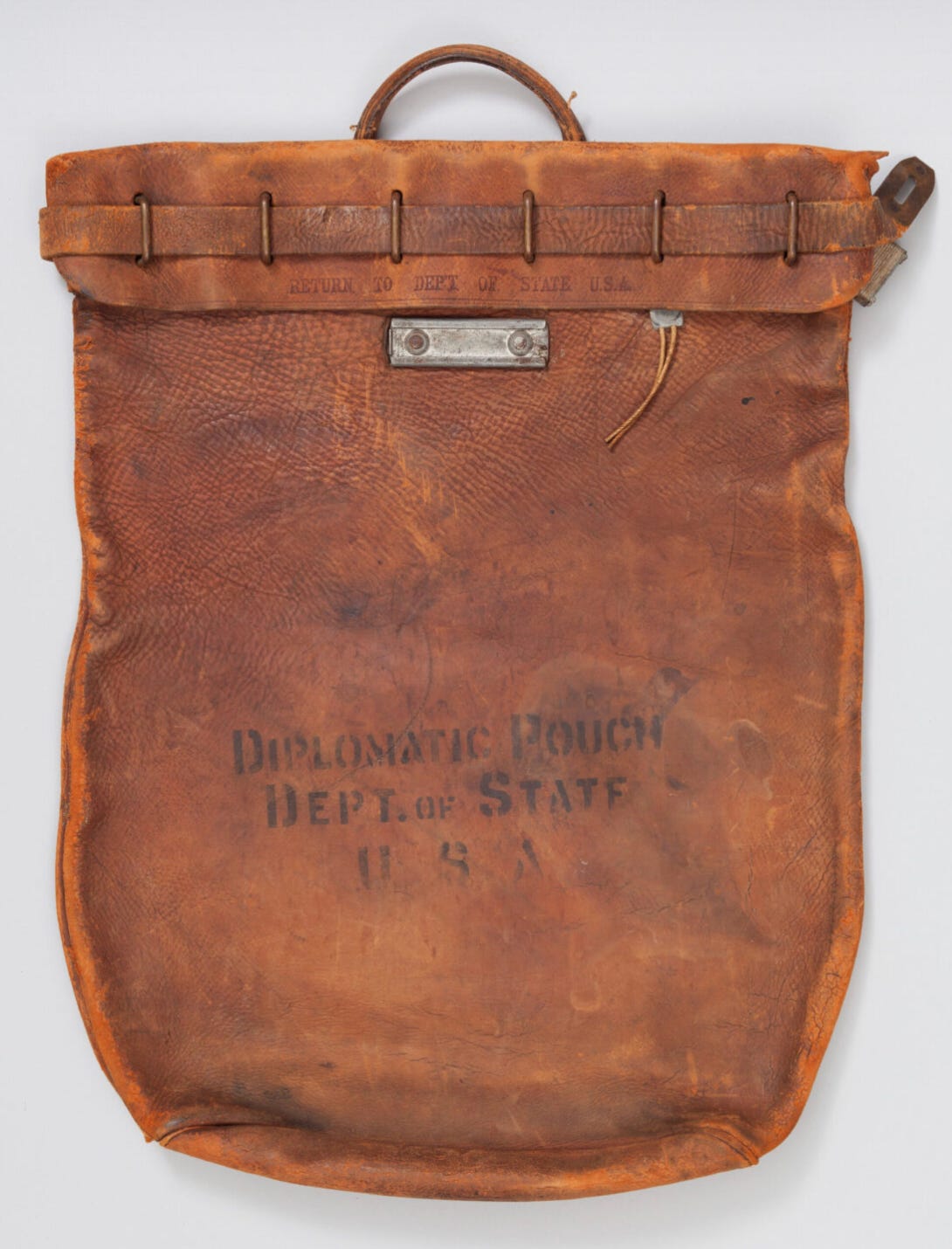
A diplomatic courier pouch used to carry secure materials between Washington and U.S. missions abroad. Credit: National Museum of American Diplomacy.
Diplomacy has a public image problem. From the outside, it can look like the work of summit rooms, formal receptions, crisis calls, and carefully worded statements. Those moments exist. But they are not most of the job.
Jonathan Rose has spent fourteen years inside the machinery of American diplomacy. He began in the State Department’s Bureau of Near Eastern Affairs, served overseas in Saudi Arabia and the Philippines, and later worked on assignments touching cyber and digital policy, Congress, and religious freedom. His career has moved through some of the central institutions of U.S. foreign policy, but the story he tells is less cinematic than most people imagine.
The work, Rose says, is usually slow. It is drafting, reporting, relationship-building, negotiation, cable-reading, and knowing when a crisis demands a decision in thirty minutes or in a week. It is also a life of movement: rewarding, broadening, and sometimes personally costly.
For students interested in foreign affairs, Rose offers a useful corrective. Diplomacy is not only about grand strategy. It is about judgment, patience, curiosity, and the ability to keep working when the results may not appear for years.
This interview has been edited for clarity and length.
From the Archive · originally published in The Pathway Blog, January 2026.
A Career Without a Neat Narrative
Benjamin Wolf: For readers who may not know your path, what has been the through line of your career, and what problem have you consistently tried to work on?
Jonathan Rose: I’ll give a quick summary of how I got to where I am today, but I want to preface it by saying that we should all be skeptical of people who present a very clear narrative of their careers.
In retrospect, it is always easy to craft a story: I did this, and then, for this reason, I did that. But the reality is there is a lot of randomness. There is a lot more trying things that did not work out than people often include on their LinkedIn pages.
Having said that, I grew up in Connecticut, then came to Georgetown in 2006, a few years after 9/11 and the U.S. invasion of Iraq, when Middle East policy was very front and center. I started studying Arabic and the history and politics of the Middle East, and I spent a lot of time in the region as an undergrad.
As a Jewish American, I really appreciated the opportunity to engage in dialogue with Arab and Muslim communities, to talk about issues and try to build understanding. Those were formative experiences for me, and they have guided my career to this day.
I ended up staying at Georgetown for an extra year to complete a combined bachelor’s and master’s degree at the Center for Contemporary Arab Studies. From there, I went to the State Department as a Presidential Management Fellow. I worked as a civil servant in the Bureau of Near Eastern Affairs for a few years on a number of country desks, focusing on U.S. relations with Jordan, Lebanon, and Egypt. I also had the chance to go to our embassy in Cairo for a few months on a temporary assignment.
I really enjoyed the work and found it very interesting, so I decided to switch over to the Foreign Service side. My first assignment was in Saudi Arabia, then the Philippines. Since then, I have had a number of assignments in Washington, including in the Bureau of Cyberspace and Digital Policy. I also did an assignment in Congress as a Pearson Fellow, and I am currently with the Office of International Religious Freedom.
Seventy Percent Curiosity, Thirty Percent Strategy
BW: You said you are skeptical of people who claim there is a straight through line in their careers. When you were moving from your PMF work to the Foreign Service, what was your sense of where your career was heading? Were you uncertain entering the Foreign Service, or was it something you wanted to do since undergrad?
JR: Here’s the thing: when I arrived at Georgetown, I was not thinking about the Foreign Service at all. I was an undecided major. I was not even initially in the School of Foreign Service.
In my first year, I quickly took to my Middle East studies courses, so I switched into the School of Foreign Service and started studying Arabic. Even then, I did not necessarily see myself going into government.
But as I entered my master’s program, thought more about future paths, and then became a recipient of the Presidential Management Fellowship, government service seemed like an interesting and unique opportunity. So I went for it, and here I am fourteen years later.
Especially early on, I was not pursuing my career in a very strategic way. I was taking assignments and thinking, Oh, I didn’t like that as much. Maybe I’ll try something else. Or, That seems really interesting. Let’s go do that.
When I talk to young people about how to structure their careers, I usually advise them to be about 70 percent driven by what is interesting and exciting to them, and maybe 30 percent focused on the medium- and long-term plan if they pursue a particular path.
The Slow Work of Diplomacy
BW: For people outside government, the State Department can often feel opaque in terms of the work it does. In your time at State, what have you found is most misunderstood about how diplomacy works day to day?
JR: We have an image in our heads about different careers — medicine, diplomacy, anything — that is often very different from the day-to-day reality.
On TV, doctors are often performing emergency surgery, rushing in and operating. But as we know, that is a very small percentage of medical work. It is the same with lawyers. The TV image of litigating in front of a judge is a tiny percentage of what most lawyers do.
It is the same with diplomacy. Our image is people in tuxedos clinking glasses with other diplomats and telling fancy stories. That is maybe 1 percent of the work. Most of it is writing reports, going to meetings, and having important conversations — but it is not often “sexy” or high-profile work.
Diplomacy is slow. It is incremental. It is absolutely crucial, but you often do not get to see the fruits of your labor, certainly not in the short term. Sometimes, in the medium or long term, you see things develop in a way you helped shape. But it takes time. It is slow, steady work.
How Negotiations Actually Happen
JR: I’ll give one example. When I was working in the Bureau of Cyberspace and Digital Policy, I was involved in negotiations for a compact at the OECD — the Organization for Economic Cooperation and Development — related to protecting freedom of speech.
After over a year of negotiation, the compact was finalized, but only after I had left the office. And that was still just the first step. Once the compact is in place, it is basically a framework of guidelines for countries to use if they want to implement legislation on that topic. It is a best-practices document. The actual effects, which depend on countries passing and implementing legislation, are potentially years down the line.
BW: Within those negotiations, is it mostly one-on-one meetings with another representative — knowing what you want and what you can give up — or is it more like email exchanges and internal back-and-forth?
JR: It is all of that.
You will have a long draft document that has to be reviewed by various subject matter experts within the State Department and elsewhere in the U.S. government, especially the lawyers. That is where the art of diplomacy comes in.
We know the U.S. ideal outcome. We know our red lines, what we simply cannot accept. The question is: how close can we get the final document to the ideal outcome? Where are we going to yield in the desire to get a final deal?
You have to have good relationships with interlocutors from other countries. You have to understand what their constraints are. You have to build coalitions with other countries, get them to help you on some things, and help them on other things. That is the magic.
Crisis Means Finding the Decision Points
BW: Working in governance and foreign affairs for fourteen years now, what are the first questions you ask in periods of crisis to avoid reacting to noise and decide what is actually worth focusing on?
JR: In a crisis situation, the first thing you want to understand is: what are the decision points? What is the timeline? Do we need a decision in thirty minutes? In twelve hours? In a week?
That tells you how much time you have to gather information, understand context, and ask: is there precedent? What happened last time?
We see on TV this idea of quick and decisive action, and there is a place for that. But the best decisions are informed by context and information gathered through engaging with those in the know, keeping abreast of the latest developments, and so on.
I will give a less consequential example, but I think it is instructive. In a previous assignment — I cannot get into too many details — we received a gift from the leader of an allied country of perishable food that was intended for the White House.
There were a number of hurdles. The food showed up at a U.S. airport. How do we get it through customs in light of Department of Agriculture regulations? And generally, it is very difficult to give food gifts to high-ranking U.S. officials because of safety concerns, anything from food poisoning to more sinister possibilities.
So we had to take it step by step: What do we need to do tonight? Is the food refrigerated? Is there a danger it spoils? Who are our interlocutors elsewhere in the U.S. government? Who can we talk to about this basically novel issue, at least to us?
You gather information, go to your contacts, and keep your higher-ups informed.
The Cable Habit
BW: What have been some of the most effective habits, or moments where you consistently approached the work with a mindset that contributed to your success?
JR: Reading cables. That is definitely something I prioritize and think is important.
We like to joke that within the State Department, we have a “foreign affairs magazine” with the lowest circulation in the world, and that is our diplomatic cable distribution: reports from U.S. embassies and consulates around the world that go back to Washington and to other embassies.
They have a real wealth of information because our diplomats overseas engage with consequential people: business executives, politicians, civil society leaders, and many more. Then they send that information back to Washington. I always prioritized reading those reports to make sure I understood what was happening on the ground.
What Makes Reporting Worth Reading
BW: On that note, what separates a truly effective policy memo or cable from an average one? Is it framing, clarity, evidence, the ask?
JR: Most simply: value add.
These days, there is so much open-source information available compared to, say, fifty years ago. Back then, people did not have news alerts on cell phones. If there was breaking news in another country, embassy reporting sometimes provided context that was not available elsewhere.
Now, a lot of information is readily available through news and social media, so the best cables I have seen do two things.
First, they combine reporting from different offices and functions within the embassy, including the political, economic, military, and other aspects. Bringing in different forms of expertise makes something extremely effective.
Second, sometimes cables are written jointly across countries, with multiple embassies reporting together. That can be very useful because it reveals macro trends. I am excited to see how AI will allow us to do this more effectively and detect those trends across reporting.
What Service Abroad Gives You
BW: What has been the most rewarding part of the last fourteen years for you?
JR: The people and the perspective.
Embassies have all sorts of people: military, State Department, Department of Commerce, USAID, Department of Homeland Security, and others. They represent different facets of American society. And when you are making decisions in an embassy, you are balancing different interests.
Being in the Foreign Service gives you a more balanced perspective on the United States. It lets you see the great things about the U.S., but also the things we need to work on, in the context of living in other countries.
It also makes you thankful for what we have. I have met amazing people in many countries achieving incredible things within their circumstances. But they make me think: if this person were in the U.S., they would be able to achieve so much more.
That is not to say the U.S. is a utopia. You also notice the flaws and challenges, both through comparison and because foreigners ask you pointed questions about various aspects of American society and culture. Overall, gaining perspective on the United States is something I have found very valuable.
The Costs of the Work
BW: On the flip side, what is the least discussed cost of national security and foreign policy work — something you did not fully consider before entering the field?
JR: I will answer in two ways.
Institutionally, security is a major challenge. U.S. diplomats are under constant threat, with a recent high-profile example being the murder of Ambassador Chris Stevens and other embassy staff in Benghazi in 2012. When incidents like that happen, security requirements rightfully increase for U.S. embassies around the world.
Today, when we build new embassies, they have specific and extensive security requirements. That often means embassies are not in the city center, where meeting security requirements is often more challenging. That makes the work of diplomacy harder. Having lunch with a contact takes more travel and more coordination.
Security requirements are absolutely necessary. American diplomats are targeted in many countries. But balancing those demands with the work of diplomacy is an ongoing challenge.
On a personal level, spending long periods abroad can be super fun and rewarding, but sometimes it also means missing important events back home: birthdays, weddings, funerals. Friendships can be harder to maintain if you are moving from place to place. Frequent moves and spending the majority of your time abroad can be a challenge for your personal life.
Advice for Students
BW: If you were advising a student trying to enter this field, what would you tell them about experiences or habits, perhaps things you did in college, that set you up for success?
JR: Find things that interest you and spend time engaging on those issues.
At your university, there are probably professors doing interesting work on topics you care about, and they are often looking for research assistants. That is one way to get experience.
If you are in a big city with government agencies, nonprofits, or private-sector organizations, internships in a field of interest are another way to get experience.
And as you do those things, take the time to have conversations with people. Have coffee or lunch with them and ask what their work actually looks like, what they love, and what they hate. People are usually very happy to talk.
Sometimes the most important things in those conversations are the things left unsaid. How do people talk about their careers? Do they have regrets? Are they excited about what is next?
Also, do not be afraid to cold-call on LinkedIn or by email. Most people are eager to chat with students and give advice, even if they do not know you. Put yourself out there.
Two Books on Vietnam and Diplomacy
BW: Last question, as is customary with the blog: if there is a student interested in this field and wanting to follow a pathway like yours, what is a book, essay, or piece of literature they should read, and why?
JR: I will give two books, one fiction and one nonfiction. They are both coincidentally about the Vietnam War, but they focus on very different aspects.
On the fiction side: The Sympathizer by Viet Thanh Nguyen. It is a spy novel and a refugee story. It is really fantastic. It grapples with the role of America in the world, and what that looks like domestically and internationally.
The other book is Diplomats at War by Charles Trueheart. It is about the real-life relationship between the author’s father, William Trueheart, who was Deputy Chief of Mission at the U.S. Embassy in Saigon, and his boss and close friend, Ambassador Frederick Nolting.
It shows how their friendship fell apart because of policy disagreements about the war and how events unfolded. It is compelling because you get the work perspective, the family perspective, the bureaucratic wrangling within the U.S. government, the geopolitical context, and more.
BW: I am actually going to Vietnam this summer for about a month through an international studies program at Tulane, so I am definitely going to check those out before I go. Jonny, thank you again for your time. This has been incredibly informative. It has been a real honor.
JR: Thanks so much for having me.
About the guest: Jonathan Rose is a U.S. Foreign Service Officer at the U.S. Department of State. His assignments have included work in the Bureau of Near Eastern Affairs, overseas postings in Saudi Arabia and the Philippines, the Bureau of Cyberspace and Digital Policy, a Pearson Fellowship in Congress, and the Office of International Religious Freedom.
About The Pathway Review: The Pathway Review publishes long-form interviews with people in politics, policy, journalism, law, diplomacy, markets, and public service about the work they do and the path that brought them there.
Subscribe to receive new interviews in your inbox.
This interview was conducted in January 2026 and has been edited for length and clarity.