

Daniel Schuman on Modernizing Congress, Transparency, and Rebuilding the First Branch
Daniel Schuman is the founder and executive director of the American Governance Institute, the creator of EveryCRSReport.com, and the editor of First Branch Forecast.

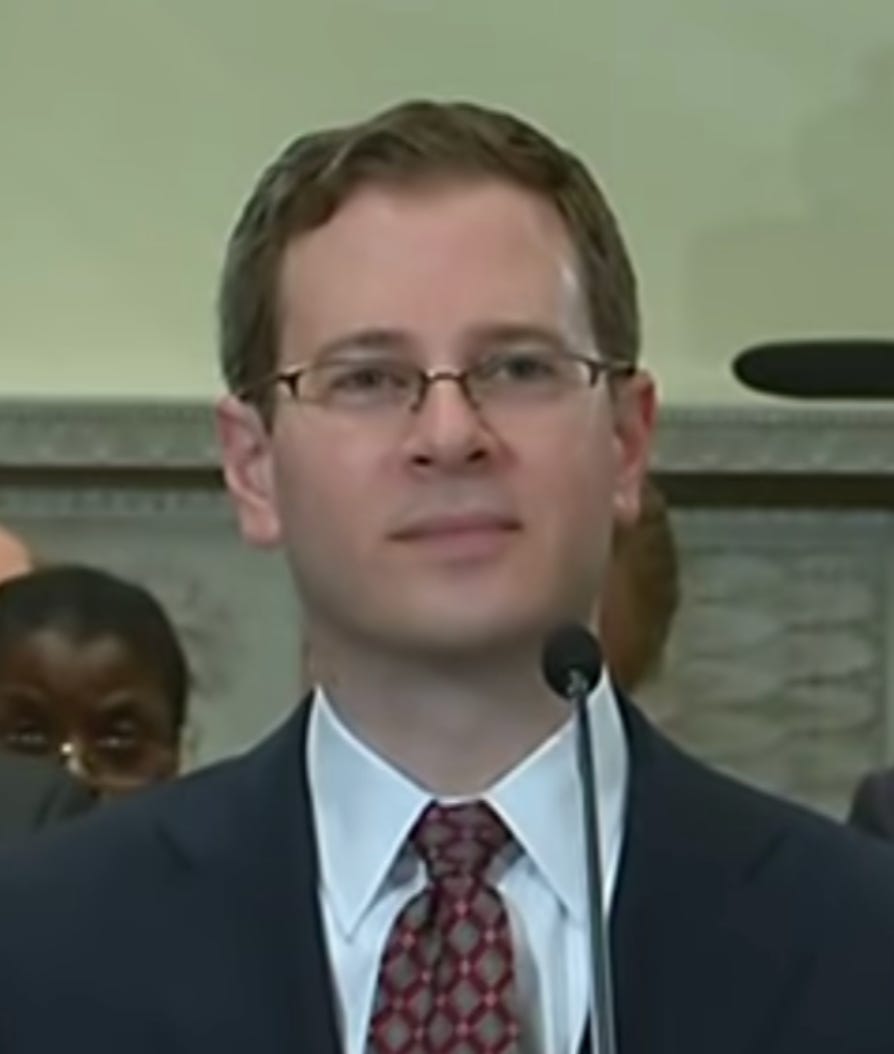
Daniel Schuman testifies before the House Select Committee on the Modernization of Congress in 2019. Photo courtesy of the U.S. House Select Committee on the Modernization of Congress, public domain.
Congress is supposed to be the place where power gets argued over before it gets exercised. That is the theory, at least: a noisy, imperfect institution where competing factions bargain, compromise, and resolve conflict without violence.
Daniel Schuman has spent much of his career asking why that institution so often fails to meet its own purpose, and what it would take to make it work better. His focus is not the usual cable-news story of Congress: who is up, who is down, who embarrassed whom at a hearing. He is interested in the deeper machinery: rules, staff capacity, public access to information, oversight, appropriations, technology, and the quiet ways power moves when institutions are too weak to resist it.
Schuman’s work has helped shape some of the modern transparency infrastructure around Congress, including EveryCRSReport.com and the broader push to make legislative information more usable to the public. But one of his most important lessons came from a fight that began as a technical demand and turned into something larger: a lasting culture of modernization inside the legislative branch.
This conversation is about Congress as an institution, not just a political theater. It is also about what reform really looks like: not a single breakthrough, but a series of openings, coalitions, habits, and sometimes accidents that create room for the first branch to govern again.
This interview has been edited for clarity and length.
From the Archive · originally published in The Pathway Blog, February 2026.
The Problem: A Parliament That Can Govern
Benjamin Wolf: Daniel, I want to start by asking: for readers meeting you for the first time, what is the core problem you have spent your career trying to solve, and what made it feel worth committing to?
Daniel Schuman: For the last 20 years, I have been focused on this question: how do you build a strong and effective parliament in our political system?
What put me down this path is that I’m interested in how systems work. And one of the most interesting and pivotal institutions in the world is the United States Congress. So that is why I focus there.
BW: When you say you’re interested in how systems work, what do you mean? How they get things done?
DS: Congress is the place that, at least in theory, people can come together and solve their problems in a nonviolent way. And of course, the United States has been the pivotal nation of the world. Decisions we make here don’t just affect people inside the United States. They affect people around the world.
There are lots of different ways that power gets concentrated. You can have corporate power, political power, economic power, oligarchical power. But Congress is the institution we created that is a counterweight, or at least can be a counterweight, to these things.
And the rules it creates change the incentives for all the other actors. It gets to change the landscape. That is very interesting.
But it doesn’t work all that well, or it doesn’t seem to be working all that well. And it has gotten markedly worse in the last 10 or 15 years. So I’ve been very interested in that problem. That is where I’ve been spending my time.
BW: Where do you see the future of governmental, maybe not efficiency but efficacy, actually working in your terms?
DS: Yeah, and it is not necessarily efficiency. That is a useful value. It is really the legitimizing of the exercise of power.
Congress and politics are about power: how it works and who it benefits. And I’m having a really hard time these days seeing a positive outcome from all this work.
I see a pathway to make things better. The pathway is becoming narrower and narrower. But that is where I focus my life’s work, just trying to get us to go down the right path to fix things.
BW: And what is that path?
DS: At this point, it is allowing multiple factions to be able to operate inside the legislative branch, so you don’t have two different teams fighting with one another. And it is having the vast majority of the players committed to democracy and rule of law, to countering the power grabs we see in the executive branch, the courts, and elsewhere.
A Technical Fix That Became a Cultural Change
BW: Was there a specific experience, inside an institution or watching from the outside, when you realized your earlier assumptions about how change happens in Washington were incomplete?
DS: Oh, yeah.
I came to Washington in 2001. My first day on Capitol Hill was 9/11. And I had been on and around Congress for maybe, by that point, about 10 years.
Around 2010, I was working at the Sunlight Foundation, a nonprofit focused on government transparency. We had been fighting to get the Library of Congress to publish data about legislation online.
Since the mid-’90s, there was a tool called THOMAS, a website where you could see bills being considered, but it didn’t work very well. Links would break after five minutes. It didn’t publish information in a way that other people could reuse. So if you wanted to analyze legislation, if you wanted to track what was going on, you were using this really bad information source.
And THOMAS at the time was essential for journalists and for civil society. It helped collapse the difference in power between those who are very wealthy and well connected, who could find out what was going on, and the vast majority of people who could not.
We had been pushing and pushing and pushing for the Library of Congress to publish this information online as structured data, and they just would not do it. We had been fighting that fight for 15 years, and they were not going to give in.
We found legislative allies, and we had a memo that was being offered in an appropriations bill by Darrell Issa, who was, and still is, a congressman from California. He was chair of the House Oversight Committee.
Republican leadership said to him: don’t do this. If you do this, it is going to create all sorts of problems for us. They really twisted his arm on behalf of the Library, which did not want this information to be available in a useful way.
They came up with a compromise: they would create a committee to study the issue, the Bulk Data Task Force. The idea was that the issue would go there and quietly be killed. At least that was the idea on the part of Republican leadership.
They pulled together people from the House, the Senate, support offices, support agencies, to figure out whether this information should be made publicly available as structured data.
What they did inadvertently was bring together all the technologists from these different places, people who care about making things work right, people who didn’t know each other. They got to know each other through this task force: leadership, committees, personal offices, support offices, and agencies.
I brought a group of folks and we testified before them. They agreed with us. And they ultimately directed the Library to publish the information.
But that wasn’t the thing that was interesting.
What was interesting is that they kept meeting. They have been having quarterly meetings with the public for the last 16 years now. They have become a driver of modernization in the legislative branch.
We aimed for a technical fix: publish this data in this format. And what we got was a cultural change. Bringing together people created a different attitude, a different way of relating, and a different focus.
This is not to say we have solved all of our problems, because we haven’t. But what I was aiming for was not the right thing. We stumbled into it, and that thing continues to transform the way Congress works.
September 11 and the Anthrax Letters
BW: You mentioned your first day in Washington was on 9/11. Can you tell me a little bit about what that experience was like?
DS: Yeah. So 2001 was a really tough year for me. My grandfather passed. My father had open-heart surgery. So I came to D.C. in September of 2001 instead of earlier, when I had intended.
It is difficult to explain how different things were then. There was a job announcement bulletin that was published on paper once a week. And one of the ways you could look for jobs was that you would go and knock on doors.
So I did that. I went and knocked on doors. I met with my two senatorial offices, my member of the House, and other people as well — committees — asking: are you looking for anyone? Do you need anybody right now?
One of the places I looked was with one of my two senators, Joe Lieberman, who was a Democrat at the time. I had gone to interview for an internship, and that interview was on 9/11.
So I came into, I think, the Hart Building or the Dirksen Building. I don’t remember anymore.
I was staying in an unfurnished apartment in Georgetown. The only furniture I had was a blow-up air mattress and my clothes. I took the D6 bus from Georgetown to Union Station. I got off at Union Station, and I was walking to the Senate.
I was getting close to the building, and I started seeing everybody running the other way. It was 9:30 in the morning. My interview was at 10. The World Trade Center had been hit at 8-something. The Pentagon was hit a little bit later than that, so it had been hit as well.
People were running out of the buildings. I was getting closer, and I can pick up on a hint: this is clearly not right.
I asked a police officer what was happening. He said the World Trade Center was hit, the State Department was blown up, which of course was not true, but it was the fog of war, so you didn’t know. And everything was locked down.
And I said: it looks like I should get the hell out of here. He said, yeah. And that is what I did.
I first tried going to Union Station, which was closed. I ended up walking back to Georgetown.
I came back the next week, had my interview, and got the internship. I was there for five weeks or four weeks, and then it was the anthrax attack.
I was an intern, so I was working in the mail room. Lieberman’s mail room was right next to Daschle’s mail room, and Daschle was one of the people who received the anthrax. That was the end of my time in the Senate.
I was on Cipro for 10 weeks. I switched to the House. It was really tough. It was really tough for a lot of people.
There is a photograph in The Washington Post from that day. It is a picture of a guy holding a giant vial with a Q-tip in it. That is my friend Greg, who was interning with me in Lieberman’s office. The expression on his face is basically saying, “WTF.” He is looking at me and showing me what we are in for.
Nowadays, with COVID, everyone is used to having giant Q-tips shoved up your nose. But that was a novel thing in 2001, and I hadn’t had that done before.
Afterward, I worked in Rosa DeLauro’s office as an intern, and I got a job later on as a staff assistant for a congressman from Florida.
Four months into that job, they started delivering the mail again, and it was all irradiated. It was crinkly, crackly stuff that you opened and it just spurted out, like it was from the movie Alien, like the spores of irradiated crap just flowed into the air.
That is what I remember of that time, along with getting trained on how to put on a quick hood in case of a chemical attack. Have you ever seen the Austin Powers movies?
BW: No.
DS: Well, there is a scene where Dr. Evil has this giant clear mask over his head, like he’s in a bubble. That is what it was. You got trained in putting those things on.
So that was my introduction to working on Capitol Hill.
BW: Wow. Quite an introduction.
Inside vs. Outside
BW: You have navigated spaces that reward different instincts: policy, advocacy, institution-building, public-facing work. How do you decide when to be a builder inside the system versus a pressure source outside of it?
DS: I don’t think there is a distinction.
I think you look for where you have the greatest ability to do the greatest good.
Part of this conversation is: how did I get to do what I’m doing now? And the answer is that my job did not exist when I started my career.
My job at the Sunlight Foundation didn’t exist. They made the position for me. My job at Demand Progress didn’t exist. The executive director recruited me to go work there. The jobs were built around my strengths and weaknesses.
A lot of the people I know who are really good at what they do build the things around them. They find a way to make the space their own.
Whether you’re on the inside or the outside, you go back and forth between the two. For me, when I had a choice about what I did next, I would always angle toward the thing that was more interesting and a better fit.
So if someone asks, “How do I get to be the executive director doing a focus on rules reform, appropriations, and all the other stuff that I do?” It wasn’t a thing. It’s a thing now, but it was never a thing before.
Media, Incentives, and Recency Bias
BW: From your perspective, how has the modern media environment changed incentives for members and staff in ways that make serious governance harder, and also for the people on the journalism side of things? Are there any counter-trends you find encouraging?
DS: I’m not sure that’s true.
BW: What isn’t?
DS: In the 19th century, members of Congress would give speeches on the floor, and there were no transcripts. Journalists would write what was said, and then the members would go hang out with the journalists at Swampoodle, near what is now Union Station. They would clean it up and then send it out to be published in newspapers. That would create a tremendous political reaction around the country that would influence what members did.
So the media, major media, has always been closely related to the work Congress does.
I’m not sure the current media environment makes it harder for them to do their jobs. I think the way they have designed their institutions is making it harder for them to do their jobs. Most members of Congress don’t have anything meaningful to do with their time. They’re not being valued. They haven’t created institutions that support their work.
The nature of Congress has changed in ways that are more radical than is easy to understand. And the nature of the press has changed.
In the 19th century, you had journalists who would sit in the House, who would be clerks for committees, and who would gamble on the stock market with insider information about what they were covering.
You had the press at the turn of the 20th century stampeding Congress into war with Spain: yellow journalism.
There was a series of articles in Century Magazine that exposed corruption of senators and led to direct election of the Senate.
So I think we suffer from recency bias when we evaluate the press.
Now, there is definitely a lot more crud, bad-faith political stuff. It seems like there’s a lot of it right now. It was also really bad at other times in our history, where it was nasty. And it was harder to ascertain the facts.
I do think algorithm bias in social media has changed the way we access information around us, for good and for ill. But I wouldn’t necessarily say things are worse in terms of the relationship between the press and those they cover.
If anything, there are not enough journalists covering what is going on, so a lot of things remain uncovered in ways that would be helpful if they were exposed.
BW: Just to play devil’s advocate: even when reporters aren’t lying, the incentive structure can still reward selection and framing, highlighting the most provocative lines because outrage travels farther online and attention converts into revenue. How do you think that dynamic affects coverage of Congress today? And are there norms or counterweights that still keep serious reporting anchored to what is actually true?
DS: I think it has almost always been true.
We had a period of time where it was a little bit less so. But even then, who are you?
So, for example, in the 1940s, 1950s, and 1960s, television news might have been a little bit more neutral, or the Associated Press might have been.
But do you know why the Associated Press takes a neutral perspective in its reporting?
BW: I couldn’t say.
DS: It’s really interesting.
They realized that the papers they were trying to sell reporting to in the 19th century were all Democrats or Republicans or whatever. And if you put a perspective in your writing, you couldn’t sell to all of them. So they made it as clean as possible, so whoever took their reporting could put their own spin on it.
So the reason they did it wasn’t some noble calling or higher truth. It was because they could make more money.
And the idea that “if it bleeds, it leads” has certainly been true throughout my lifetime.
Think about all the stories newspapers didn’t cover: civil rights, employers mistreating workers. Historically, there was no women’s perspective, no Black perspective, depending on what paper you were reading and when.
We look at it through rose-colored glasses, as if having Tom Brokaw or Dan Rather was a pure good. And they were, to some extent. My parents talk about Walter Cronkite. But there is a whole lot of stuff that never got coverage, ever.
And the elite consensus around what you can and can’t talk about: it’s fine if you’re part of the elite, if you benefit from it. Not so great otherwise.
Journalists have always been in business to make money. There have been changes. Billionaires now own journalistic publications. “Freedom of the press” only counts if you own a press.
Of course, now more people can publish themselves. I do think there is less filtering now. But in the past, if you go back 100 years, you would read a paper relevant to your political party, and that is how you got your news.
Advice to Students
BW: As we close, I want to turn it directly to students. If you were advising a sharp undergrad, or if you could go back to your time as an undergrad, wanting to work in government, governance reform, and journalism, what concrete steps would you take: internships, experiences, habits, and why?
DS: The first thing that is valuable: if you want to be a journalist, if you want to engage in the policymaking process, if you want to be a press person, I would intern for Congress, if there is a way to do so.
I would aim at committees or leadership more than personal offices, if you can. Understanding the tempo and the incentives and the nature of the people who work there is incredibly valuable for the rest of your life.
Doing what you’re doing — being curious, talking to people, asking them questions, figuring out what they do and why — is incredibly valuable as well.
Be willing to try new things, different jobs. Experiment and see what fits you and what doesn’t.
There is a lot of received wisdom about how to do stuff. Everyone has an opinion about the right way and the wrong way.
It is worth finding out that just because something has been done one way in the past doesn’t mean it has to be done that way in the future.
You hear a lot of people talk about Chesterton’s fence, the idea that if there is a fence out in the woods, it is there for a reason.
I can tell you: oftentimes, things are done a certain way for no good reason whatsoever, or the reason no longer exists. So there is nothing wrong with being bold and trying to think things through for yourself. That is how progress is made.
Start With CRS
BW: Finally, Daniel, I like to close Pathway Blog conversations by asking: for someone interested in your career path, or at least entering the same general field, what is a piece of literature, a book, an essay, an article, that you would recommend, and why?
DS: It’s such a tough question.
I won’t recommend a book, although I have several that I can think of that would be really interesting. I would recommend a website.
I run EveryCRSReport.com, which has 20,000-ish Congressional Research Service reports, more than is available from any other source.
Go to that website and type in a topic you care about. I used to write those reports. You can see what an expert on a topic says. It helps give you grounding for what the subject matter is.
Then go look at the footnotes. Find the footnotes that are interesting and use that as a jumping-off point to learn more about what you care about.
About the guest: Daniel Schuman is the founder and executive director of the American Governance Institute, a nonpartisan nonprofit focused on strengthening American democracy’s institutions. He created EveryCRSReport.com, edits First Branch Forecast, and has worked across congressional transparency, oversight, appropriations, rules reform, legislative data, and institutional capacity. He previously worked at the Sunlight Foundation, Demand Progress, and the Congressional Research Service.
About The Pathway Review: The Pathway Review publishes long-form interviews with people in politics, policy, journalism, law, diplomacy, markets, and public service about the work they do and the path that brought them there.
Subscribe to receive new interviews in your inbox.
This interview was conducted in February 2026 and has been edited for length and clarity.