


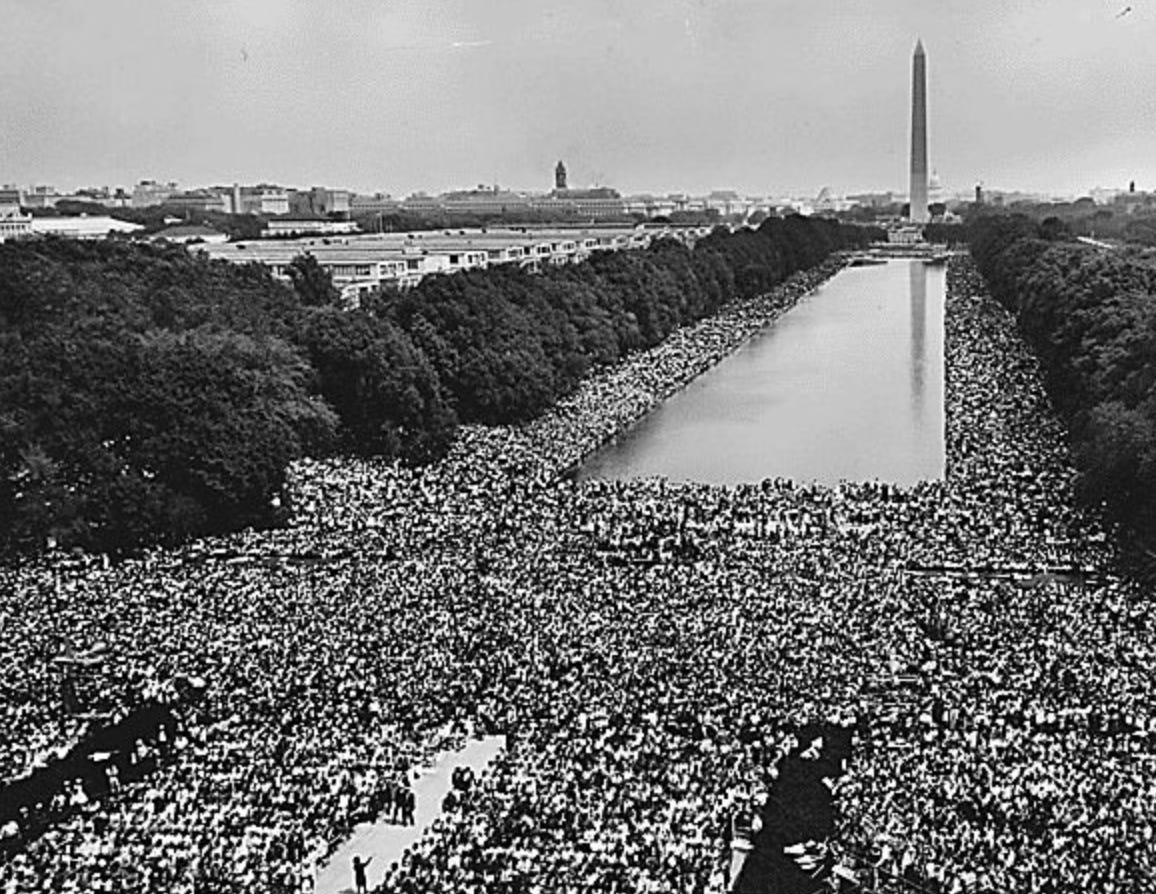
March on Washington for Jobs and Freedom, August 28, 1963. U.S. Information Agency / National Archives. Public domain.
For decades, Americans tended to talk about human rights as something that happened somewhere else. Political prisoners in authoritarian states. Refugees fleeing wars. Governments shutting down newspapers or persecuting minorities. The United States, in that telling, was the country doing the scrutinizing.
Léocadia Tchouaffé’s work starts from a different premise: What if the same international standards Washington invokes abroad are applied at home?
Tchouaffé is a human rights fellow at the Southern Poverty Law Center, where she works to connect international human-rights mechanisms with domestic civil-rights advocacy. It is a fitting assignment at a strange moment for that system. The United States declined to participate in its scheduled 2025 Universal Periodic Review at the UN Human Rights Council, and in January President Trump ordered the government to withdraw from 66 international organizations, including 31 UN entities, arguing that they no longer served American interests or sovereignty.
Tchouaffé sees that retreat as a mistake. But her own career also gives her an unusual vantage point from which to make the argument. The daughter of Cameroonian immigrants, she began in refugee resettlement and African development advocacy before turning toward human-rights work inside the United States. We spoke about what changed when she brought that framework home, the strongest case for American skepticism of international institutions, what activists can do when Washington refuses to participate, and why there is no obvious résumé for a career in human rights.
This interview has been edited for length and clarity.
The Interview
Ben Wolf: Most Americans hear “human rights” and picture issues abroad. What does your work actually consist of?
Léocadia Tchouaffé: I work in human-rights policy, which encompasses a lot of different things. In my role specifically, I work on applying international human-rights policy and the mechanisms that exist globally to domestic civil-rights and policy work in the United States.
A lot of Americans tend to think of human rights as a foreign-policy issue — something that happens in developing countries or somewhere outside the United States. My work asks how those same frameworks and mechanisms apply to what is happening here.
BW: How did you end up doing that?
LT: I’ve always been interested in human rights. My parents are from Cameroon, in Central Africa, and I think growing up in an immigrant household gave me a somewhat different understanding of what human rights meant.
It was something we talked about growing up, even if we weren’t discussing the specific international mechanisms or legal structures. For a long time, I thought I wanted to become an international human-rights lawyer. Like a lot of people interested in this field, I looked at someone like Amal Clooney and thought that kind of career was incredibly interesting.
Eventually I realized I was more drawn to organizing and policy work on the ground than to practicing in a courtroom.
I worked in refugee resettlement for a couple of years. After that, I worked in foreign-aid advocacy, trying to persuade members of Congress to fund programs dealing with HIV/AIDS, poverty, education, and other issues in Sub-Saharan Africa.
Until graduate school, almost everything I had done was international. Then, through the Master of Human Rights program at the University of Minnesota, I received a fellowship with the Southern Poverty Law Center. That brought me into domestic human-rights work.
It was a major shift. I had spent years thinking about what human rights meant internationally. Now I was asking what those same standards mean in the American context.
BW: What changed when you began applying that framework to the United States?
LT: Knowing what I know now, I’m not sure the difference is as large as I once thought it was.
When you look internationally, some violations can appear much more obvious. Take Cameroon. There has been a long-running conflict involving the country’s Anglophone minority. During that conflict, villages have been burned and the government has shut down internet access in English-speaking parts of the country. Those are actions that very clearly raise human-rights concerns.
From an American perspective, it is easy to look at something like that and think: That is what a human-rights violation looks like. We have freedom of speech and freedom of religion here, so human rights must be something happening elsewhere.
But those freedoms have never been experienced equally by everyone in the United States.
One thing I have noticed in my current work is that Americans often lack a formal education in human rights. In many other countries, people encounter the United Nations, the Human Rights Council, and international human-rights mechanisms as part of their education. In the U.S., unless you study something like political science or international affairs in college, you may never learn much about those systems.
That is beginning to change in some organizing spaces. I was recently in Minnesota speaking with a former professor who has been involved in local organizing. She told me that one community meeting actually began with a presentation on human-rights theory — what these rights are, where they come from, and how they relate to organizing.
A few years ago, I’m not sure people would have thought that was necessary. Now there is more recognition that understanding the framework can help people understand both what is happening and what mechanisms exist for responding to it.
BW: The administration frames its withdrawal from these institutions as a question of American sovereignty rather than an abandonment of human rights. Steelman that argument. Where does it have a point, and where do you think it goes wrong?
LT: I can understand why someone would ask why the United States needs to participate in all of these institutions, or whether every international organization is actually effective. Those are legitimate questions.
But I think it is striking, because the United States played such a major role in constructing the international system in the first place. For decades, despite all of the country’s own faults, the United States presented itself as a leader on human rights.
Coming from an immigrant family, that matters to me personally. The United States was often seen as a place where you could be safe and become who you wanted to be. So seeing an administration dismiss large parts of the international human-rights architecture is disappointing.
I also think there is a broader philosophical question underneath the administration’s approach. My concern is that human rights are increasingly being framed through a particular conception of “natural” or God-given rights rather than through a universal international framework.
As a Christian myself, the phrase “God-given rights” can sound perfectly reasonable. But in a religiously and culturally diverse country, the obvious question is: whose conception of God, and whose definition of those rights?
That is where I worry about Christian nationalism becoming part of the conversation.
And these institutions are not simply symbolic. They create mechanisms through which countries can be scrutinized and held accountable. You can absolutely criticize whether those mechanisms are effective enough. But if you withdraw from the institutions that provide external accountability, you still have to answer the question: what replaces them?
BW: If the federal government will not participate, what can people working in human rights actually do?
LT: One major part of our work right now involves the Universal Periodic Review, or UPR.
The UPR is a process through the UN Human Rights Council in which every UN member state periodically has its human-rights record reviewed by other countries. Governments report on what they are doing, other states make recommendations, and then there is another review several years later.
The United States chose not to participate in its most recent scheduled review. [The Human Rights Council rescheduled the U.S. review for the working group session of November 2–13, 2026, while urging Washington to resume cooperation before then.]
So our question became: if the federal government is not going to participate, how do we still involve Americans in this process?
One thing we have been doing is what we call “UPR at Home.” We bring state legislators together with NGOs and people directly affected by these issues, so lawmakers can hear testimony about human-rights conditions in their own communities.
We held one in Atlanta in May. State legislators heard from organizations and directly impacted people working on voting rights and democracy, migration, reproductive rights, and criminal justice. [The May 18 convening, co-hosted with the State Innovation Exchange, drew legislators from Georgia, Florida, and Tennessee.]
Obviously a state legislator cannot formally substitute for the federal government in the UN process. But the point is to show that the federal government is not the entirety of American society. There are state officials, members of Congress, civil-society organizations, and ordinary Americans who still want to engage.
It also builds a foundation for the future. Administrations change. Congresses change. If the federal government eventually reengages with these institutions, the work does not have to begin again from zero.
And even before then, it helps hold government accountable by making more people aware of the standards that exist and the commitments the United States has made.
BW: For someone who wants a career like yours, what has experiences have mattered most in your own development?
LT: The first thing I would say is that human-rights careers are not very linear.
I know so many people doing this work who arrived here through completely different paths. My boss, for example, spent years as a litigation lawyer working on civil rights before moving into human rights. I thought I was going to law school and didn’t. I worked in refugee resettlement, then foreign-aid advocacy, then went to graduate school, and eventually ended up here.
So I can’t tell someone: do A, then B, then C, and you will get this job.
What I would tell them is to stay very open and learn about things outside their immediate specialty.
Most of my background was in Sub-Saharan Africa. But through graduate school and through meeting other people in this field, I’ve learned about LGBTQ rights, housing, climate change, criminal justice, and many other areas where I would never claim to be an expert.
Knowing those people, hearing their stories, and understanding their work gives you a much broader conception of what human rights actually encompasses.
I would also tell people to learn history. I studied history as an undergraduate, and that way of thinking has been enormously useful. Human-rights issues do not appear out of nowhere. Understanding how we arrived at a particular political or social situation helps you understand the people you are working with and the problems you are trying to solve.
So there isn’t one credential I would recommend. Stay curious. Learn a little about a lot of things. Understand the history. And be willing to take a path that does not look linear.
About the guest
Léocadia Tchouaffé is a human rights fellow at the Southern Poverty Law Center, where her work includes engagement with the United Nations and other international mechanisms and connecting those frameworks to domestic policy and advocacy. She holds a Master of Human Rights from the University of Minnesota, where she was awarded the Barbara Frey Human Rights Fellowship, and a B.A. in political science and history from the George Washington University. She previously served as a regional organizer for the ONE Campaign, advocating for U.S. foreign-aid funding on HIV/AIDS, gender-based violence, and poverty in Sub-Saharan Africa, and worked in refugee resettlement in Kansas City.
About The Pathway Review
The Pathway Review is an interview publication about foreign policy, government, political economy, and the people who shape them.
Subscribe to receive new conversations directly in your inbox.