

Bret Stephens on Polarization, Social Media, and the Practice of Citizenship
Bret Stephens is a Pulitzer Prize-winning opinion columnist for The New York Times and a former foreign-affairs columnist and deputy editorial page editor at The Wall Street Journal.

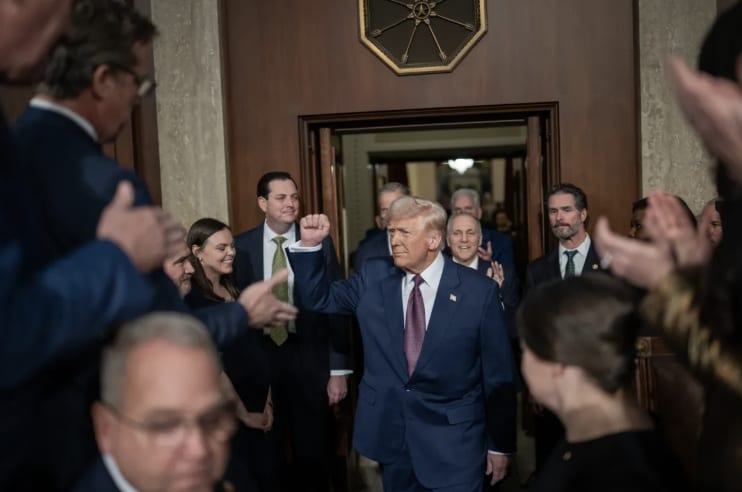
President Donald Trump delivers a joint address to Congress in the House Chamber of the U.S. Capitol, March 4, 2025. Official White House Photo by Daniel Torok, public domain.
Bret Stephens thinks Americans have forgotten how to disagree.
That sounds simple enough, until you follow the argument into the places where disagreement is supposed to be learned: families, classrooms, newsrooms, Congress, and friendships across party lines. Stephens’s concern is not just that Americans hold strong political views. It is that more of us now live inside communities, marriages, media diets, and online worlds that make the other side feel less like fellow citizens and more like strangers.
This second conversation with Stephens is about the habits that make democracy possible before anyone ever casts a vote. Dinner-table arguments. Real friendships across ideological lines. News organizations that put opposing views in conversation instead of sorting readers into separate rooms. Colleges that reward hard work and intellectual seriousness. None of that is a grand constitutional reform. But for Stephens, it may be closer to where the repair has to begin.
This interview has been edited for clarity and length.
From the Archive · originally published in The Pathway Blog, April 2025.
Polarization at home
Benjamin Wolf: You’ve talked before about the “dying art of disagreement.” One stat I dug up for my capstone: today, fewer than a third of marriages are between people of opposing political parties, and only about 6 percent are between Democrats and Republicans, a big drop since the 1970s. What civic consequences do you see coming from this kind of political sorting?
Bret Stephens: The short answer is mutual incomprehension.
In 2016, many Democrats couldn’t understand how anyone could vote for Trump and concluded that those who did must be ignorant or morally corrupt, hence Hillary Clinton’s “basket of deplorables” line. On the other side, many MAGA Republicans see Democrats as elitist, unpatriotic, or anti-American.
All of that is shaped by increasing political homogeneity in our communities and families. When people mostly live, marry, and socialize with those who agree with them, it becomes easier to see the other half of the country as alien, or even contemptible. That’s dangerous for democracy, and it’s bad politics. I think Democrats lost in 2024 partly because they didn’t grasp the priorities of voters who don’t live inside their cultural or media bubble.
Families, echo chambers, and learning to argue
BW: Given that rise in ideological echo chambers, how does polarization affect public discourse at a human level?
BS: One of the most important places we learn how to be citizens is at home.
In politically diverse families, kids watch disagreements play out around the dinner table. They learn that people they love can hold opposing views and still respect one another. That’s an education in both argument and empathy.
In homogenous households, kids mainly learn certitude. They grow up without hearing smart, good-faith versions of the other side. I grew up with parents who didn’t always agree politically. My father was more conservative than my mother, and they debated around the table. That experience helped me later when I became a conservative columnist at a very liberal paper. I’d already learned how to argue for my views before an audience that didn’t share them.
Why social media is terrible for disagreement
BW: You’re not very active on social media, but people often blame it for polarization. Is social media fundamentally bad for disagreement?
BS: Yes. It’s terrible for disagreement.
It’s impersonal. On Twitter, I could insult you, call you a moron, not that I would. But it’s much easier to do that online than face-to-face. And if you reply, I can just block you. Social media lets you speak without compelling you to listen.
It doesn’t foster humane, thoughtful exchanges. It encourages cruelty because the interaction is disembodied. You’re not engaging with a whole person, just their opinions floating in the ether. That’s a very unhealthy way to practice politics.
BW: So is social media the main driver of polarization?
BS: It’s a major contributor, but not the only one.
We’re also polarized because of how districts are gerrymandered, how cable news separates audiences into tribes, Fox versus MSNBC, and more. But social media introduced a new kind of political interaction that’s omnipresent and difficult to adapt to.
Every new communication technology has unforeseen consequences. Radio in the 1930s is a classic example. We’re still grappling with the consequences of this one.
Performative politics and the breakdown of governing
BW: Politics today feels performative, driven by outrage rather than policy. How does that affect lawmaking and governance?
BS: Look at Donald Trump. He figured out how to use social media to dominate his party.
If a member of Congress crosses him, a single post can threaten their career. That kind of direct, unmediated power would have been unthinkable in the Reagan era.
What’s changed is that there’s no longer an intermediary between politicians and the public. In the past, journalists and editors played a filtering role, contextualizing and, frankly, sometimes sanitizing what leaders said. Now, leaders speak directly to millions in real time. In some ways, it’s like Franklin Roosevelt using radio, except the tone can resemble darker examples, like how demagogues also used radio.
With no filter, public opinion is constantly being whipped around, and Congress struggles to perform its traditional role as a deliberative body.
What journalism can do
BW: I recently spoke with Jane Kamensky, who made a similar point about the loss of filters and the way people now choose media that simply reinforces their beliefs. Given your experience in print and digital media, are there reforms journalism itself could pursue to help?
BS: Yes, there are things we can do.
One example is the running debate I have with Gail Collins at The New York Times. Our exchanges force readers to engage with two distinct viewpoints in one place. I’d love to see more of that: structured, good-faith debates, rather than siloed opinion spaces.
Television could do something similar. Instead of assembling panels where everyone agrees, bring on people who genuinely disagree and let them argue substantively, not just shout.
Can institutional reforms help?
BW: Some scholars argue polarization alone doesn’t kill democracy, but when it’s combined with declining trust in institutions, it can lead to democratic erosion. Are there institutional reforms you think might help?
BS: I’m cautious about institutional tinkering. Reforms often fix one problem and create another.
Take ranked-choice voting: it sounds attractive in theory, but it can produce bland, lowest-common-denominator candidates. That doesn’t excite anyone.
What I’m more drawn to are social reforms that rebuild basic human contact. I sometimes joke about a “Congressional date night”: every week, randomly pair a Democrat and a Republican, and have them go to dinner and talk about life, not politics. Just building human connection.
We may not need to fix the hardware of democracy first. We probably need to start with the software, our habits, relationships, and norms.
Hope, history, and college advice
BW: Big-picture question: do you think we can reverse polarization, or are we stuck in a self-perpetuating cycle?
BS: I don’t think we’re doomed. We’ve been through very polarized periods before: the 1960s and ’70s, with Vietnam, civil rights, and Watergate. Those were wrenching times.
But we came through them. Abraham Lincoln talked about the “better angels of our nature,” and I still believe those exist. The fact that people like you are asking these questions is encouraging. Democracies have an unusual capacity for self-criticism and self-correction. Autocracies don’t.
BW: On a more personal note, I’m literally driving back from a college visit with my dad as we talk. Any advice for college?
BS: My father always told me: “Get full value.”
Take the hard classes. Don’t be embarrassed to be the last person in the library. My son is at Colorado College, doing exactly that. He’s not taking the easy route. I worked my tail off at the University of Chicago, and that made hard work feel easier later in life.
People talk about “work-life balance,” but I prefer to think in terms of choices. Make good choices early, especially about how seriously you take your education, and you’re unlikely to regret working harder than everyone else.
BW: Thank you again for your time. This has been incredibly helpful, for my capstone and for thinking about college.
BS: My pleasure. Good luck with both.
About the guest: Bret Stephens is a Pulitzer Prize-winning opinion columnist for The New York Times, where he writes on foreign policy, domestic politics, and culture. He previously served as foreign-affairs columnist and deputy editorial page editor at The Wall Street Journal, editor in chief of The Jerusalem Post, and editor in chief of SAPIR: A Journal of Jewish Conversations.
About The Pathway Review: The Pathway Review publishes long-form interviews with people in politics, policy, journalism, law, diplomacy, markets, and public service about the work they do and the path that brought them there.
Subscribe to receive new interviews in your inbox.
This interview was conducted in April 2025 and has been edited for length and clarity.