

Ambassador Rick Barton on Peaceful Democratic Change, Early Warning, and the Venture Capital of Peacebuilding
Frederick Barton is a lecturer at Princeton’s School of Public and International Affairs, the author of Peace Works, and a former senior U.S. official.

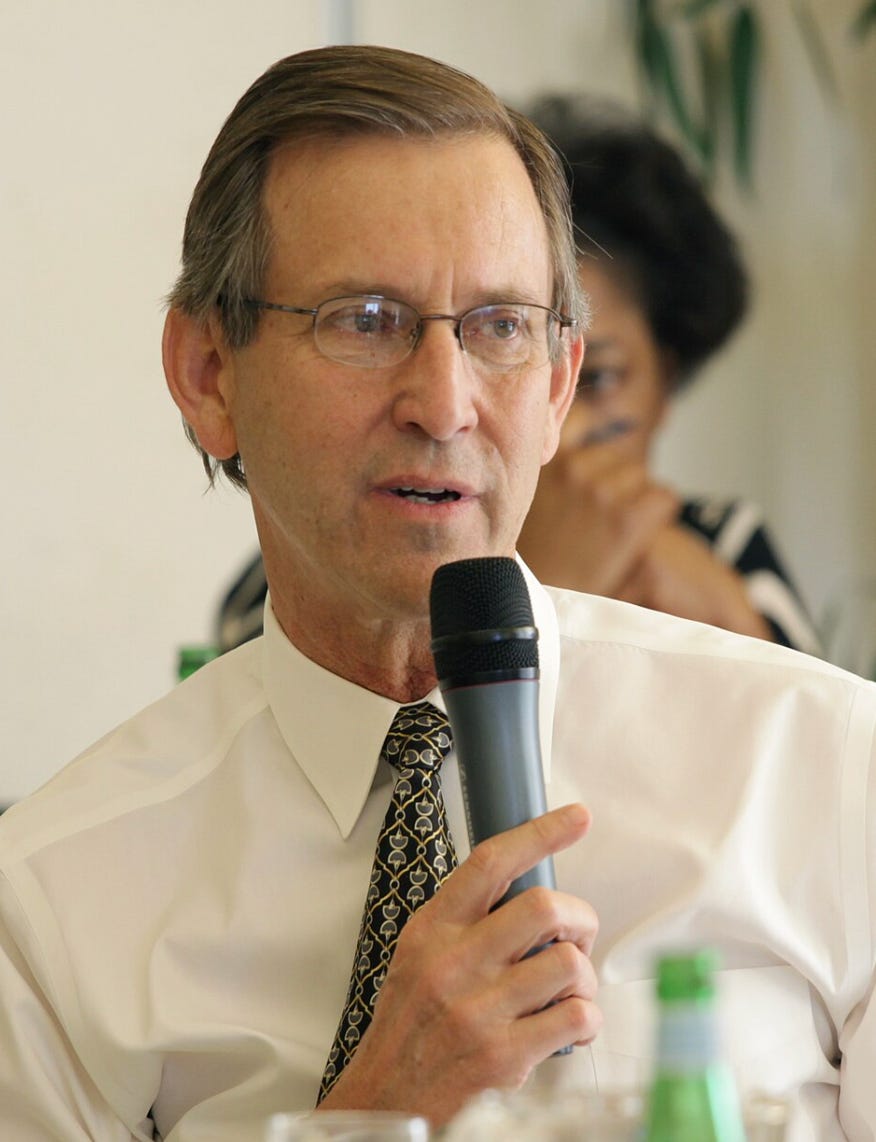
Ambassador Frederick D. Barton opens an ECOSOC ministerial roundtable on education in 2011. Photo by United States Mission Geneva, CC BY 2.0.
The hardest foreign policy work often begins after the cameras leave and before the institutions can stand on their own. A country is emerging from violence. An election may or may not hold. Refugees are moving. The old order is collapsing, but the new one has not arrived.
Frederick D. “Rick” Barton has spent much of his career in that space. He founded USAID’s Office of Transition Initiatives, served as the first Assistant Secretary of State for Conflict and Stabilization Operations, represented the United States at the United Nations Economic and Social Council, and worked across more than 40 crisis zones. His work has focused on what he calls “advancing peaceful democratic change,” a phrase that began as an office slogan and became something closer to a career thesis.
Barton is skeptical of grand designs that arrive from Washington with too much certainty and too little local knowledge. He thinks political instinct matters. He thinks early warning is often less mysterious than the intelligence world makes it sound. And he thinks the work of stabilization is closer to venture capital than bureaucracy: many experiments, many failures, and a premium on knowing when something is starting to work.
For students interested in diplomacy, development, or crisis response, his advice is bracingly practical. Go somewhere. Learn a place. Build teams. Get comfortable with risk. And never assume that being smart is the same as being useful.
This interview has been edited for clarity and length.
From the Archive · originally published in The Pathway Blog, January 2026.
“Advancing Peaceful Democratic Change”
Benjamin Wolf: To start with the big picture: for readers who may not be familiar with your path, what is the through-line of your career? What problem have you most consistently tried to solve?
Frederick D. Barton: I didn’t really have a clear-cut mission statement until I started working at USAID, when I was working on countries in transition. I came up with a slogan for our office, the Office of Transition Initiatives, and it was “advancing peaceful democratic change.” It turned out that was probably my through-line as well.
Before that, I had worked in domestic politics. I worked on a Senate campaign, then for the senator when he won. I ran for office myself. I was a state party chair. So I was working in domestic politics, but I always had an interest in global issues. I helped start the World Affairs Council of Maine because I felt there needed to be more access to these issues, and I was interested in them.
Then I got lucky and got a job in Washington. Luck is a big part of it, but it was something I had in mind. I got the right job because the USAID administrator had promised Congress he would start a new office to deal with countries in transition. At the time, the big “countries in transition” were mostly in the former Soviet Union.
But the regular bureaucracy really loved the former Soviet Union. There was a lot of money for programming, it was relatively safe, and it was traditional development work. So I was left with a portfolio of countries that were in conflict, which I found dynamic. They seize the front page quickly. They become the biggest source of attention.
So I would say the through-line became advancing peaceful democratic change, and elevating the importance of local people in that effort.
The First Wake-Up Call
BW: Before the prestigious titles, was there a first experience that pulled you toward conflict work and stabilization, something that made you think, “This is what matters”?
FDB: I was lucky to have a couple of volunteer opportunities when I was living in Maine.
For years, I tried to get on an election-monitoring mission with the Carter Center or someone like that, and they never selected me. I was in Maine. I wasn’t in play.
But a guy came to Maine and said he worked with the National Democratic Institute. It was this long evening program. We had the ambassador of El Salvador there, and he talked too long. I was ready to go home. And my wife said, “Why don’t you go talk to that guy who said he works on election-monitoring missions?”
So I went over and talked to him, and almost right away he said, “Would you like to go to Haiti in two weeks?”
It was July in Maine. Who would want to go to Haiti? But I couldn’t exactly say, “Why don’t we go to Paris?”
So I went to Haiti. Later, when I went to Rwanda and places like that, I realized Haiti was much worse off. And it is right off the U.S. coast. It had been mismanaged by the U.S. and by Haitians as well, and the French, for sure.
Once I started seeing places coming out of difficult periods, it became hard to look away. NDI then invited me to be part of an expert panel in Ethiopia and in Poland. Those experiences helped me get the job at USAID because I didn’t have much formal experience, but it turned out almost nobody did.
I also had family exposure. My father had been a diplomat, I had lived in these countries, and I spoke Spanish. But Haiti was the wake-up call. And it became one of the first countries we worked in when I started the Office of Transition Initiatives at USAID in 1994.
Ambition, Bureaucracy, and Limits
BW: Looking back at your early career, what is a judgment you were confident in then but would approach more cautiously now, not because you were wrong, but because experience complicated it?
FDB: My core judgment is about putting people first: local organizing, the opportunities that exist even in tough places, and giving greater voice to local people. Those instincts were good.
I don’t think I ever had a messiah complex, either for what we were doing or for the United States. I tend to look at every case individually, and I like to do lots of local interviews — dozens, hundreds if possible — so we really see what the priorities are.
Those instincts helped OTI thrive for about 30 years and be seen as a major asset. The same instincts carried over to starting the Conflict and Stabilization Operations Bureau at the State Department.
One thing I did that worked was that I often went for money rather than people. I figured if I had the money, I could find the people and hire the right people, rather than getting stuck with a fixed staff.
I was careful about which countries we picked. Bureaucracies judge whether you are relevant based on where you end up working. I didn’t get stuck in places I thought would be extraordinarily difficult to move, places where you can pour in effort and still make no meaningful progress.
Entry timing matters. You need the right “ripeness.” That is a theory I picked up from a professor, Bill Zartman of Johns Hopkins.
If anything, I probably underestimated how difficult it is to build something new inside the U.S. government. The natural bureaucratic resistance, the inclination to keep doing things the same way, can be intense.
And maybe I overestimated what individuals could do. Maybe I was too ambitious in thinking we could achieve more. These places are fragile.
Domestic Politics as Foreign Policy Training
BW: Ambassador Mark Green once told me that his time in domestic politics shaped how he operated in foreign affairs. For you, did domestic politics influence how you worked on the global stage?
FDB: Absolutely. Tom Friedman once wrote about Clinton becoming good on foreign policy and said: he was obviously good at domestic politics, and foreign affairs is essentially politics on an international scale, so why wouldn’t he be good at it?
There is direct relevance.
A funny but influential lesson for me was this: in many of these places, you are not always dealing with George Washington types. You are dealing with lesser figures, let’s say.
I had an experience in Maine when I was party chair dealing with a candidate for governor who was quite erratic. That ended up being instructive for meetings around the world because I could think: this is just like that guy in Maine.
I was also very attracted to working with women and young people because they were often disenfranchised. If you want to promote change, you go to the people who most want it, or who are least responsible for the status quo. Often, that is women and young people.
That bias came from organizing campaigns in Maine. In my first campaign, we were running against Senator Margaret Chase Smith, a long-term incumbent. When I went into her hometown to organize, nobody was willing to work against her in a visible way except junior high school kids, their parents, and their mothers.
They were great. The older men would come in and say, “We need a new television commercial,” or some big strategic idea. But those people — kids and their moms — were the ones going door to door and doing the work.
And then there is communications: if you are not communicating all the time, you are probably in trouble. That is a good lesson from politics.
Speed vs. Legitimacy
BW: In crisis response, there is always tension between acting quickly and building legitimate local ownership. How did you decide when speed was essential and when patience was non-negotiable?
FDB: One of the rules in my book Peace Works is this: if you don’t know 100 people in a place, don’t send U.S. soldiers.
And I don’t mean just the minister of treasury or your taxi driver. I mean 100 people. That rule would have kept us out of Iraq and Afghanistan, and it should have kept us out of Vietnam. If we had stayed out of those three, we would be a very different, and probably better, country.
Venezuela and the Problem of What Comes Next
BW: What do you make of what happened in Venezuela?
FDB: I got rediscovered the last couple of days because I did an NPR interview on Sunday and then another with Ana Cabrera.
As I said then, as usual, we spent hundreds of millions of dollars and months planning a military intervention, and it looks to me like we haven’t spent ten minutes on what comes next.
When the president gets asked, “You say we’re going to run Venezuela. What happens next?” and he turns around to the three guys behind him, the general, the head of the Joint Chiefs, Hegseth, and Rubio, that is probably the extent of the planning.
And there is carelessness, even if it is a skilled military operation. It is like Tulane playing a local high school. It is not a fair match. Venezuela’s military can enforce a regime, intimidate people, and allow thugs to run loose, but it is not a war-fighting machine.
The president’s giddiness is out of order. Nobody likes Maduro, but there are sixty guys like him around the world. And this is a crowd that says, “We’re not going to be the world’s policeman.” Well, what is this then? If not military intervention, at least a police intervention.
On legality, it doesn’t hurt to have a few rules. If the U.S. makes up a rule every day, it is sloppy.
Early Warning Is Often Not Complicated
BW: I spoke with Andrew Natsios recently about early warning as the difference between prevention and catastrophe. In your world, what early warning signals do you take most seriously, and how do you avoid reacting to noise?
FDB: I had a boss who once said: you can give me all the intelligence reports in the world, but if I look at Reuters in the morning and 10,000 people have left their homes, that is a really good early warning.
When people are packing up and moving out, that matters.
After that: random violence showing up in unexpected places. Repression. I once got bawled out for an hour by a minister of interior in the Ivory Coast because I asked why they put the leading opposition figure in prison. He said I was invading domestic politics.
At the end of it, I said: the reason I asked is that when these things happen, we often end up with thousands of refugees, and we are in the business of not producing more refugees. We would rather not have refugees than process them for the rest of their lives.
He was a little apologetic. They had a coup a month later. He was the first guy seized.
So those are very real indicators.
What Separates Effective Young People
BW: When you evaluate young people for roles in this space, what reliably separates the ones who will be effective from the ones who are smart but not yet useful? What is the most common mistake?
FDB: First, a fascination with politics.
When I get to Liberia, the first thing I want to see is the newspapers, whatever they have. People mimeographing rags in a basement, running off a copy machine. I want to read what they are writing and what they think is important.
So: fascination with politics and news; readiness to listen, talk, and listen some more; talking to the people of a place and not accepting conventional wisdom.
People arrive and declare, “This is a tribal war,” or “a religious war,” or “an elite war,” or “an economic war.” It is probably a witch’s brew. I want you to have a better understanding.
Then: being able to make choices. Working well on a team. You are not going to be the genius by yourself.
Many people are good analysts but not great at coming up with solutions. Fewer people are creative about solutions. It is tough to come up with ideas.
That is why I think of this work like venture capital: experiments, pilots, tests. Nothing is precedent unless it works.
Agility, flexibility, making something, and making more out of it — those are key.
Risk, Luck, and Building Teams
BW: If you were advising a student today trying to enter this field, what would you want them to be honest about: the tradeoffs, uncertainty, timing, luck? And what is one skill they can build this semester that compounds over time?
FDB: Once you get experience in one or two places, don’t go straight to Washington. If you can live and work in a country, that is how you build your reputation. That is how you get promoted in Washington. Apply your thinking to a real place.
Comfort with risk is important. A lot of people are not comfortable with risk, but risk brings high rewards.
I had a boss who called OTI “venture capital.” If we hit on one out of ten countries, we were successful. Whereas USAID sometimes acts like everything it does is brilliant. That is not possible.
I like measures of progress. I want to know how we are doing.
Studying a language helps. Working political campaigns helps too. State doesn’t always respect that, but I do. You learn how to manage volunteers. Volunteers are tough: you can’t fire them, you don’t pay them, and you have to learn how to lead.
An underappreciated skill set is building teams, creating followership, and making common cause. Political appointees often come from the Hill, academia, or a niche subject area. They may know a lot, but they don’t always know how to build a team around an outcome.
What to Read
BW: To close: what is a book, essay, poem, or anything else you would recommend to someone interested in joining this field?
FDB: They can read my book, Peace Works. It is not a memoir, but it lays out how to get things started.
I also think people need what I call a perverse fascination with bureaucracies, because you are going to work in a big organization. Enjoy it. It is another challenge.
I read a lot of articles. I used to share two or three articles a week with my staff, often challenging ideas in organizational development.
There is a Harvard Business Review article from a former dean of Yale Law School — something like “Why Smart People Can’t Learn” — that is excellent. And I would look at Atul Gawande’s pieces in The New Yorker, the one on the bell curve and the one on coaching. Those are accessible and the kinds of things I shared with staff and used in courses.
About the guest: Ambassador Frederick D. “Rick” Barton is a lecturer at Princeton University’s School of Public and International Affairs and the author of Peace Works: America’s Unifying Role in a Turbulent World. He was the first Assistant Secretary of State for Conflict and Stabilization Operations, U.S. ambassador to the Economic and Social Council of the United Nations, Deputy High Commissioner for Refugees at UNHCR, and founding director of USAID’s Office of Transition Initiatives.
About The Pathway Review: The Pathway Review publishes long-form interviews with people in politics, policy, journalism, law, diplomacy, markets, and public service about the work they do and the path that brought them there.
Subscribe to receive new interviews in your inbox.
This interview was conducted in January 2026 and has been edited for length and clarity.