


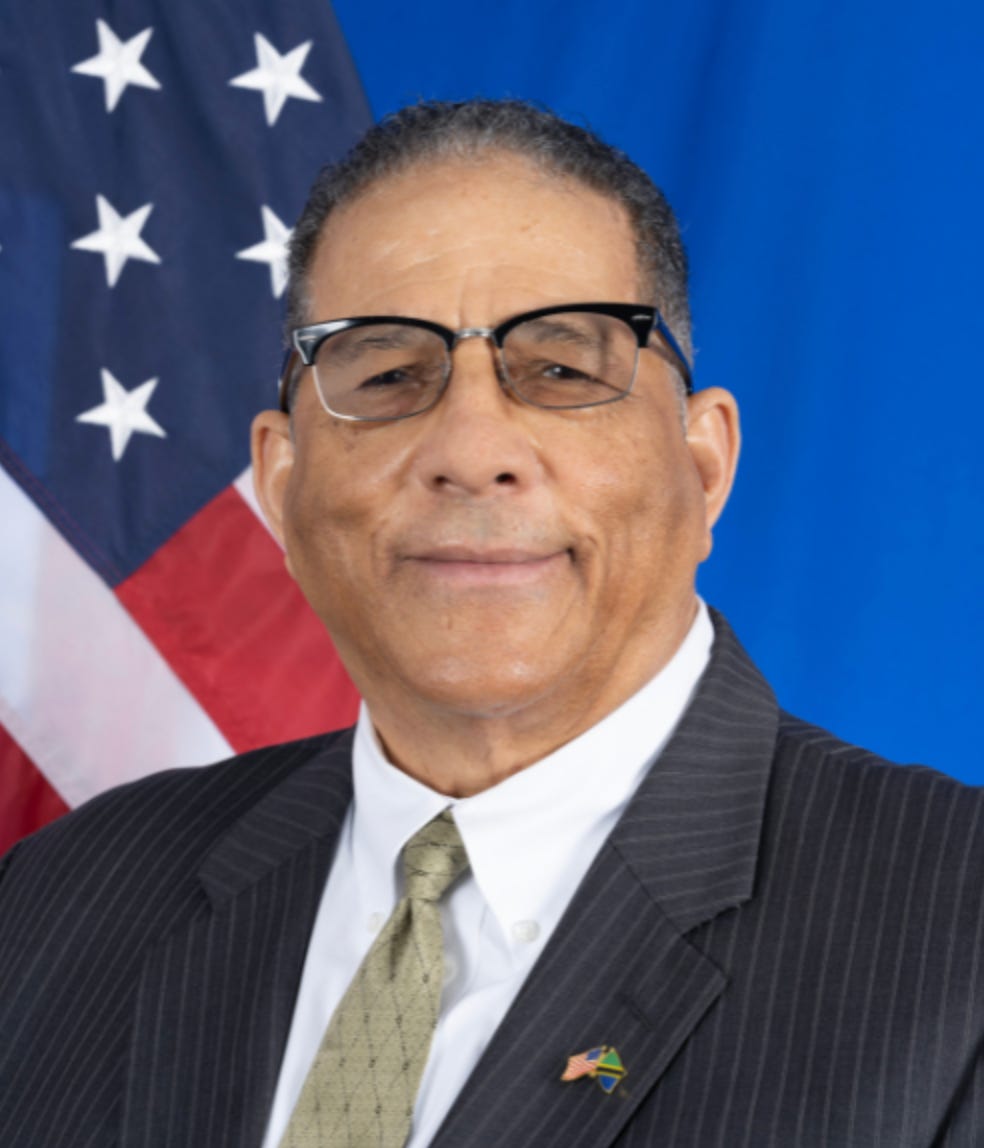
Ambassador Michael A. Battle Sr., U.S. Ambassador to Tanzania. Photo courtesy of the U.S. Department of State, public domain.
Michael Battle’s career does not fit neatly into one professional category. He has been a minister, an academic leader, a military chaplain, and an ambassador. The through-line is not a single institution. It is a habit of leadership: building trust across difference, persuading without posturing, and taking people seriously enough to understand the world as they see it.
That skill matters in a church. It matters in a classroom. It also matters inside an embassy, where the job is not only to represent Washington abroad, but to explain reality back to Washington when policy assumptions collide with local context.
Battle served as U.S. Ambassador to the African Union and later as U.S. Ambassador to Tanzania. In this conversation, he explains why embassy life has no such thing as a normal day, how commercial diplomacy depends on relationships as much as strategy, and why pressure without context is usually performative.
For students interested in diplomacy, his advice is simple but demanding: become globally aware, learn to argue without becoming disagreeable, and read biographies of people you admire and people you do not.
This interview has been edited for clarity and length.
From the Archive · originally published in The Pathway Blog, January 2026.
Three Vocations: Clergy, Academic, Diplomat
Benjamin Wolf: To begin, you have been a chaplain, an academic leader, and a diplomat. If you had to describe your career as three vocations rather than job titles, what are they, and what did each teach you about leading people?
Ambassador Michael Battle: As an academic, as a member of the clergy, and as a diplomat — those three descriptions fit best, even though I spent almost twenty years in the military, including a period as a military chaplain.
As an academic, I learned the benefit of working with and challenging young minds, as young minds challenged me. The reciprocal process was always there. I taught logic and scientific method for most of my academic career, even though I also taught religion. I was assigned many courses in the philosophy department, and logic and scientific method became what I was most known for when I was at Hampton University, while also serving as the university chaplain.
The challenge was teaching people how to think critically, and then getting up on Sunday morning and preaching to many of the same people. I really enjoyed it when a student would come back to class and say, “I listened to your sermon. Now let’s critique some of the arguments you tried to make.” That kind of exchange was immensely rewarding.
Serving as an academic administrator was also a pleasure. I was president of a seminary that, at the time, consisted of six different seminaries from six distinctive denominations working together in a consortium: the Interdenominational Theological Center in Atlanta, Georgia. Diverse theological backgrounds, from Presbyterian to Pentecostal to Church of God in Christ. It was quite interesting.
As a diplomat, I discovered that the same skills of building relationships in ministry and academia were necessary in building relationships as a diplomat.
My first diplomatic assignment was as U.S. Ambassador to the African Union. I was responsible for multilateral policies of the United States government affecting the entire African continent, working with 54 states. Morocco had left the African Union at that time. Working on policy development and trying to get the African Union to see the necessity of the sustainability goals set forth by the United Nations was quite a challenge, but I enjoyed it.
In the last three years of that four-year assignment, I was also assigned as a U.S. representative to the United Nations Economic Commission for Africa, which is the largest UN body on the African continent. My next assignment was as the bilateral ambassador to Tanzania. After Tanzania, I was assigned as the U.S. representative to the East African Community, the EAC, which includes eight countries. So I worked bilaterally, but also multilaterally with EAC countries.
Now, since I taught philosophy, I can give an answer that could last an hour. I don’t want to do that, so I’ll keep it shorter.
BW: Please, go as long as you want. The less I say, the better. This is your interview, after all.
How the First Ambassadorship Happened
BW: Before we dive into the day-to-day work, I’m curious: what was the connection or step that led to your ambassadorship at the African Union? Was it someone you knew? How did that position come about?
MB: For a long period of time, I had been active on the African continent. I led academic missions in North Africa and West Africa while at Hampton University, and I directed a very large interdenominational conference of clergy nationwide. I also served as vice chairman of the American Committee on Africa, which at that time was one of the larger and more powerful think tanks on African policy.
Even when I was president of the seminary, because we had so many students from Sudan and other parts of Africa, we decided to internationalize, to develop a more global theological interpretation of texts and a theological interpretation of how to respond to social dynamics. We developed a white paper on how to globalize theology, particularly related to what is now South Sudan. This was before Sudan split.
But the role that actually led to my first ambassadorship came through two young men who were asked by then-candidate Barack Obama to work on his campaign early, before anyone really thought he would win: Paul Monteiro and Joshua DuBois. They were having challenges with older ministers who did not respect the fact that young people had been asked to take such serious roles. I worked with them and helped them bridge gaps with older clergy and open doors.
Joshua DuBois was very close to Barack Obama. He was asked whether there was someone he felt should get an appointment, and he said, “Michael Battle.”
Normally, the process takes a long time. But they looked at my background and called the next day and asked: would you go to the African Union?
I served for four years at the AU, which makes me the longest-serving U.S. Ambassador to the African Union.
The lesson is this: whenever you are given an opportunity to help someone, do it without regard to whether they will ever be in a position to open a door for you. If you authentically respond to someone’s needs without looking for reward, and you find the reward in the helping itself, doors open that intentional networking often will not open.
And, of course, I had known Barack Obama for some time. When I was vice president at Chicago State University, he was a minor junior state senator, someone nobody thought would be elevated the way he ultimately was. I supported his early efforts, and later his Senate run as well.
No Such Thing as a Normal Day
BW: Let’s get concrete. With your ambassadorship in Tanzania, what did a normal day look like? What time did you start? Where did most of your attention go: bureaucratically, operationally, leadership-wise?
MB: With the African Union, it was peace and security almost 85 percent of the time.
With Tanzania, I focused on commercial development. One of the accomplishments I’m most proud of is that we developed a commercial dialogue, the first ever developed between the U.S. Department of Commerce and the Tanzanian counterpart. We brought together private and public sector leaders in Tanzania and in the United States to talk about removing trade barriers and making it easier for U.S. companies to invest significantly in Tanzania.
Every now and then, I intentionally check on progress because I still have great relationships with the Tanzanian ambassador to the U.S. and with staff in Tanzania. I’m proud to say that dialogue continues to this day.
Now, there is no such thing as a normal day for an ambassador. It depends on the issues. Sometimes a president will call the entire diplomatic corps to meet in the capital.
In Tanzania, while Dar es Salaam has historically been the capital, the capital moved to Dodoma, more than a hundred miles away. So you can wake up planning to be at the office at 10:00, and someone calls and says, “No, the president has asked you to be in Dodoma by 8:00.” Then you are trying to find transport immediately.
And there are days that go late into the evening because of diplomatic receptions and engagements. I found that you often get more work done in those engagements outside your office than you get done in your office.
There were times in Tanzania when we dealt with peace and security, but it was not the predominant focus. The predominant focus was building trade relationships.
Translating Reality Back to Washington
BW: People often imagine the hardest persuasion is convincing foreign counterparts. But sometimes the harder persuasion is internal: Washington, interagency dynamics, politics. Can you describe a time you had to translate reality back home, and what made it difficult?
MB: I’ll give you an example from the African Union and one from Tanzania.
At the African Union, there were times when the National Security Council pushed me to convince the AU to pressure the Libyan transitional government after Qaddafi fell. The U.S. was trying to get Libya’s transitional authorities to collaborate with the African Union, and to get the African Union to pressure them.
We were not making headway. So I met with the AU Commissioner for Peace and Security and the AU chairperson. I asked: why is it that much of the West is pressuring the transitional government in Libya, but you are not?
They said: what the U.S. and the West are not understanding is that the Libyan transitional government had a long history of racist policies toward Black Africans, persecuting them, expelling them, abusing them.
I reported back to Washington. I was told, “Go get proof.”
Working collaboratively with the AU, with others, and with a French TV station, France 24, we validated it. Secretary Clinton did not hesitate. Once she saw the evidence, she conveyed clearly to the transitional Libyan government: you need to stop abusive behavior if you expect the African Union to work with you, and we will not work with you until you do.
Within weeks, we had the transitional Libyan government meeting with the African Union in Ethiopia.
The difficulty was not that the African Union was unwilling. The reality was that the transitional government’s behavior made cooperation impossible. My job was to convey that and to push U.S. policy to address the real obstacle.
In Tanzania, there were instances where Washington wanted us to pressure Tanzania to sign on to policy statements, like explicitly affirming Russia as the aggressor and Ukraine’s territorial integrity.
I personally am convinced the world should support Ukraine against Russian aggression. But Tanzania has, since its founding, been non-interventionist when it comes to issues it does not see as directly affecting Tanzania in the moment.
So I had to help Washington understand: our relationship with Tanzania should not rise or fall on a single isolated instance that is philosophically complex for Tanzania. They had intervened in Uganda under Idi Amin, but Uganda is a direct neighbor and part of the EAC. Tanzania saw a direct responsibility there that it did not see in the same way regarding Russia and Ukraine.
Pressure Without Context Is Performative
BW: I read your Senate confirmation statement where you discussed unconstitutional changes of government and the AU’s stance. When democratic norms are tested on the diplomatic battlefield, what tools are effective in practice versus performative? Where can diplomats shift incentives, and where can’t they?
MB: The performative thing is trying to apply pressure without understanding context. That is not only performative. It is a waste of time.
The most effective thing is to get a country to see that it is in its best interest to be democratic, because democratic countries tend to be more economically prosperous, more stable, more constitutionally reliable, and transitions in government tend to be smoother.
The challenge the U.S. has right now is that we are not shining the light on the hill the way we want to. The idea of a “city set on a hill” was part of what made U.S. diplomacy credible: stability, human rights, resistance to aggression, defense of territorial integrity.
Some American diplomats now face the reality that our example is not what it traditionally has been.
But you continue anyway, because U.S. policymaking is temporal: four to eight years, and then it changes. You try to persuade people that America’s deeper commitment to democratic norms, stability, human rights, and territorial integrity is not going to be extinguished in the long run.
And in the meantime, we continue the argument: democracy is better for every nation than governments dominated by dictatorial and totalitarian policymaking. In the long run, most governments recognize that.
Advice to Students
BW: As we wrap up, for students who want to work in diplomacy or global affairs, what should they do that is not obvious, beyond internships, over the next 12 months to become genuinely useful?
MB: My first foreign policy speech was made in high school at Model United Nations. I was 16 or 17, arguing against the policies of what was then Rhodesia, now Zimbabwe.
The best thing a student can do is develop a passion for international policy, a passion for people around the world, and develop a global sense and a global awareness.
When you take the Foreign Service exam, it will test how you see issues globally and what common-sense approaches you take to solving global problems.
You should develop the sense that there is no global problem without local and national implications, and no local or national problem without global implications.
Also, develop confidence in talking to other people. And confidence in disagreeing without becoming disagreeable, without becoming argumentative. You don’t persuade people by being angry or mean. You persuade people by being consistently passionate about the argument in the sense of logic, not emotion.
Biographies as Training in Judgment
BW: To close, as is customary with the blog: for those interested in pursuing a career like yours, what is a piece of literature you would recommend, and why?
MB: As a diplomat, I encourage people to read great biographies. Read the biography of George W. Bush. Read Tony Blair. Read Condoleezza Rice. Bill Clinton. Colin Powell.
Biographies show you how people work and how people fail. You see small pieces of their lives you would never think would shape them completely.
One of the best ways I came to understand Barack Obama was reading the biography of his mother, not just his own books.
And don’t only read biographies of people you like. Read biographies of people you don’t like, people who oppose your thinking, because then you get a window into what shaped their positions.
And the last piece of advice: be authentically you.
BW: Ambassador Battle, thank you so much for joining me.
About the guest: Ambassador Michael A. Battle Sr. is a former U.S. Ambassador to Tanzania and former U.S. Ambassador to the African Union. He also served as U.S. Representative to the United Nations Economic Commission for Africa and has held senior leadership roles in academia, ministry, and public service, including as president of the Interdenominational Theological Center and as a chaplain in the U.S. Army Reserve.
About The Pathway Review: The Pathway Review publishes long-form interviews with people in politics, policy, journalism, law, diplomacy, markets, and public service about the work they do and the path that brought them there.
Subscribe to receive new interviews in your inbox.
This interview was conducted in January 2026 and has been edited for length and clarity.