


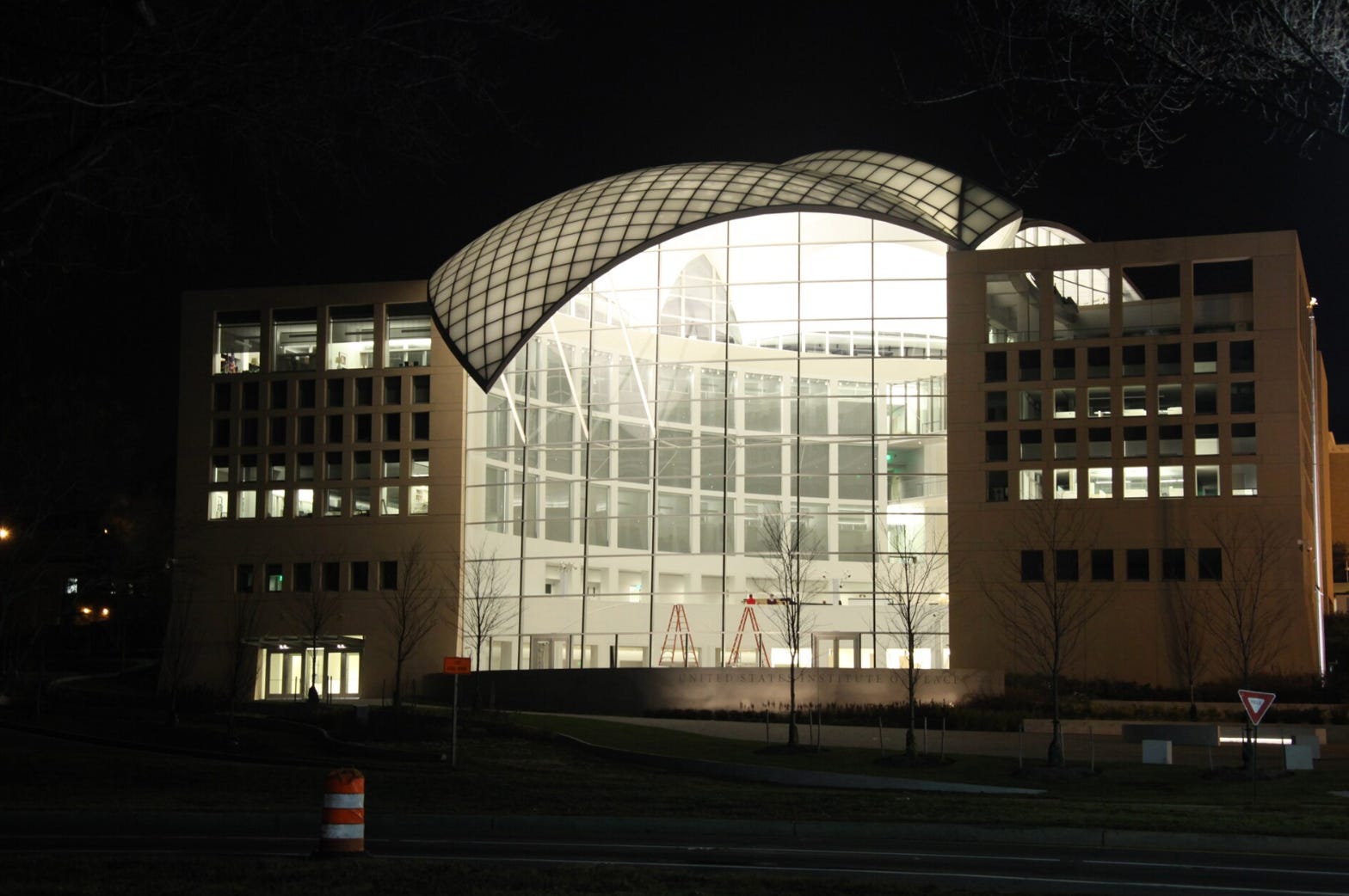
The United States Institute of Peace headquarters in Washington, D.C. Photo by Tim Evanson, CC BY-SA 2.0.
Washington is full of institutions most Americans never think about until they are suddenly gone, defunded, or pulled into the center of a political fight. The U.S. Institute of Peace was one of those places: congressionally created, often understated, and built around the unfashionable work of conflict analysis, democracy support, peacebuilding, and prevention.
Adam Gallagher spent years inside that world. At USIP, he edited and shaped foreign policy analysis, worked with experts who studied conflict from the ground up, and helped translate institutional knowledge into arguments that policymakers and readers could use. Before that, he worked at the Carnegie Endowment for International Peace and the International Foundation for Electoral Systems, where he helped tell the story of election and democracy-support work across the world.
Then came DOGE, and with it a wider disruption of the peacebuilding and democracy-promotion ecosystem. Gallagher’s view of U.S. foreign policy is now shaped not only by his experience inside those institutions, but also by his work in the restraint community, where he argues that Washington repeatedly inflates threats and then builds strategy around the exaggeration.
This conversation is about institutions, incentives, and writing. It is also about a basic question for anyone trying to enter foreign policy: how do you think clearly in a field that rewards speed, certainty, and alarm?
This interview has been edited for clarity and length.
From the Archive · originally published in The Pathway Blog, January 2026.
USIP, Publishing, and the DOGE Disruption
Benjamin Wolf: To start, can you walk me through your time at the U.S. Institute of Peace, what you did there day to day, and what changed once DOGE targeted the organization?
Adam Gallagher: I started at the U.S. Institute of Peace in 2018 as the managing editor of the website. The organization had two publishing sides. One was longer, more academic-style reports. Then there was the website, which published more newsy foreign policy analysis. That is what I did for most of my time there. By the end of my tenure, I was editor-in-chief and oversaw both sides.
USIP was a really interesting place to work. It was founded by Congress during the Reagan administration, and over time it changed a lot. It started more as a think tank focused on publishing research and analysis on peace processes and conflict resolution. Then, after the wars in Iraq and Afghanistan, it began doing a lot more groundwork. Later, it moved into Africa and into spaces in Asia and Latin America.
I was never an on-the-ground peacebuilder, but I worked closely with a lot of those people to get their insights and analysis, and to think about how their expertise could be folded into U.S. foreign policy to address major conflict issues.
It was a great place to work and a great way to get a sense of all the different things the U.S. is doing around the world, both good and bad. I either edited, wrote, ghostwrote, or played some role in thousands of pieces being published, along with hundreds of videos and podcasts. It was a great place to understand what was happening globally.
You also got a sense of the disparity between how much focus the United States puts on expending resources to build peace, as opposed to security and defense. I think you could make an argument that the work USIP did was about security and defense of the homeland. Ultimately, the Trump administration did not see it that way, but I think most people understand that a more stable world with less conflict is better for America.
Going to the DOGE aspect: USIP really shifted its rhetoric and messaging and began talking about how to align its work with the objectives of a Trump administration foreign policy. But it never really got the chance to implement that because we were named in an executive order to be essentially dismantled in February 2025.
There has been a lot of back-and-forth in the courts, but by July 2025, effectively the entire organization had been dismantled. A few Trump administration officials were brought in to keep it running, but I do not understand how or why.
If you go to the website now, it is basically a splash page that says something like, “Stay tuned for the latest updates on what Trump is doing to make peace around the world.”
So, yes, 2025 was a challenging year for me and for a lot of friends and colleagues, not only at USIP, but at places like USAID, which is where USIP got some of its funding. Not a huge portion, but some. And similar organizations, like the National Endowment for Democracy, the National Democratic Institute, and the International Republican Institute, were affected. Another organization I used to work for, the International Foundation for Electoral Systems, got a lot of its money from USAID.
Essentially, this whole ecosystem of international development, international aid, peacebuilding, and democracy promotion was undercut overnight, and it has left a huge gap in U.S. foreign policy.
From Law School Plans to Foreign Policy
BW: Before USIP, how did you decide this was your lane? Was foreign policy the plan in undergrad, or did it emerge job by job?
AG: I started undergrad wanting to be a lawyer because I have a bunch of lawyers in my family. But over time, I took classes and did a few summer activities in D.C. that got me more and more interested in foreign policy and international affairs. By the time I graduated, I was pretty certain that was the path I wanted to pursue.
Immediately after graduating, I applied for a State Department program called the Critical Language Scholarship. That sent me to Jordan for three or four months, where I studied Arabic with about thirty other American students.
The language aspect was important, of course, but even just being in a different country like that was hugely valuable. It was also a unique time because I was there in 2007. The war in Iraq was still going on. There were a lot of Iraqi refugees in Jordan.
Jordan is already a country with a huge number of refugees. Depending on who you talk to, some people would say that 50 percent of the Jordanian population is made up of Palestinian refugees. If you said that to someone who considered themselves Jordanian-Jordanian, that might make them mad. But in any case, there are a lot of refugees.
You were basically in the middle of a war zone. The region was tense after the Israel-Lebanon war. Some friends and I wanted to go to Lebanon over a weekend, and we were told explicitly not to. We were not supposed to travel outside the borders of Jordan, but if we went anywhere, we were told not to go to Lebanon or Iraq.
I got to go to Syria, which was cool before Damascus became a war zone. I went around the West Bank and Israel. It was an awesome time in my life that really opened my eyes to different ways people are living, and to how U.S. foreign policy affects that. That was a key moment that pushed me further into foreign policy and international affairs as a career.
I came back to Washington and had a couple of beginner jobs that were tangentially related to foreign policy, because I just wanted to move to D.C. Then, a couple years later, in 2009, I got a job at the Middle East program at the Carnegie Endowment for International Peace, which is a very prominent think tank in Washington. I worked there for four or five years.
A lot of that time was during the Arab uprisings, or what some people call the Arab Spring. We were heavily focused on analyzing those events, disentangling what they meant for U.S. foreign policy, and thinking through what role the United States could play. By that point, I had cemented my career path.
I also started a PhD program during that time at George Mason University in international relations. I ultimately ended up just getting my master’s there and not following through on the PhD.
Afghanistan Media Analysis and Election Observation
AG: My next job was brief. I worked for a defense consultancy called SOS International, for a subsidiary that was a media analysis and open-source intelligence wing of a massive government contractor. I worked on media analysis for the U.S. Embassy in Kabul and for NATO staff there.
On my shift, I would read everything being written about Afghanistan in the mainstream U.S. press: The New York Times, The Wall Street Journal, The Washington Post, Foreign Policy, Foreign Affairs, those kinds of outlets.
At that time, mostly due to Western funding, there was also a pretty vibrant English-language press in Afghanistan. So I would read everything they were publishing and then write a summary analysis. It took about six hours to do the reading in a shift and then about two hours to distill it. It was a cool job. It was intense because you had a short window to distill all that information.
I only did that for a brief period, and then I went to the International Foundation for Electoral Systems, which focuses on elections: helping countries build the building blocks they need to have transparent, credible elections. They work with election management bodies to ensure that electoral processes are smooth, free, and fair.
The organization also had a more research-focused wing that looked at best practices for credible elections, including cyber issues that come up in elections now, hacking voting systems, and so on. I was a writer and editor there. I focused on telling the stories of what the organization did.
The coolest part of that job, by far, was that three times I went as an officially accredited election observer and monitored elections: Liberia, Tunisia, and Myanmar. Those were all really critical elections for those countries.
Tunisia’s was its first post-Arab Spring presidential election. The election in Myanmar is, sadly, part of what set the stage for the civil war the country is still going through today. Aung San Suu Kyi and her National League for Democracy won that election. And in Liberia, it was their first peaceful election in the history of the country.
Those were all really cool, unique experiences. But I always wanted to be on the policy side, as a researcher, writer, and editor. IFES was more of what I would call an implementing organization, a “do tank” rather than a think tank.
So then I got the job at USIP in 2018. And then DOGE dismantled USIP in July 2025.
Defense Priorities, JQAS, and Threat Inflation
AG: Since then, I have been working with Defense Priorities, which is a small think tank. I had been a contributing fellow there before what happened with USIP, which basically means I write op-eds and other analysis for the organization and participate in messaging and communications work. Since what happened to USIP, I have picked that up more.
Last year, I was also a Strategic Leaders Fellow for the John Quincy Adams Society. It is a fellowship that focuses on mid-career people like me in foreign policy who are interested in promoting restraint and realism in U.S. foreign policy. It included think tank people, congressional staffers, private-sector people, and even people working in the administration. The goal is to network, help each other career-wise, and talk through how we can promote realism and restraint.
That is a similar worldview to Defense Priorities. So in my post-USIP life, I have been more enmeshed in the restraint community through my research and writing.
I actually had a piece published this morning in World Politics Review about what is often called the “axis of authoritarianism”: China, Russia, North Korea, Venezuela, and Iran, and how it is supposedly this implacable coalition dead set on destroying the U.S.-led international order.
I think that is bogus. And I think there are a couple examples we have seen recently. The U.S. bombing of Iran in June, and then what happened over the weekend with Nicolás Maduro: you did not see any of these countries come to the defense of their so-called ally in this axis.
So I think this is a perfect example of how U.S. foreign policy and the foreign policy establishment inflate threats, which ultimately distorts our foreign policy and makes it something that does not serve America’s interests.
How Foreign Policy Writing Actually Gets Made
BW: I want to come back to threat inflation, especially in the context of the so-called “Donroe Doctrine,” which I have been reading about recently. But first, your day-to-day work is research-heavy. What does your research process actually look like? How do you choose a question, pressure-test assumptions, and know when you are ready to publish?
AG: Great set of questions. For me, I spend the first part of every day scanning what is going on in the world, reading analysis and takes, and then trying to develop ideas from there.
From there, I talk to people I know who work on those issues, whether it is someone in the private sector affected by an event or development, fellow think tank people, or people in government. I use those conversations to develop my specific take or perspective.
I am always sitting with, like, fifteen Word documents open on my computer: different articles, different ideas. It would be crazy to say that every one of them ultimately results in something published. Sometimes it becomes a piece. Sometimes it moves into something else, like helping produce videos or coming up with concepts.
You have to keep working through it until you feel like you have hit on something and have something interesting to say. There is so much content out there. Some of it is really good. Some of it is terrible, not grounded in reality, or so partisan and ideological that it is worthless to engage with.
I never want anything I put out there to come across that way. I want somebody to think I came to the issue, or the argument I am making, through a rigorous process of testing these ideas and then trying to articulate them. That is often the most difficult part.
I spend a lot of time walking my dog and using that as a moment to think. There are a lot of times where I am halfway through the walk and I think, That’s it. I hit on it. Then I come home, sit down in front of my laptop, and try to put it into words, and it just does not work for whatever reason.
The research side is typically the easiest part. The writing part, as much as I like to write, can be the most torturous part: trying to articulate your ideas in a way that is both novel and interesting, and compelling enough for people to engage with.
Breaking In Without Connections
BW: For students without personal connections in foreign policy, what actually works for breaking in, and what is overrated? Is it cold emailing, publishing early, conferences, grad school, programs?
AG: My biggest overarching advice is that you have to put yourself out there. You have to do the kind of things that you are doing, Ben. You have to say, “This is what I want to be,” and you have to risk embarrassment. You have to risk being ignored or hearing “no” over and over again.
If you want to pursue a career in this field, it is a small world, made even smaller by what DOGE did, frankly. To break in, you have to be persistent.
I would definitely recommend publishing as much as possible. There are a lot of outlets out there, and many of them are thirsty for content. Places like The New York Times get hundreds of op-ed pitches a day, but there are a lot of really good outlets that people read and that want as many writers as they can get.
Of course, being in The New York Times or The Washington Post is important, but just being published somewhere is valuable. You can send that link to someone interviewing you for a job, or to contacts who may share it.
I had a little dispute once with someone who was pitching a piece I wrote to an outlet I did not care about. I wanted a more prominent outlet. I lost, and the media relations person got it published there. Within a half hour, I had three different people, including some well-known colleagues in the field, say, “Oh hey, I just saw your piece.”
That taught me not to obsess about where your byline is. It does not always have to be the most prominent place. Getting your name out there is the most important thing.
Unfortunately, grad school is pretty important because people want to see those letters after your name. It does matter. Journalism might be the one place where it is not necessarily as required as it is in the think tank community. But I do not come across a lot of analysts or editors in the think tank world who do not have a master’s or a PhD.
Conferences can be useful from a networking perspective, but I would put that at the bottom of the list. You go, you meet dozens of people, and you forget about them unless they keep reaching out to you. And now we can do things like this: you can cold email me out of nowhere, and now we are having a robust conversation instead of a thirty-second one at a conference.
Intellectual Honesty in a Hot-Take Economy
BW: How do you stay intellectually honest when the incentives reward the outrageous, the quicker story, the hotter take? What does that honesty mean to you?
AG: It means everything to me. If I were willing to sacrifice it, I think I could publish anywhere, any day, anytime. A lot of people could.
I have a specific perspective on the issues I work on. I want that perspective promoted and advanced because I think it would make for a better world. And I think it would make Americans’ lives better.
If I could not come away from a piece and feel good seeing it published and having people engage with the arguments, whether they are trashing them or praising them, I could not look myself in the mirror.
Even working at a place like USIP was a challenge in that regard because it was congressionally funded. We always had this sword of Damocles hanging over our head. If we somehow contravened what Congress wanted, we could have our funding cut. That was a challenging thing to square at USIP.
It is easier in my current role.
The “Donroe Doctrine,” Latin America, and Greenland
BW: In the wake of Venezuela, and the administration’s recent rhetoric about Greenland and the Western Hemisphere, what do you make of the justifications being offered? What is real, what is inflated, and what do you think the next steps will be?
AG: I do not think this is going to do anything in Latin America to pull countries away from China or get them to sever their relationships with Beijing. For many countries in Latin America, China is already the top trading partner. And China’s diplomacy in Latin America is largely focused on economics and trade. It is not overly securitized.
Countries do not want to be bullied. They do not want to be told what to do. Even Venezuelans who hate Maduro, who may have had a family member tortured or killed by that regime, do not necessarily want foreigners coming in and saying, “This is how you have to run your country.” You saw that in the war in Iraq. People who hated Saddam fought against the U.S. occupation.
China has conducted its foreign policy in Latin America, like it has in much of the Global South, in a transactional way. We want this critical mineral. We want to sell you this infrastructure, an airport or a port, and we want Chinese companies involved. Those countries need development, and they are happy to work with a country that is not going to lecture them about human rights or drug trafficking or whatever the case may be.
I think what the Trump administration has done in Venezuela will accelerate trends in this growing Global South coalition that is looking to refashion how the international order works today. You see this in movements like BRICS, which started as Brazil, Russia, India, China, and South Africa, and has expanded with other Global South countries interested in joining. Part of that is to get away from the dominance of the dollar and U.S. finance and trade restrictions.
But a big part of it, too, is that a lot of countries in the Global South see the hypocrisy of the U.S. and the U.S.-led order. They see the response to Ukraine and the response to Gaza as contradictory. They see that the U.S. applies international law to its adversaries and to weak states, and lets itself or its allies off scot-free.
I think the Venezuela operation is a perfect example of that. And I think it will expand Chinese influence in Latin America, ultimately, because these countries are going to want to work with reliable partners who are not bullying them.
Russia is not quite as important in the Latin America case, but the same broad principles apply in terms of bullying and hypocrisy.
When it comes to Greenland, I do not think the administration is going to do anything as dramatic as we saw over the weekend in Venezuela. Greenland is part of Denmark, which is a NATO ally. I think the administration has to have somewhere in the back of its mind a calculation that this kind of move would undercut the far right in Europe, which it has tried to support and view as a natural ally. And it would have really negative impacts there.
I think the next steps are continued rhetorical pressure. We will see a lot of talk about how Greenland is part of America’s sphere of influence. And there will be an effort, through rhetorical pressure, to come to some accommodation where the U.S. has greater access to critical minerals or something like that on Greenland. We already have extensive basing rights there, so I do not really understand what else the administration would want.
More broadly, I think the Venezuela operation, the rhetoric about Greenland, and talk about Mexico, Cuba, and Canada are ultimately about the perspective of some people in the administration: that the Western Hemisphere is America’s natural sphere of influence, international law does not matter, we are a superpower, and we can do whatever we want in our part of the world.
You can see a lot of this reflected in the new national security strategy, which turns the orientation of U.S. foreign policy toward the Western Hemisphere and away from conflicts in Europe or potential conflict with China over Taiwan.
The Skills That Compound
BW: If you were building an analyst from scratch, what skills compound most over time: writing, methods, languages, regional expertise?
AG: I am biased because my entry point into a lot of this has been editing and writing, but good writing skills are probably the most important thing in this world.
You can make your life a lot easier by being a good, concise, clear writer. Editors want to work with people like that. You can get your stuff published more easily if an editor does not have to spend a day disentangling every sentence.
Being a good writer also helps you test your thinking. I have moments where I have an idea that seems great, and then if I sit down and cannot articulate it, I know it is not a good idea. If I cannot explain it in a couple sentences, or in a way an average person who is not steeped in the field can understand, then it is not ready.
Writing helps with everything from a convincing cover letter to pitching a project to your boss. If you can write something compellingly, you are more likely to get the job or get the project greenlit.
Language skills can be important, definitely, but it depends on your trajectory. If you want to be a Japan expert, obviously knowing Japanese is important. You can go to the country, talk to people, and read primary sources.
I am more of a U.S. foreign policy generalist. I studied Arabic, but it is not something I use every day in my work. If you want to be an editor like I am, being a generalist is helpful. I know a decent amount about a lot of places and issues, and I can test ideas: “What you are saying contradicts what I know. Explain why.”
So to a certain extent, it depends on where you want your career trajectory to go. But I will finish by saying: focus on your writing. As someone who has edited hundreds of U.S. foreign policy experts in the D.C. think tank space, it is not something you can take for granted. The people who are strong writers tend to be more prominent, and their analysis tends to be more influential.
BW: That makes sense. In earlier interviews I have heard both sides. Bret Stephens made a strong case for becoming an expert in a specific region, while Sarah Kreps argued for a more generalist approach tied to a theme like technology. Your point seems to be that it depends on the role you want.
AG: Yes, definitely.
The Most Common Mistake in Young Foreign Policy Writing
BW: To close: what is a common mistake you see in young foreign policy writing, and beyond “write more,” what practical habits help fix it?
AG: A big mistake I see in younger people, because I edited a lot of younger foreign policy professionals, especially at USIP, is wanting their writing to be the skeleton key or silver bullet to whatever issue they are discussing, as though their 800-to-1,200-word piece is going to be the authoritative analysis.
Instead, focus on constructing a sound argument. Even if somebody else has made the argument before, you can put your own spin on it. It does not have to be a brand-new shiny thing. And the pursuit of the brand-new shiny thing often stymies people from being able to finish.
Somebody would come to me with a pitch, and I would say, “This is a good idea, but instead of hitting all five points, let’s focus on these two key things. You can touch briefly toward the end on the others.” People can get stuck on the adjustment an editor suggests.
So, one: be willing to take criticism. A lot of times these are smart people with advanced degrees from really good schools, and they think, “Well, I have an idea. It must be the most important idea, so it must be worthy of being published.” But that is why there are editors. That is why there are peers: to pressure-test these ideas.
Two: be willing to think on a smaller scale in what you are focusing on.
And then, maybe as a natural wrap to the first part of our conversation, be willing to put yourself out there and risk being criticized. A lot of times that is another impediment: “This is what I think, but I do not want people to come after me for it.” If you are not willing to take that risk and put yourself out there, you are probably not going to advance, especially if you are working in a field that is about promoting and advancing ideas.
BW: Adam, thank you. This conversation was incredibly rewarding, and I learned a lot in a short time. I really appreciate you taking the time.
About the guest: Adam Gallagher is a contributing fellow at Defense Priorities and a foreign policy editor, writer, and analyst. He was most recently editor-in-chief at the U.S. Institute of Peace and has also worked at the Carnegie Endowment for International Peace and the International Foundation for Electoral Systems. He was a 2025 Strategic Leaders Fellow at the John Quincy Adams Society and has served as an accredited election observer in Tunisia, Myanmar, and Liberia.
About The Pathway Review: The Pathway Review publishes long-form interviews with people in politics, policy, journalism, law, diplomacy, markets, and public service about the work they do and the path that brought them there.
Subscribe to receive new interviews in your inbox.
This interview was conducted in January 2026 and has been edited for length and clarity.